Daycare, Tottho Apa, Joyeeta: Employees in uncertainty as projects expire
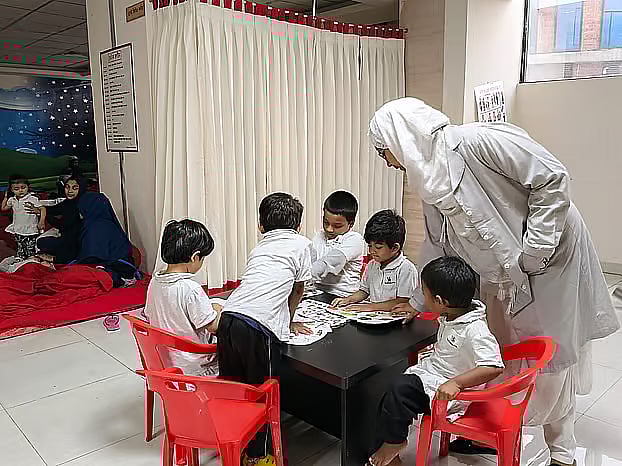
For working mother Tanjila Mostafiz, finding a place for her nearly two-year-old child at the government-run daycare centre inside the National Library building in Agargaon was a relief after much searching. It offered safety, affordability and proximity to home. But that comfort is now fading.
The daycare was launched under the Department of Women Affairs’ project “Establishment of 20 Daycare Centres.” Currently, around 550 parents’ applications are on the waiting list for a seat. However, the project officially expired on 30 June, and although the centres remain open, the staff have not received their salaries since.
“My child feels comfortable here,” said Tanjila. “It’s safe and affordable. Private centres are too expensive. If this one shuts down, I don’t know where to leave my child.”
But it’s not just daycare workers, more than 2,500 officials and employees, including at least 1,700 women, working under several projects of the Ministry of Women and Children Affairs are facing similar uncertainty.
These include staff of the ‘Multi-Sectoral Programme on Violence Against Women,’ the ‘Tottho Apa, Empowerment of Women through ICT’ project, and employees of the Joyeeta Foundation’s marketing centre and food court at Rapa Plaza, all of whom have gone unpaid for months.
Hiring project-based, no job security
Several ministry officials, speaking on condition of anonymity, said most projects lack long-term planning for sustainability and continuity. “Often, projects are launched abruptly with new recruitments, but when the term ends, those people have no future,” one official said.
In some cases, foreign donors propose and oversee the projects themselves, making them consultant-driven rather than impact-driven. As a result, although the number of projects rises, they often fail to achieve their goals for women and children’s welfare.
Officials also pointed out that many project proposals are flawed. For instance, the Tottho Apa project’s development proposal originally included a provision for integrating jobs into the revenue budget — which was later removed, despite the recruitment of over 1,500 women.
Salary stopped at daycare centres
The “Establishment of 20 Daycare Centres” project began in 2016 with an initial plan for 11 centres, later expanded to 20 — 11 in Dhaka and 9 outside. More than 1,100 children are now enrolled. The project’s budget was Tk 840 million (84 crore).
The duration was later extended to June 2025, during which income rose significantly — from Tk 700,000 in FY 2018–19 to around Tk 10 million in FY 2024–25. The project employs 243 staff, about 170 of them women.
“We take care of the children, play with them, and teach them — but now we’re not being paid,” said one worker. “A new project for 60 daycare centres is being planned, but we don’t know if we’ll be included.”
Project Director Shabnam Mostari said she hopes authorities will take appropriate steps to keep child care services running.
Multi-sectoral programme: Discontent over outsourcing
Launched jointly by the Government of Bangladesh and Danish Development Agency (DANIDA) in 2000, the Multi-Sectoral Programme on Violence Against Women is one of the ministry’s oldest initiatives. The project currently employs 381 staff, including 102 women, with 262 of them directly appointed.
After DANIDA’s withdrawal in 2022, the government scaled down expenditures and downgraded the project from an A-grade flagship to B-grade, causing salary cuts and delays.
“I used to earn Tk 32,000 per month; now it’s Tk 29,000,” one worker said. “Ten per cent is also being withheld from our honorarium.”
A new project, “Strengthening Integrated Services for Prevention and Response to Violence Against Women and Children and Quick Response Team Activities,” is being developed. It will recruit 554 staff, but through outsourcing, requiring even existing staff to reapply.
Project Director and Joint Secretary Prokash Kanti Chowdhury said the Finance Division now mandates outsourcing for project approval. However, he assured that existing and female staff would get preference.
Currently, the programme covers 14 One-Stop Crisis Centres at medical college hospitals, 67 crisis cells, a National Forensic DNA Lab, 8 regional DNA screening labs, a National Trauma Counselling Centre, 8 regional centres, and the 109 helpline for women and child abuse prevention.
Tottho Apa project: Uncertainty despite protests
Workers from the Tottho Apa project staged a 72-day protest near the National Press Club demanding job regularisation — many of them women with children who stayed through sun and rain. They returned to work after assurances, but uncertainty persists.
The project began in 2011 as a pilot in 13 upazilas and expanded in 2018 to 492 upazilas, employing 1,483 staff, including 1,172 women, along with 497 outsourced office assistants.
According to Khandaker Golam Moazzem, Research Director of the Centre for Policy Dialogue (CPD), project instability due to political transitions and lack of long-term policy puts women in precarious positions.
“Many mid-career women lose their jobs when projects end,” he said. “Ministry policymakers cannot escape responsibility. To avoid such crises, mid-term evaluations and adjustments are crucial.”