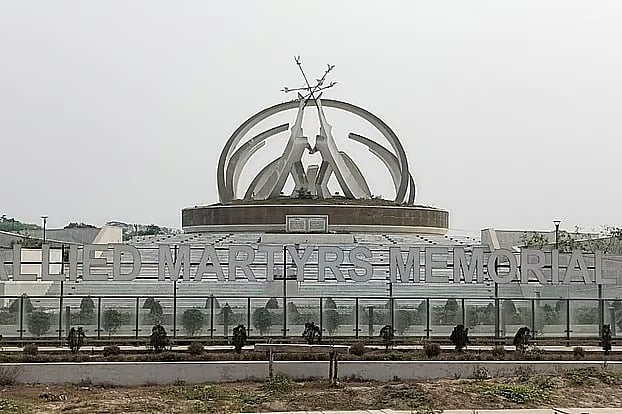
Liberation War Memorial
Tk 720m Maitree Stambha at risk of ‘damage’ even before inauguration
The walls are filled with engraved scenes from the 1971 Liberation War. One section depicts the unconditional surrender of the Pakistani army to the Bangladesh-India joint forces on 16 December, 1971.
Elsewhere, there are images of men, women, and children walking toward India to escape the horrors of war. Some panels portray the painful struggle of carrying an elderly mother on one’s shoulders, while others show the suffering of people weakened by hunger.
These engravings are featured on the Allied Martyrs Memorial (Maitree Stambha) built in the Kamaura area of Ashuganj upazila in Brahmanbaria. The memorial, constructed in memory of members of the allied forces who sacrificed their lives during the Liberation War, was completed in 2024.
However, it has not yet been opened to the public. Dust from the Dhaka–Sylhet highway and black smoke and husk particles from nearby rice mills are gradually damaging the memorial’s appearance and polluting the surrounding environment.
Local freedom fighter Abul Hashem told Prothom Alo that the memorial should be opened so that the current generation can learn about the history of the Liberation War and the contribution of the allied forces.
According to sources at the Ministry of Liberation War Affairs, no progress has been made on inaugurating the memorial due to strained relations with India following the fall of the Awami League government during the 2024 mass uprising and the period of the interim government.
Project cost and construction
To commemorate the sacrifice of Indian allied forces during the 1971 Liberation War, the then Awami League government decided in 2017 to build the Memorial in Ashuganj. The initial estimated cost was Tk 160 million, with a completion deadline set for June 2019.
As the work was not completed on time, the deadline was extended to June 2023, and the project cost was increased to Tk 470 million. Even then, construction remained unfinished. Eventually, the cost rose further to Tk 720 million.
Officials from the Ministry of Liberation War Affairs said delays in land acquisition were a major reason for missing the deadlines. The construction was finally completed in December 2024 during the tenure of the interim government.
In November 1971, a joint command of the Mukti Bahini (freedom fighters) and Indian forces was formed. From then until victory on 16 December, Indian troops fought alongside Bangladeshi freedom fighters against Pakistani forces.
During the war, at least 1,661 Indian soldiers were killed in different parts of Bangladesh, including the border district of Brahmanbaria.
Fading before inauguration
A recent visit earlier this month showed that the Memorial in Kamaura is clearly visible from the Dhaka–Sylhet highway. It has two entry gates. Upon entering, the western wall features an engraved depiction of the Pakistani forces’ surrender to the allied forces. A line from a poem by Sikandar Abu Zafar is also inscribed there.
On the western side of the southern park, the walls display engravings of the chains of martial law imposed in 1958, scenes of imprisonment, protests by the Swadhin Bangla Biplobi Parishad in 1962, and images of national leaders. On the eastern side, there are depictions of allied forces carrying weapons, along with helicopters, warplanes, artillery, and tanks, as well as Bangladeshi freedom fighters with radios and arms.
Around the base of the main memorial, the names of Indian soldiers killed in the Liberation War have been engraved in bronze. These include 1,482 personnel from different ranks of the Indian Army, 29 members of the Indian Eastern Theatre border forces, 11 from the Air Force, six from the Navy, and 79 officers along with 70 junior commissioned officers.
Between the two gates inside the complex is a water fountain. There are also eight shops on the western side, 10 on the eastern side, and 14 shops forming a food court along with a restaurant behind the memorial. Beneath the memorial are office spaces and a museum, while a children’s park has been built at the rear.
However, dust and black smoke from nearby rice mills are visible throughout the entire area.
Security guards Md. Mofizul Haque and Joy Samaddar Shuvo, gardener Md. Shahinur, and cleaners Ashish Chandra Das and Palash Harijan have been maintaining and cleaning the site for the past seven months on an outsourced basis. They said they have not received their wages.
Cleaner Palash Harijan said, “We wash it with water every two days, but dust settles again almost immediately.”
Sub-divisional engineer of the Public Works Department in Brahmanbaria, Mofazzel Ali Khadem, told Prothom Alo that the memorial and the children’s park were handed over to the Ashuganj upazila administration last year, which has since been responsible for its maintenance.
‘It should be opened quickly’
According to sources at the contractor firm Nirman Builders and Developers, carpets, hedges, and ornamental trees such as radhachura and krishnachura have been planted inside the complex. Due to a lack of proper maintenance, these are deteriorating.
Ashuganj Upazila Nirbahi Officer Raffey Mohammad Chhrha said it is very difficult to keep the memorial clean because of the surrounding rice mills.
He added that about a year ago, the Department of Environment issued a letter instructing that the mills be relocated. The Ministry of Liberation War Affairs has requested a list of structures ready for inauguration, and the upazila administration has submitted it. The ministry will now make a decision.
A senior official of the ministry, speaking on condition of anonymity, said that it has been about a month since the new government took office following the 13th national parliamentary election. The issue of inaugurating the memorial will be placed before the head of the government.
He added that relations between the two countries are gradually improving, and since the memorial remains unused, it should be opened quickly; otherwise, it risks further deterioration.