Looking Back
2014 Election: Anatomy of a tainted vote
A report published in the print edition of Prothom Alo the day after the 10th parliamentary election held on 5 January 2014 carried the headline: “18 votes per minute in Dhaka-18.”
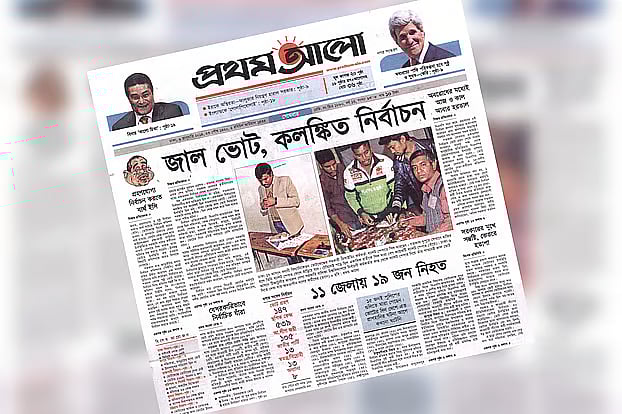
One of the polling centres in Dhaka-18 (Uttara) was at Kaola Government Primary School. A Prothom Alo reporter stayed there throughout polling day. He wrote that the centre remained almost empty all day. In the final hour and a half of voting, he saw roughly 150 people enter the centre. Yet in that same period, the official count showed 1,583 votes cast.
The next day, the newspaper’s lead headline read: “Rigged votes, a tainted election.” The stain was not limited to ballot stuffing. For the first time in Bangladesh, candidates were elected unopposed in more than half the constituencies — 153 seats.
The blemishes extended beyond fraudulent voting and uncontested victories. Widespread violence marked election day, leaving at least 19 people dead. Between the night of 3 January and 10:00 pm on the eve of voting, 111 educational institutions designated as polling centres were set on fire. Attacks and ballot snatching were reported at another 100 centres.
There was another dimension to the controversy. The election was effectively contested by the ruling Awami League and its aligned parties. The BNP-led 18-party alliance boycotted the polls, demanding a neutral caretaker government.
In reality, the Awami League government had abolished the caretaker system as a strategy to keep the opposition out of the election, as its popularity was declining. A Prothom Alo opinion survey published on 10 October 2013 suggested that if elections were held then, 50.3 per cent of respondents would vote for BNP, while about 35 per cent would support the Awami League.
Fearing defeat, the Awami League avoided a competitive contest. Through a one-sided and engineered election, what critics termed “authoritarianism under a democratic façade” began.
The strategy was not new. In his 2002 article “The Menu of Manipulation,” Andrés Schedler, research fellow at Central European University’s Democracy Institute, explains that modern autocrats rarely reject democracy outright. Instead, they hold elections — but in ways that ensure results favour them.
This “menu of manipulation” includes discouraging voters, excluding opposition candidates, intimidation, vote theft, and result tampering. Many of these tactics, critics argue, were visible in the 2014 election and the subsequent two national polls.
Before the vote
The “unequal playing field” strategy described by Schedler began well before 2014. The major step was abolishing the caretaker government system.
Most credible elections in Bangladesh had been conducted under neutral non-partisan administrations. One year after taking office on 7 January 2009, the Awami League government saw the Appellate Division declare the Fifth Amendment unconstitutional on 2 February 2010.
On 21 July that year, following Prime Minister Sheikh Hasina’s proposal, a special parliamentary committee was formed to amend the constitution. As its work neared completion, the Appellate Division issued a brief and divided order stating that the 13th Amendment — introducing the caretaker system — was void prospectively, but also noted that the 10th and 11th parliamentary elections could still be held under such governments.
The parliamentary committee initially recommended retaining the caretaker provision. However, after a meeting with Sheikh Hasina, it finalised its recommendations excluding the system and allowing parliament to remain in place during elections — a move that some committee members reportedly opposed.
The detailed court verdict came out in 2012. But earlier, on 30 June 2011, parliament passed the Fifteenth Amendment, abolishing the caretaker system altogether. The final judgment did not reiterate that the next two elections should be held under such arrangements.
Ahead of the 10th parliamentary polls, the BNP-led alliance launched protests demanding restoration of the caretaker system. Amid entrenched positions by the two main parties, the United Nations attempted mediation in late 2013.
Oscar Fernández-Taranco, UN Assistant Secretary-General for Political Affairs, visited Dhaka, and talks were held between delegations led by BNP acting secretary general Mirza Fakhrul Islam Alamgir and Awami League general secretary Syed Ashraful Islam. No agreement was reached.
While dialogue continued, the government pushed ahead with preparations for a one-sided election. A day after Taranco’s second round of meetings, Jatiya Party chairman HM Ershad — who was reluctant to participate — was taken by RAB to the Combined Military Hospital on 12 December 2013.
The preceding period had been dramatic. Without political consensus, Chief Election Commissioner Kazi Rakibuddin Ahmed announced the election schedule on 25 November 2013. Jatiya Party nominated candidates in 248 seats but declared on 3 December that it would boycott.
India’s then foreign secretary Sujatha Singh visited Bangladesh and met Sheikh Hasina, Khaleda Zia, and Ershad. Ershad later said she encouraged him to contest, praising the government’s work. He still announced that he would not participate, even threatening suicide if arrested.
Subsequently, he was taken to CMH, while a faction led by Rowshan Ershad joined the election. Withdrawal requests by others were rejected, leaving the party formally in the race.
Polling day
On 5 January 2014, voting took place in 147 constituencies for about 43.9 million voters. Another 48 million did not need to vote — their representatives had already been elected unopposed.
There was no festive atmosphere. BNP chairperson Khaleda Zia was effectively confined to her residence. Violence erupted across the country. Only 12 of 40 registered parties participated.
With BNP enforcing strikes and blockades, long-distance transport was largely halted. I travelled to Jhenaidah on the night of 3 January by bus to cover the election, fearing arson attacks. A fellow passenger, cattle trader Ansar Ali, when asked whether he would vote, replied: “When is the vote?”
On polling day I was in Jhenaidah-3 (Maheshpur–Kotchandpur). Amid widespread violence and arson, voting at 20 of 147 centres was suspended. Turnout appeared extremely low, though officials later reported 15.57 per cent participation.
Similar violence occurred elsewhere. Reports said 19 people were killed on election day, 15 by police gunfire. Voting was suspended at 539 centres nationwide.
According to Bangladesh’s Electoral System and Results, the Awami League contested 247 seats and won 234; Jatiya Party contested 86 and secured 34. The Workers Party won 6 seats, JSD 5, Bangladesh Tariqat Federation 2, Jatiya Party (JP) 2, and BNF 1. Independent candidates — most aligned with the Awami League — won 16.
Average turnout in the 147 contested seats was 40 per cent. Out of 92 million registered voters, only about 17.4 million cast ballots — roughly 20 per cent overall.
Following the vote
At a press conference on 6 January, Sheikh Hasina was asked whether she meant holding an early mid-term election when she spoke of “the next election.” She replied, “I said the next election. Whenever it comes, it will be held.” Political discussions suggested that the government had assured the UN and Western partners of another election soon.
Forming the government produced an unusual arrangement: Jatiya Party was made the opposition while also participating in government. Ershad became the prime minister’s special envoy, and Rowshan Ershad the opposition leader — prompting a Prothom Alo headline on 13 January: “The guardian of democracy is gone.”
The UN, EU, United States, United Kingdom, China, Japan, Canada, Australia, South Korea, and human rights groups questioned the election’s credibility. India, however, said it was constitutionally necessary.
Ten years on
The government ignored domestic and international criticism. Opposition movements weakened under repression after the vote. Subsequent elections — in 2018 dubbed the “night vote,” and in 2024 the “dummy election” — kept the Awami League in power.
Schedler also explains how authoritarian regimes masked by democratic procedures fall. Such regimes endure as long as they convince citizens that protest is futile. When a movement breaks this “culture of fear,” a cascade effect follows — those who once stayed silent take to the streets.
Bangladesh witnessed such a moment in July 2024 — a lesson for all.