Old Dhaka DC office
Sanctuary for birds on the rooftop
The Dhaka Deputy Commissioner’s Office is housed in a three-storey building on Johnson Road in Old Dhaka. Tall buildings surround it on all sides, with a few trees growing in the gaps in between.
In this brick-and-concrete neighborhood, kites, pigeons, and various other birds fly across the sky in the mornings and late afternoons. Monkeys can also occasionally be spotted here.
The Dhaka district administration has taken an initiative to create a sanctuary for these birds in their rooftop.
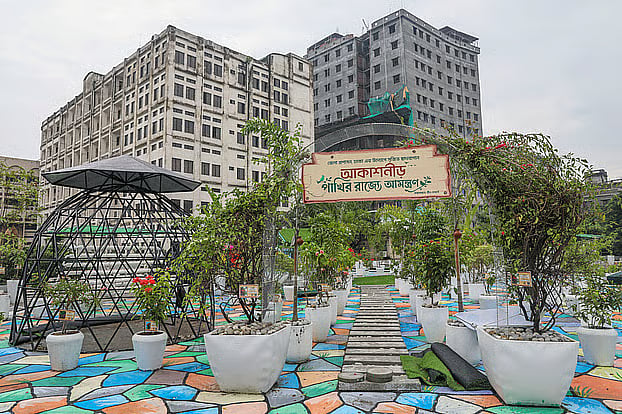
The rooftop of the Deputy Commissioner’s Office building covers approximately 11,000 square feet. Until recently, it had remained largely unused. Now it has been furnished with fruit trees and flowering plants, water for birds to quench their thirst, birdbaths and various other amenities.
The staff of the DC Office are now waiting to see whether the birds will respond to this invitation. On 30 September from 4 pm until evening, no birds were seen on the rooftop. However, a monkey was spotted confidently walking across the roof.
People working at the office said that at other times, birds, mongooses, rabbits, squirrels, and monkeys can be seen here. But perhaps they are now hesitant to come because of the presence of people. Besides, the flowering and fruit-bearing plants have not yet grown much, and there is not much fruit on them. The animals may also not yet know what food will be available here besides honey and fruit.
However, video footage sent by the DC Office the following day showed that some birds had arrived at the rooftop garden from the surrounding area. They were seen feeding on the roof.
“Welcome to the kingdom of birds” says the slogan of the rooftop garden developed as an initiative of the Dhaka district administration. It has been named “Akashnir.”
On 16 September, Md. Moniruzzaman Mia, Commissioner of the Dhaka Division, inaugurated “Akashnir.” The initiative cost approximately 1 million taka, with support from the district administration as well as various individuals and organisations.
Farida Khanom, Dhaka Deputy Commissioner and District Magistrate, told Prothom Alo, “I grew up in a village as a child, where there was the chirping of birds all around. In the city’s urban landscape of brick and concrete, that birdsong is gradually disappearing. This initiative was undertaken to bring that familiar chirping back to the city.”
Farida Khanom took charge as the DC of Dhaka on 22 April this year. She said that when she went up to the building’s rooftop to inspect the installation of solar panels, she noticed that the entire roof was lying unused. She also saw birds flying across the sky. That was when the idea of creating a safe shelter for these birds occurred to her.
The rooftop garden was subsequently developed with comprehensive support from Green Savers, a private organisation that promotes urban greening, with a particular focus on birds. One day, it will become a sanctuary for birds. They will come here without fear and feed. But that will take a little time, she said.
She described the initiative as a “small window” through which people can reconnect with nature.
The plants on the rooftop have begun spreading their branches and turning green. Various flowers have bloomed, including white hibiscus and pink bougainvillea. Fruits are beginning to appear on some of the trees, including starfruit.
According to the district administration and Green Savers, a total of 418 plants belonging to 58 species have been planted in the rooftop garden.
There are a total of 329 flowering plants here, including bougainvillea, ixora, crape jasmine, anjaliya, night-blooming jasmine, Rangoon creeper, jarul, gulmohar, kadam, kamini, hibiscus, copperpod, bakul, frangipani, gardenia, melaputiya, periwinkle, rose, canna lily, devil’s tree, and cannonball tree.
Among the aquatic flowers are water lilies and lotuses. A total of 41 fruit trees have been planted here, including lychee, starfruit, sapodilla, mango, guava, wax apple, karonda, olive, Burmese grape, hog plum, lemon, jujube, banana, papaya, cherry, and mulberry. There is also a medicinal neem tree. Other plants include nagachua, pomelia, fan palm, areca palm, China doll, cycas, variegated foliage plants, and ornamental bamboo, which will attract various insects.
The district administration has signed a three-month contract with Green Savers regarding the rooftop garden. Under the agreement, Green Savers staff will maintain the rooftop garden for these three months. After that, employees of the DC Office will take over its upkeep.
To provide birds with a safe refuge, the rooftop has been designed with artificial bamboo thickets, birdhouses, and an environment featuring trees with large canopies.
Some birds that are typically kept in cages have also been placed on the rooftop. Their chirping could be heard from the roof. DC Farida Khanom said they were kept there with the idea that birds outside would be attracted by the sound and come to the rooftop. For now, they believe these birds will serve to “invite” other birds.
According to Farida Khanom, a positive change could be brought about if, alongside government and private institutions, individuals also take initiatives to create green spaces on the rooftops of city buildings and provide a safe environment for birds.
Ahsan Rony, chief executive of Green Savers, was present at the DC's rooftop garden. He told Prothom Alo that this is a planned rooftop garden. The main message is that if city residents want to, they can turn their rooftop gardens into sanctuaries for birds. The birds can come, bathe, and feed—and then leave if they wish. They can also build nests on the rooftop if they choose.
Ahsan Rony said that the initiative at the Dhaka District Commissioner’s Office is an example of how a government institution can take steps to protect the urban environment and give special consideration to birds. Other government institutions can also be encouraged to take similar initiatives by seeing this example.