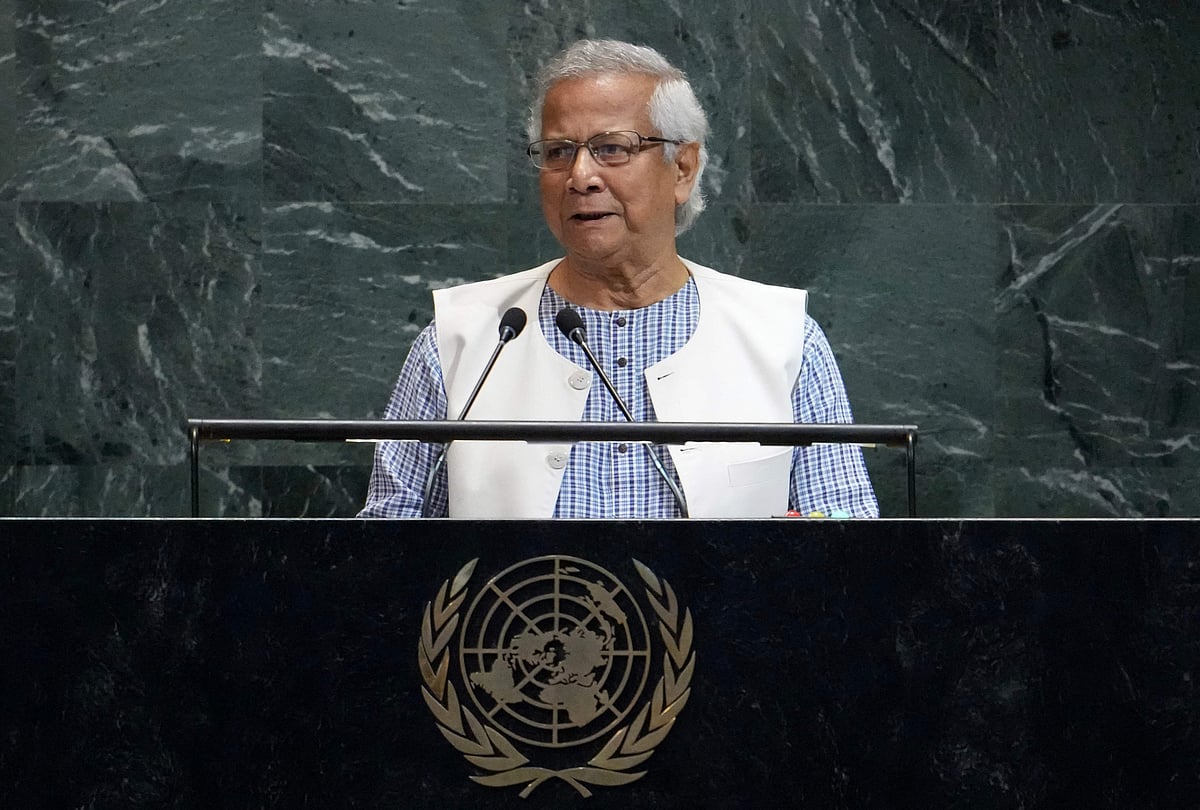
Chief Adviser at UNGA
National election in February, reforms to continue
Chief Adviser Professor Muhammad Yunus has informed the United Nations that Bangladesh’s 13th parliamentary election will be held in February.
He also said that the ongoing reform process aimed at ensuring transparency, accountability and the rule of law will continue in parallel.
Addressing the 80th session of the UN General Assembly on Friday night, the Chief Adviser spoke of the measures taken by the interim government following last year’s student–public uprising. He also spoke about global and regional challenges, conflicts, and aspirations for building a safer world for the youth.
The session resumed at 9:00 am New York time (7 pm Bangladesh time), where Professor Yunus delivered his speech, broadcast live by BTV, BTV News and Bangladesh Betar.
Standing before the global forum, he said, “Last year, I stood in this august assembly to share with you the aspirations of a nation in transition after a mass uprising. Today I will tell you how far we have been able to advance on that journey of transformation.”
Professor Yunus explained that his government had been entrusted with fulfilling the people’s aspirations for an equitable and just society. “Rebuilding a collapsed state structure required comprehensive institutional reforms. Given the overwhelming public mandate, the easier path would have been to impose changes by executive order. But we chose the harder path—an inclusive and sustainable one.”
Muhmaad Yunus called for an immediate political solution and urged the international community to take remedial measures against the discriminatory policies that caused the Rohingya crisis.
He referred to the formation of 11 reform commissions and their recommendations, noting, “Our objective was to build a balanced democratic structure, where no autocrat can ever re-emerge. No elected leader will be able to undermine the democratic character of the state, nor will the protectors of the nation and its people ever again become predators.”
Stating that on the first anniversary of the uprising, political parties stood on a single platform to commit to reforms through the “July Declaration”, Muhammad Yunus stressed that regardless of which party wins the next election, the implementation of reforms will no longer be in doubt.
Economic reforms and asset recovery
The Chief Adviser emphasised that good governance, social inclusion and sustainable development form the centrepiece of the interim government’s development strategy.
Criticising the ousted Awami League government, he said that development without accountability proved fragile and short-lived. “Corruption-ridden projects undertaken for narrow political interests have not only burdened the economy but have brought no real welfare to the people.”
One of the interim government’s top priorities, he said, is the recovery of assets illegally siphoned abroad during the past decade and a half. Hundreds of millions of dollars were smuggled overseas, making the national economy “alarmingly fragile and vulnerable”.
He admitted, however, that legal hurdles and a lack of political will from certain countries posed obstacles.
Do not become accomplices to this crime. Return these resources to their rightful owners—the farmers, the workers, the ordinary taxpayers. I propose the establishment of strict international regulations to prevent the plunder of wealth from developing countries and ensure their enforcement.Dr. Muhammad Yunus, Chief adviser of the interim government
“Without the strong goodwill of these countries, the stolen assets of the Bangladeshi people cannot be recovered,” he said.
He appealed to those countries and institutions holding such illicit funds, “Do not become accomplices to this crime. Return these resources to their rightful owners—the farmers, the workers, the ordinary taxpayers. I propose the establishment of strict international regulations to prevent the plunder of wealth from developing countries and ensure their enforcement.”
Misinformation and propaganda
Professor Yunus warned of the serious dangers posed by disinformation, hate speech and the rise of AI-driven ‘deepfakes’.
He said vested groups had deliberately spread false narratives during and after last year’s uprising. “We must collectively counter these distortions so that they do not erode trust among people or weaken social harmony.”
Rohingya crisis
The Chief Adviser said the ongoing conflict in Myanmar threatens not only regional stability but also the safe repatriation of forcibly displaced Rohingya refugees.
Bangladesh, he said, has been compelled for eight years to shelter those fleeing persecution, yet no resolution is in sight.
“The marginalisation and oppression of the Rohingya, rooted in identity-based politics in Rakhine, cannot continue,” he stated.
He called for an immediate political solution and urged the international community to take remedial measures against the discriminatory policies that caused the crisis.
Children are dying of hunger, civilians are being indiscriminately killed, hospitals, schools and entire communities are being obliterated. In full view of the world, a genocide is unfolding.Dr. Muhammad Yunus, Chief adviser of the interim government
He reminded the Assembly that the crisis is not a bilateral issue between Bangladesh and Myanmar but a regional and international humanitarian concern. With donor fatigue worsening, the World Food Programme has already warned of severe ration cuts, leaving refugees with as little as US $6 per month.
“Any further reduction would undoubtedly heighten risks of insecurity and instability extending beyond the camps,” Yunus cautioned, urging both existing and new donors to step up support.
Gaza situation
Addressing the situation in Gaza, the Nobel Peace Prize laureate condemned Israel’s actions. “Children are dying of hunger, civilians are being indiscriminately killed, hospitals, schools and entire communities are being obliterated. In full view of the world, a genocide is unfolding.”
He lamented the failure of humanity to halt the massacre, warning, “If this continues, future generations and history will not forgive us.”
On behalf of the people of Bangladesh and conscientious citizens worldwide, he called for the urgent implementation of a two-state solution, with an independent State of Palestine established with East Jerusalem as its capital.