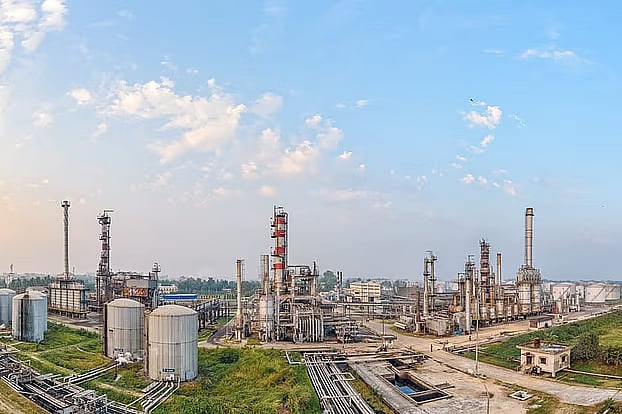
New oil refinery to be built in Bangladesh after 58 years
The country’s only oil refinery was built in 1968. After 58 years, construction of the country’s second and largest oil refinery is finally set to begin. With a refining capacity of 3 million tonnes, the refinery will be able to meet 45 to 50 per cent of the country’s demand for fuel oil once it becomes operational. This will reduce imports of refined petroleum products such as diesel and octane, lowering costs.
According to sources in the Energy Division, securing financing had emerged as the main challenge in implementing the refinery project. On Thursday, the government signed an agreement with the Islamic Development Bank (IsDB).
Under the agreement, the bank will provide USD 1 billion, or Tk 123 billion (at Tk 123 per dollar), to finance the project. The project is scheduled to be completed by November 2030.
The country’s only government-owned refinery, with a capacity of 1.5 million tonnes, is currently located in Patenga, Chattogram. It is operated by Eastern Refinery Limited (ERL), a company under the Bangladesh Petroleum Corporation (BPC).
The second refinery, with twice the capacity, will be built in the same area. Six months after the project was approved, a joint secretary of the Energy Division was appointed project director last Wednesday.
It has been 15 years since the government first began discussing implementing the project, at different times proposing government financing or foreign loans. The project, titled “Installation of ERL-2,” was first taken up in 2012.
Although the Development Project Proposal (DPP) was revised at least 11 times, the project never got off the ground. Instead, its estimated cost increased each time. In 2024, the Awami League government decided to implement it jointly with controversial Chattogram businessman Saiful Alam, or the S Alam Group.
After the fall of the Awami League government amid the July mass uprising, the interim government cancelled the previous project. It renamed the project “Modernisation and Expansion of ERL.” On 10 February this year, an official notification issued following an ECNEC decision said the project would cost Tk 310 billion. Of this, Tk 185.6 billion was expected to come from the government treasury and Tk 124.3 billion through BPC.
After the BNP government came to power, it changed the financing arrangement and decided to implement the project with foreign financing. The financing was confirmed on Thursday. The financing agreement was signed in the presence of Prime Minister Tarique Rahman and Islamic Development Bank Group Chairman Muhammad Al Jasser.
At the Bangladesh Secretariat, Additional Secretary Md Mizanur Rahman of the Economic Relations Division signed the agreement on behalf of the Bangladesh government, while IsDB Director General (Country Programs) Anas Al-Isami signed on behalf of the bank.
Officials from the Energy and Mineral Resources Division and the Economic Relations Division said implementing the project with domestic funds would put pressure on the national budget. The government has therefore decided to finance the project through a foreign loan.
BPC officials said annual demand for fuel oil in Bangladesh is 6.5 to 7 million tonnes. Of this, 4 to 4.5 million tonnes is diesel, most of which is imported directly. Once ERL’s second unit becomes operational, it will strengthen energy security in the country.
Storage capacity will increase threefold. At least USD 11 could be saved on every barrel (159 litres) of fuel oil imported. Annual savings could reach Tk 30 billion. Dependence on imports of refined petroleum products will decline, while storage capacity will also increase.
However, there is some uncertainty over BPC’s financing for the project. Fuel oil prices have risen in the global market following the outbreak of war in the Middle East. As a result, BPC’s losses have been increasing every month. A shortfall of more than Tk 200 billion accumulated between March and June. The corporation brought in funds allocated for various projects to pay fuel oil bills. After more than a decade, it has sought a subsidy from the government.
M Shamsul Alam, energy adviser to the Consumers Association of Bangladesh (CAB), told Prothom Alo that there had been growing concern amid discussions about opening up the fuel oil sector to private investment. With foreign financing now secured for the refinery, it has become clear that the government intends to retain control over the sector. This is reassuring news, and consumers will benefit from it. The government must ensure that the project is not disrupted in any way and is completed within the stipulated timeframe.