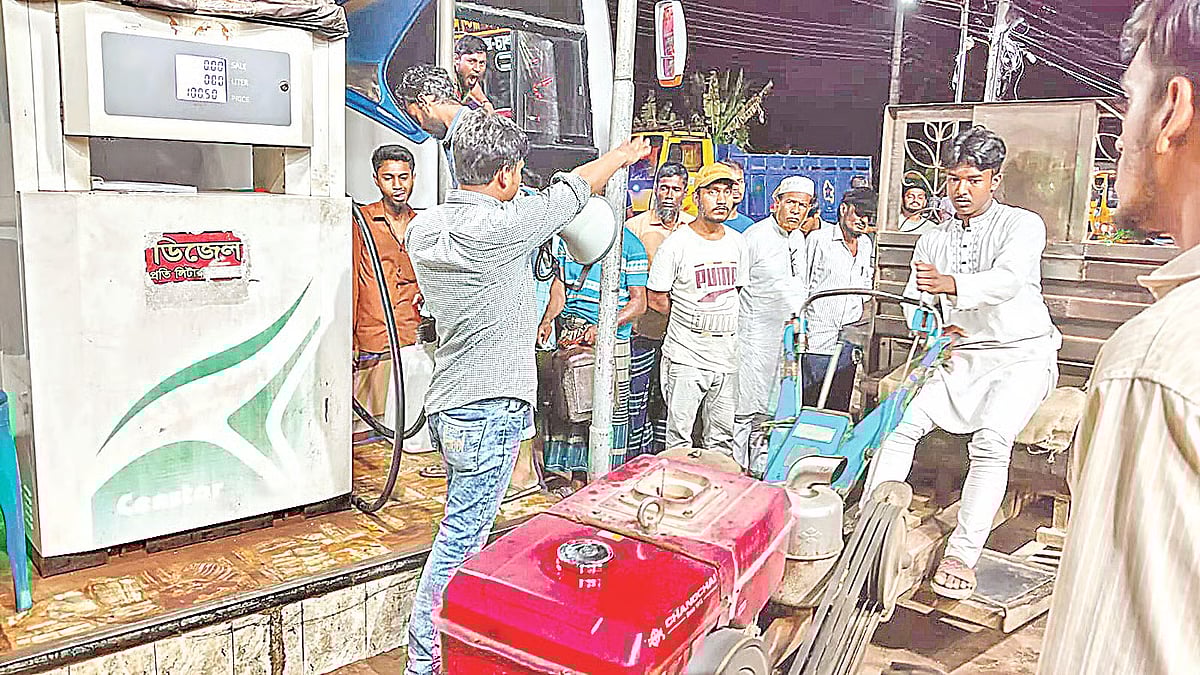
Fuel crisis: Farmers struggling to access oil for agricultural machineries
Farmers are increasingly struggling to secure fuel for agricultural machineries amid the ongoing fuel crisis, raising concerns over irrigation and the upcoming harvest season.
Md Asgar, a farmer from Pomra Union in Rangunia Upazila of Chattogram, cultivated nearly three acres of Boro paddy this season. Over the past week, he visited local markets several times in search of diesel but managed to obtain it only once, receiving just four litres against a demand for 10. He even paid an additional cost of Tk 20 per litre.
Speaking to Prothom Alo on Wednesday, he said most diesel outlets remain closed, and even when open, supply falls short of demand.
A similar account was given by Md Alamgir, a farmer from neighbouring Sarafbhata Union. He noted that as paddy enters the critical period of grain formation, insufficient irrigation could severely damage crops. Despite visiting markets daily, he is unable to procure the required amount of diesel.
Farmers across the country, from districts including Chattogram, Jamalpur, Patuakhali, Rajshahi, Gazipur, Barguna, Sylhet, Faridpur, Lalmonirhat and Nilphamari, report a similar situation to Prothom Alo on Wednesday and Thursday.
Some have been forced to purchase diesel at prices above the government-set rate. Reports from correspondents across multiple districts also point to supply shortages.
A significant proportion of irrigation equipment operates on diesel, while the rest depends on electricity. Agricultural machinery is also widely used for harvesting and threshing crops such as rice, wheat, and maize, most of which rely on diesel, with some using petrol. However, operators are now unable to obtain fuel in adequate quantities.
As a result, both irrigation and harvesting are under threat. With the Boro harvesting season approaching, any continued shortage could lead to a full-blown crisis, particularly in haor regions, where rapid harvesting is essential to avoid crop loss from early flooding.
Local administration officials have assured farmers of prioritised diesel supply. For instance, Upazila Nirbahi Officer Md Nazmul Hasan of Rangunia said farmers are being given priority and that fuel stations and outlets have been instructed accordingly. He also promised to investigate farmers’ allegations of shortages.
Machinery and demand
According to the Department of Agricultural Extension (DAE), the irrigation season runs from December to May. Bangladesh has over 2.13 million diesel-powered agricultural machines, including deep and shallow tube wells, low-lift pumps, power tillers, tractors, combine harvesters, threshers, and other machineries.
Among these, there are 10,726 combine harvesters and nearly 496,805 threshing and related machines. During the irrigation season, total diesel demand for irrigation and agricultural machinery is estimated at around 1.25 million tonnes.
Agricultural officials note that rainfall in recent weeks has somewhat reduced irrigation demand for paddy and some other crops, though it has also caused damage to crops such as potatoes and watermelons in some areas.
The Bangladesh Agricultural Development Corporation (BADC) estimates that irrigation equipment alone requires about 760,000 tonnes of fuel over the six-month season.
Diesel supply constraints
Following the escalation of conflict involving the United States, Israel, and Iran, fuel supply chains have been disrupted, particularly through the Strait of Hormuz, a critical route for global energy transport. Attacks on energy infrastructure have further exacerbated shortages and driven up prices.
In Bangladesh, panic buying has intensified demand. Although the Bangladesh Petroleum Corporation is supplying fuel at levels comparable to last year, it remains insufficient.
Long queues have formed at filling stations, which often remain closed for large parts of the day as supplies run out quickly. Hoarding has also been reported.
Farmers typically rely on local vendors, many of whom are unlicensed. Enforcement operations against hoarding have led some sellers to halt operations altogether, further constraining supply.
According to the Ministry of Power, Energy and Mineral Resources, annual diesel demand stands at around 4.5 million tonnes. Current stock is just 122,660 tonnes, against a daily demand of 12,000 tonnes. Present supply is around 11,500 tonnes per day, which is just below the requirement.
During the irrigation season between December and May, average monthly diesel demand for agricultural machinery is estimated at around 209,000 tonnes, or roughly 7,000 tonnes per day, depending on rainfall.
Md Mamun, a resident of Keorabunia Union in Barguna, said he cannot operate his power tiller regularly due to fuel shortages. He said he has had to purchase diesel at Tk 120–130 per litre, compared to the government-set price of Tk 100.
Concerns over harvesting
The use of combine harvesters for cutting, threshing, and bagging crops is increasing among farmers. The government has provided subsidies of 70 per cent in haor areas and 50 per cent elsewhere to promote mechanisation. Currently, about 15 per cent of paddy is harvested using such machines that run on diesel. Reapers run on petrol and threshers run on diesel
Industry leaders emphasise the urgency of ensuring fuel supply. Subrata Ranjan Das, Managing Director of ACI Motors, said priority should be given to supplying fuel to harvesters and tractors.
He suggested an ID-based distribution system, noting that companies maintain records of machine owners. A single harvester requires 60–70 litres of diesel per day.
Boro: The principal season
Boro is Bangladesh’s principal rice-growing season, accounting for 52 per cent of total production. In the 2024–25 fiscal year, the country produced 40.9 million tonnes of rice.
A significant share of Boro output comes from haor regions. In 2017, early flooding destroyed crops in those areas, reducing production by about 800,000 tonnes and causing a sharp rise in rice prices. Concerned experts warn that timely harvesting must be ensured to avoid similar losses.
Commenting on the overall situation, Selim Raihan, Professor of Economics at the University of Dhaka, said it is crucial to prevent the fuel crisis from disrupting agriculture, as it directly impacts food security.
He stressed the need to ensure uninterrupted diesel supply, explore alternative import sources, and, if necessary, provide subsidies to support farmers.