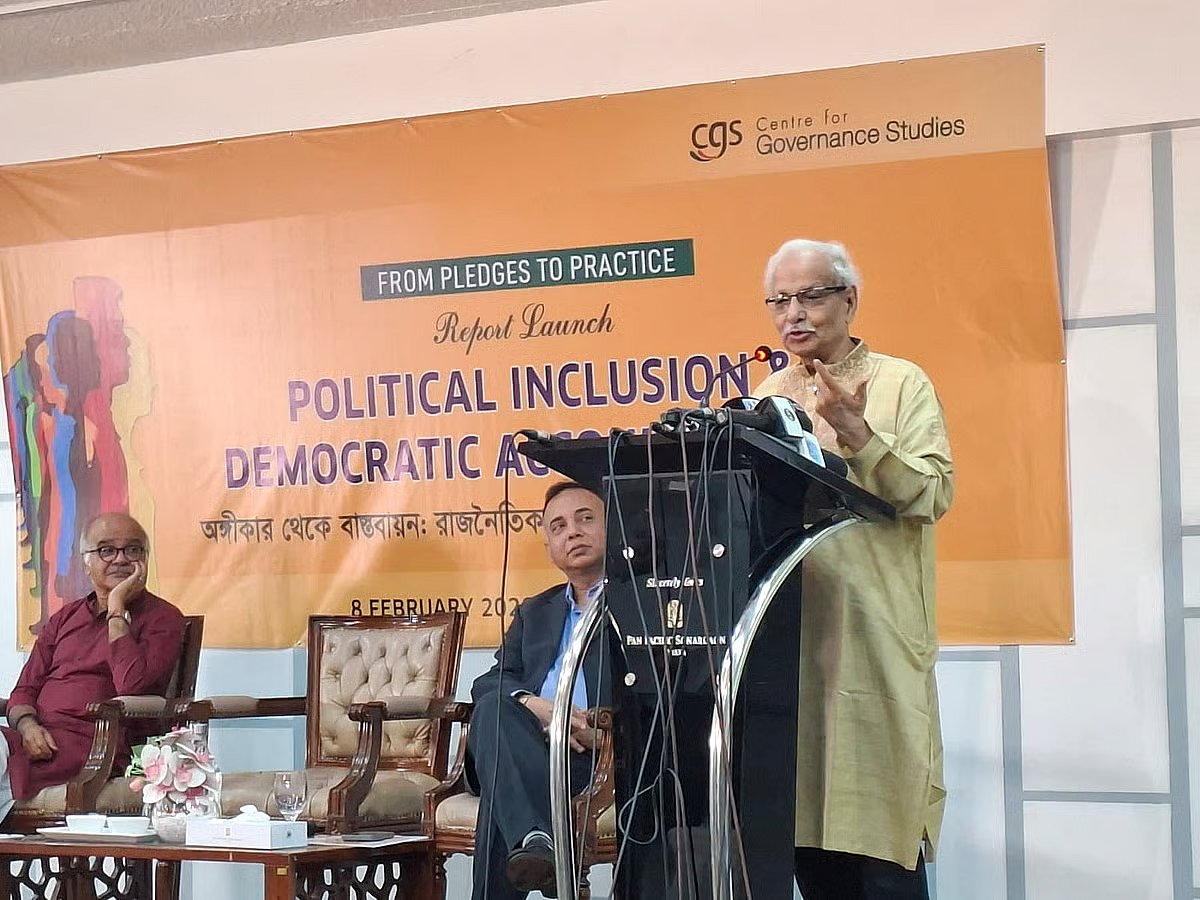
I served in commissions, but wasn’t part of govt: Badiul Alam Majumdar
Citizens for Good Governance (SHUJAN) secretary Badiul Alam Majumdar has said that although he served in the Electoral System Reform Commission and the National Consensus Commission, he was not part of the current interim government.
“There is a misunderstanding that needs to be cleared up,” he said. “The government had certain priorities, and in response to public demand we tried to assist by using our experience. But we did not work as part of the government.”
He made the remarks on Sunday morning at the launch of a report titled “From Commitment to Implementation: Political Inclusion and Democratic Accountability”, held at a hotel in the capital. The event was organised by the Centre for Governance Studies (CGS).
Badiul Alam Majumdar said that at times an impression is created suggesting that he was part of the government. He recounted that a journalist had informed him over the phone that he had been appointed to the Electoral System Reform Commission. Prior to that, he said, he had not even spoken with the chief adviser of the interim government.
“I was not part of the government,” he said, adding that his opinion had not been sought before the responsibility was assigned.
At this point, someone from the audience remarked, “That sounds discourteous.”
In response, Badiul Alam Majumdar said, “Perhaps he (the chief adviser) thought that I had some experience which he wanted to utilise.”
Following this, CGS president Zillur Rahman, who was on the stage, interjected, “A close associate.”
Smiling, Badiul Alam Majumdar replied, “I don’t think he spoke to anyone. As a senior and a guardian-like figure, he had assigned the responsibilities.”
He said that he and the other eight members of the commission worked for several months before submitting their report and recommendations, and that this constituted the entirety of his engagement with the government.
He also clarified that he did not receive any honorarium for this work.
Badiul Alam Majumdar further noted that he served on the National Consensus Commission in his capacity as SHUJAN secretary, and that neither he nor his organisation had any role in the formation of the commission.
Turning to CPD (Centre for Policy Dialogue) distinguished fellow Debapriya Bhattacharya, who was present on the stage, Badiul Alam Majumdar said, “My level of involvement was no more than Debapriya’s.”
The event was moderated by CGS president Zillur Rahman. After Badiul Alam Majumdar’s remarks, Zillur Rahman commented, addressing him directly, “He has offered many explanations about himself. There is a saying: good company leads to heaven, bad company to ruin. Perhaps that is why he felt the need to explain himself.”
“And another thing—no matter how well you dress, no matter how much perfume you apply, if you walk along a muddy road, some mud is bound to stick,” he added.