Electricity and Gas Supply
Gas, power sectors face multiple problems; imports offer a short-term solution
Gas production in Bangladesh has been declining for nine years. Imports of liquefied natural gas (LNG) have become difficult because of the war in the Middle East, while prices have risen sharply.
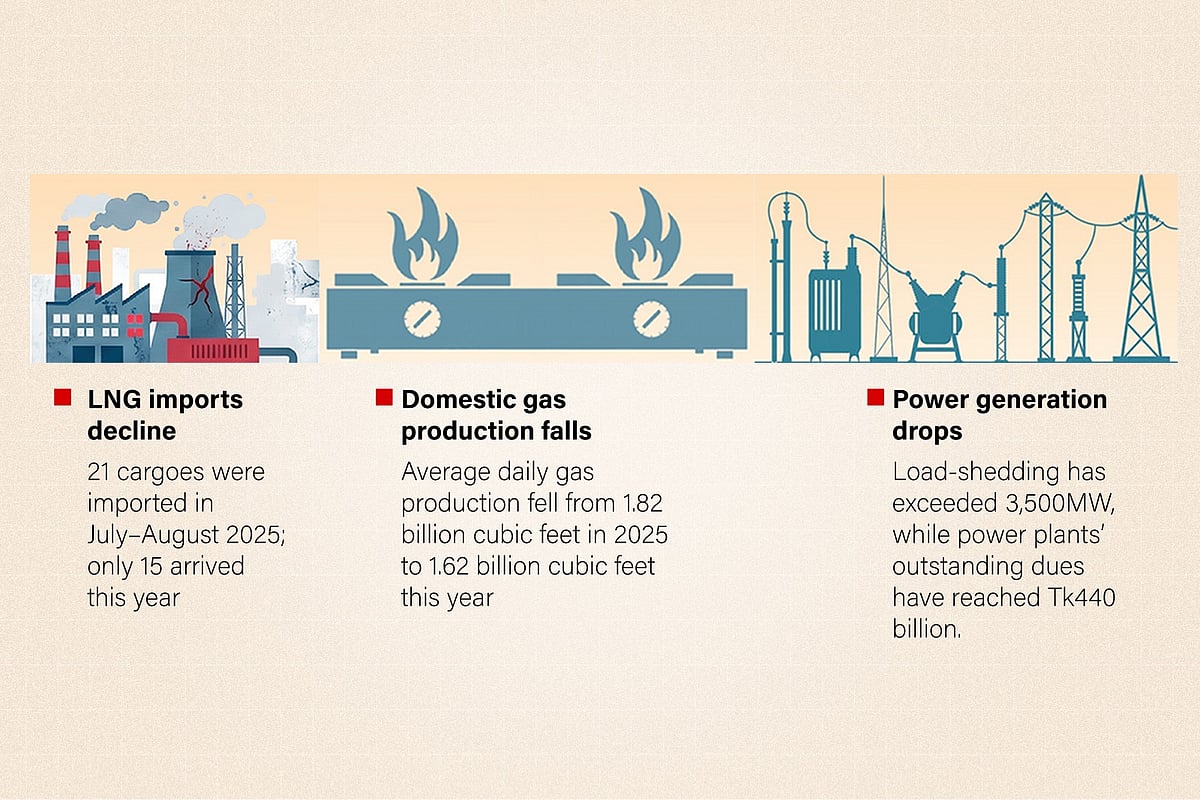
Some power plants are being forced to remain idle because of gas shortages. Load-shedding of as much as 3,500 megawatts a day is also being imposed.
Meanwhile, the government owes Tk 440 billion to private power plants. It is having to provide massive subsidies, but does not have sufficient funds. Importing fuel at higher prices is also putting additional pressure on foreign-exchange reserves.
Overall, the gas, power and energy sectors are facing multiple crises. Analysts and businesspeople in the sector, however, say solutions are available. The government needs to take decisions on the matter.
According to the analysts, if electricity can be supplied by temporarily incurring higher costs, the broader impact on the economy will be far greater. The government would also benefit indirectly through higher tax revenues. Therefore, they argue, electricity supplies should be ensured even if that means higher costs.
Temperatures in Bangladesh will begin to fall from November, reducing demand for electricity. The main concern, therefore, is the next two months—September and October.
Businesspeople are advising the government to run oil-fired power plants during this period to ease pressure on gas supplies. They say that, at current international gas prices, generating electricity with oil is actually cheaper than using imported gas.
Analysts and businesspeople have offered a range of short-, medium- and long-term recommendations. They have suggested forming a task force comprising professionals and experts to address the crisis.
The government is also considering increasing electricity generation from oil-fired plants. Bangladesh Power Development Board (PDB) Chairman Md Rezaul Karim told Prothom Alo that a plan has been drawn up to generate 4,000 megawatts from oil-fired plants.
The government has allocated Tk 60 billion to increase generation. Power plants are being asked to import oil by paying their bills regularly. There are also some difficulties in procuring oil. Everyone is now keeping an eye on the Singapore market.
LNG imports decline
The main cause of the crisis is dependence on imports. During the Awami League government, which was ousted in the July mass uprising, emphasis was placed on importing gas from abroad rather than increasing domestic production. Now, securing supplies has become difficult and prices are high.
Petrobangla oversees LNG supply with the approval of the Energy and Mineral Resources Division. RPGCL, a company under Petrobangla, handles the imports. Sources at Petrobangla and RPGCL said 71 LNG cargoes were brought into the country during the first eight months of last year, compared with 68 this year. Of these, 15 arrived in July and August this year, compared with 21 during the same period last year.
LNG supplies have declined because six fewer cargoes arrived over the past two months. At the same time, gas supplies from one LNG terminal were suspended for 16 days following a fire. This reduced the requirement by another three cargoes.
The crisis has also been exacerbated by purchase orders being awarded to inexperienced companies under the Direct Procurement Method (DPM). They were supposed to supply four cargoes in August but failed to do so.
People involved in the sector say temperatures will not fall significantly in September and October, meaning electricity demand will remain high. At least 20 LNG cargoes will therefore have to be imported during these two months. Otherwise, the gas and electricity shortages will not ease.
Bangladesh imports LNG from two sources: under short- and long-term contracts, and from the spot market based on demand. People involved in imports say LNG imports under contractual arrangements have effectively come to a halt since the war began in the Middle East.
Bangladesh has contracts with Qatar, Oman and US company Excelerate. Oman and Excelerate source LNG from Qatar and supply it to Bangladesh. As supplies from Qatar, a major global source of LNG, have declined, international prices have also risen.
Daily gas demand in Bangladesh is 3.8 billion cubic feet. Under normal circumstances, the situation has been managed by supplying a maximum of 2.7 billion cubic feet a day.
When Excelerate Energy’s terminal was damaged by fire on 21 July and supplies were suspended, the gas crisis intensified. Partial supplies resumed from the terminal on 7 August.
The terminal was ready to resume full supplies on 15 August, but supplies did not increase because sufficient LNG cargoes had not arrived.
Two Petrobangla officials said plans had been made to bring in 10 LNG cargoes in September. So far, eight have been confirmed. Four of these will arrive under short- and long-term contracts, while the remaining four have been purchased from the spot market through tenders.
The price of LNG in these purchases ranges from around US$22 to as high as US$24.62 per unit. A tender invited for one of the remaining two cargoes received a bid of US$26 on Monday, while no bid was received for the other. Fresh tenders were therefore invited yesterday for both cargoes.
Cost of generating power from oil
According to data from the Power Division, Bangladesh has power-generation capacity of around 29,000 megawatts. However, only 14,000 to 15,000 megawatts can currently be generated. On some days, load-shedding exceeds 3,500 megawatts.
The country has more than 12,000 megawatts of gas-fired power-generation capacity, but less than 5,000 megawatts is currently being generated. Coal accounts for the largest share of electricity generation in Bangladesh. Coal imports have been disrupted because of unpaid bills, while technical problems have added to the difficulties.
The combined capacity of Bangladesh’s eight coal-fired power plants is now around 7,000 megawatts. They generated less than 5,200 megawatts yesterday. One 612-megawatt unit at the Payra power plant in Patuakhali has developed a technical fault.
One 612-megawatt unit at the Matarbari power plant has gone into scheduled maintenance. Two units at the Barapukuria coal-fired power plant are also experiencing technical problems. In addition, the Adani coal-fired power plant built in Jharkhand, India, has a capacity of 1,500 megawatts.
Adani’s power plant has reduced generation since 7 August because of disruptions in coal supplies. Although it generates around 900 megawatts during the day, it supplies up to 1,100 megawatts from the evening until midnight.
Because of their high costs, oil-fired power plants are being used for only a few hours at night, generating as much as 3,500 megawatts during that period. Daytime generation remains within 2,000 megawatts. Their combined generation capacity is more than 6,000 megawatts, meaning there is scope to increase electricity production from oil-fired plants.
PDB sources say gas is currently the cheapest fuel for power generation on a per-unit basis. Given current prices, however, LNG is the most expensive. Electricity generated from furnace oil currently costs Tk 21.51 per unit. If LNG is priced at US$24, generating a unit of electricity from LNG would cost more than Tk 23. LNG imports are subject to a 9.5 per cent duty, while furnace oil imports face duties and taxes totaling 26.5 per cent. If LNG were subject to the same level of duties and taxes as oil, the cost of generating electricity from LNG would exceed Tk 26 per unit.
Power plant owners say that if oil-fired plants operate at 60 per cent capacity, the National Board of Revenue (NBR) would collect around Tk 10.96 billion a month in duties.
At 70 per cent capacity, the amount would be Tk 12.79 billion, and at 80 per cent, Tk 14.62 billion. The government could temporarily withdraw duties on furnace oil, they suggest. That would bring the cost of generating electricity down to Tk 17 per unit. Arrangements would also have to be made to clear the power plants’ outstanding bills so that they can import oil.
If oil-fired power plants are operated at 80 per cent capacity, generation could increase by more than 2,000 megawatts. There is also scope to increase coal-based generation by another 1,000 megawatts.
Experts and businesspeople say the government will have at least four months of relief once winter begins in November. However, preparations for the next summer must begin during this period. In the medium term, greater emphasis should be placed on renewable energy such as solar power, while in the long term, domestic gas exploration and production should be prioritised.
Energy expert M Tamim told Prothom Alo that LNG prices are very high and procuring it is becoming increasingly difficult. Nevertheless, it will have to be purchased. However, it may not be possible to maintain supplies at previous levels, and some shortages are likely to remain. Supplies will have to be prioritised according to demand. At the same time, electricity generation from oil- and coal-fired plants will have to be increased.