Prof Yunus went to London and handed over the ‘trophy’ of the July movement to BNP: State Minister
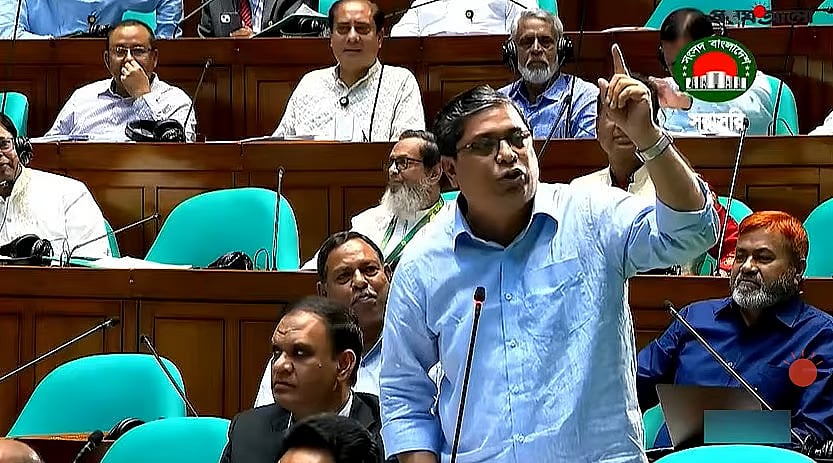
State Minister for Local Government Mir Shahe Alam has portrayed BNP as the victorious party in the country’s major movements and struggles. He said that the “trophies” of three movements—1971, 1990, and 2024—belong to BNP. Among them, the “trophy” of the July 2024 movement was taken to London and handed over to BNP Chairman Tarique Rahman.
He made these remarks today, Tuesday, while participating in the discussion on the President’s speech in the National Parliament. The session began at 10:30 am under the chairmanship of Speaker Hafiz Uddin Ahmed.
Mir Shahe Alam, elected from Bogura, highlighted BNP’s contributions to various movements, saying, “The trophies of the 1971, 1990, and July–August movements are all in our house. Only BNP has such trophies—no other political party can show this. The Awami League can speak about 1971 and 1990, but they do not have the July–August trophy. Friends in the opposition can talk about July–August, but they cannot speak about 1971 or 1990.”
When opposition members began protesting, the state minister said they might raise slogans about 1990, but in the 1986 election, they themselves had joined the polls alongside the Awami League with much fanfare.
In the 13th parliamentary election, BNP won and formed the government. Jamaat-e-Islami and the National Citizen Party (NCP), formed by young activists who were at the forefront of the July uprising, took seats as the opposition in parliament. The two parties had contested the election as part of the same alliance.
The state minister said that an NCP leader had earlier remarked outside, “Students and the public played in the July movement, but BNP took the trophy.”
As opposition MPs continued their protests, the Speaker requested that Shah Alam refrain from continuing his remarks.
At that point, opposition leader and Jamaat Ameer Shafiqur Rahman termed parts of the minister’s statements “untrue” and called for them to be expunged from the parliamentary record.
In response, the state minister said, “In the July–August movement, all of us stood with the students and the people. We did not go to anyone to take the trophy. Who was the captain? The head of the interim government, Dr Muhammad Yunus, was the captain. That is why he went to London, met our captain—Prime Minister Tarique Rahman—and fixed the election date. This proves which party and which leader played the main role in leading the student–people’s movement.”
He further added, “We all took part in the movement—there is no denying that. But there is only one captain. Because the head of the interim government went to London, discussed with that captain, and brought back the election date, a free and fair election was held in this country.”
Addressing Speaker Hafiz Uddin Ahmed, a decorated freedom fighter, the state minister said, “Some people here may like seeing you, others may not. But you represent 1971. That credit goes to BNP, because President Shaheed Ziaur Rahman declared independence.”
At this point, Shahe Alam mentioned several names from the treasury benches, saying such figures could not be found among the opposition benches. Opposition members again protested loudly.
The Speaker then said, “There are freedom fighters on the opposition benches as well. I have seen it myself—Gazi Nazrul Islam (Satkhira-3) is a freedom fighter.”
Turning to Jamaat, the state minister said, “Begum Khaleda Zia honored them before the nation by allowing opposition MPs to use the national flag on their cars, effectively giving them indemnity and making them part of the government. Yet they never mention this.”
In 2001, during the BNP-led four-party alliance government, Jamaat’s then Ameer Matiur Rahman Nizami and Secretary General Ali Ahsan Mohammad Mujahid were made ministers. Both were later convicted of war crimes related to 1971 during the Awami League government and were executed.
BNP MP Shah Alam said, “After 2014, you could not be found. For a long time, we were together in the four-party and 20-party alliances. We know each other in many ways—we sat in the same meetings, carried out movements, struggles, and rallies together. But for some unknown reason, you went underground and reappeared after July–August, now repeatedly invoking July–August to mislead the nation. You want to present July–August in such a way that it seems there was no Liberation War in 1971 or no anti-autocracy movement in 1990.”
Although the state minister claimed Jamaat disappeared after 2014, its leaders—including current opposition leader Shafiqur Rahman—contested the 11th parliamentary election under the BNP-led National Unity Front in 2018. Since Jamaat’s registration had been canceled, they ran under BNP’s “sheaf of paddy” symbol.
Toward the end of his speech, the state minister called for opposition cooperation in running the government, saying, “We want to move the country forward in unity to such a stage that people feel that although BNP and Jamaat, once allies, are now separate, they have internally come together again to take the country to a better, more beautiful place.”
State minister provided untrue information: Opposition leader
After the minister’s speech, opposition leader Shafiqur Rahman took the floor. He said, “From the very first day, we have pledged that this opposition will not be a conventional one. We will cooperate in all just matters and remain uncompromising against injustice and any steps that undermine people’s rights.”
Referring to Shahe Alam’s remarks, he said, “Today, while thanking the President, the honorable member (Mir Shahe Alam) has put us in the dock. Numerous untrue statements have been made here. You (Speaker) yourself have objected to a few. We demand that no one present untrue information in parliament.”
When Shafiqur Rahman called for parts of the minister’s speech to be expunged, the Speaker said, “I will review the statements. If there is anything unparliamentary or false, it will be expunged.”
Later, when Jamaat leader Shahjahan Chowdhury stood to speak, the Speaker urged members to move forward, leaving the past behind. He noted that 50 more hours had been allocated for discussion, where members would have the opportunity to present their arguments and counterarguments.