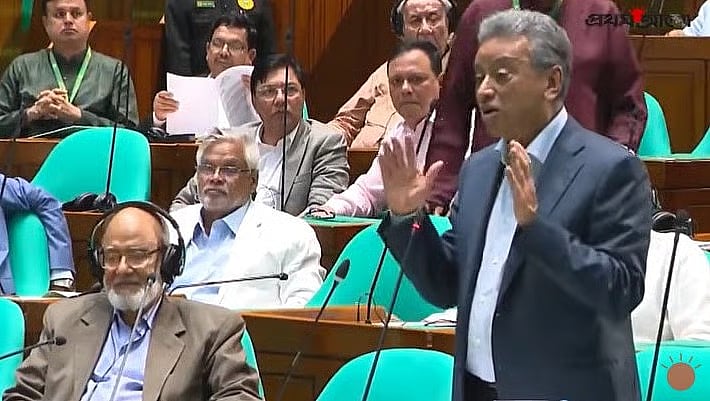
‘No scope for compromise with S Alam Group’: Finance Minister in response to Hasnat’s query
Finance Minister Amir Khasru Mahmud Chowdhury has dismissed the possibility of any compromise between the government and the S Alam Group.
Responding to a question in parliament, the finance minister said that, within the Bangladesh Nationalist Party’s (BNP) political framework, there is no scope for reaching any form of compromise with anyone in matters of economic activity.
The question had been raised by Hasnat Abdullah, chief organiser of the National Citizen Party (NCP).
The S Alam Group, widely discussed for banking irregularities during the Bangladesh Awami League’s tenure, returned to the spotlight on Monday during rival demonstrations in front of Islami Bank’s head office. The group once held control over the bank.
In parliament on Tuesday, Hasnat Abdullah stated that Islami Bank carries loans amounting to Tk 92,115 crore (921.15 billion), of which the S Alam Group alone accounts for Tk 80,000 crore (800 billion) in defaulted loans.
He asked whether the government has any special plan in the current fiscal year to recover these loans, and how attempts are being made to reinstate the S Alam Group without repayment. He also questioned whether any understanding had been reached between the government and the group.
In reply, Amir Khasru Mahmud Chowdhury reiterated that there is no scope for compromise with anyone in economic affairs under BNP politics.
He added that whenever BNP has been in power, there have been no questions regarding financial discipline, macroeconomic strategy, macroeconomic stability, or plundering of the stock market.
Allegations were raised during protests by the Islami Bank Customers’ Coordination Council on Monday that amendments to the Bank Resolution Act were intended to rehabilitate the S Alam Group.
Rejecting the claim, the finance minister said the amendments were not introduced to facilitate anyone’s return. He described the changes as creating a “new opportunity” and a “new window”.
In a supplementary question, Rumeen Farhana said that government borrowing from banks has been increasing steadily since the new administration took office, noting that Tk 44,500 crore was borrowed from banks within just 52 days. As this rapid increase has already exceeded the target set in the current fiscal year’s budget, she asked whether any new plans are being taken to boost revenue.
During the Awami League period, the S Alam Group controlled six banks. Following the July uprising that ousted the Awami League from power in 2024, the conglomerate lost control over these banks. Bangladesh Bank had also reported evidence that nearly Tk 2 trillion had been siphoned out of these banks through various means.
Expressing optimism about recovering the funds, the finance minister said lawsuits have been filed against all those who fled after taking money from banks, and that these cases are being pursued. Efforts to recover the funds are underway both through government-to-government initiatives and through private recovery firms.
‘New window’
During the tenure of the interim government, a Bank Resolution Ordinance was issued, later amended and passed by parliament. The way the new provision has been incorporated allows former shareholders of merged weak banks to regain ownership stakes.
Raising a supplementary question in parliament, Jamaat-e-Islami member of parliament Saiful Islam referred to the issue. He said the amendments allow those who had taken large sums from banks to return by paying only a small portion.
He also noted that Islami Bank had around 80 per cent foreign investment, and that those investors had already withdrawn. He asked how the government would reconcile these two matters.
In response, the finance minister again emphasised that BNP does not believe in an economy driven by patronage of individuals, adding that this has been proven repeatedly and that there is no such opportunity now.
Regarding the amendments, Amir Khasru Mahmud Chowdhury said, “We have slightly opened this window through the amendment. It is not for anyone’s return. Our objective is to ensure that money is deposited in banks. Therefore, it is a new opportunity, a new window. Existing shareholders may take it, and so may any investor.”
‘Strong efforts underway to recover laundered funds’
In response to another question from Hasnat Abdullah regarding money laundering by the S Alam Group and BEXIMCO Group, Finance Minister Amir Khasru Mahmud Chowdhury said cases have been filed in court.
He noted that Mutual Legal Assistance Requests (MLARs) have been sent to the British Virgin Islands, Cyprus, Jersey and Singapore concerning the S Alam Group, and to the United Kingdom and the United Arab Emirates concerning the BEXIMCO Group.
The minister informed the House that alongside criminal proceedings, civil procedures are also being pursued to recover the laundered funds of the two groups.
According to him, measures have been taken to trace their overseas assets through four reputable foreign law firms. He also emphasised that recovering illicitly transferred funds from abroad is a complex and long-term process.
He further said that a total of 27 cases have been filed in Bangladeshi courts over their alleged money laundering, of which charge sheets have been submitted in three cases. The court has ordered the seizure of fixed assets worth Tk 4,264 crore belonging to the S Alam Group, Tk 6,692 crore 34 lakh across 2,680 bank accounts, and shares worth Tk 24,810 crore 88 lakh in 171 companies.
The finance minister further stated that, until legal or judicial processes are completed, it has not been possible to accurately determine how much money and assets can be recovered from the S Alam Group and BEXIMCO Group in the current or next fiscal year. Nevertheless, all possible efforts under the prevailing legal framework are ongoing, and these strong efforts will continue.
Responding to another question from Hasnat Abdullah, the minister said that, on allegations of corruption and illicit transfer of funds abroad, a total of Tk 243 crore 60 lakh across 662 bank accounts, and Tk 813 crore 56 lakh in BO (beneficiary owner) accounts, linked to individuals associated with the S Alam Group, have been frozen.
He further said that a total of 27 cases have been filed in Bangladeshi courts over their alleged money laundering, of which charge sheets have been submitted in three cases. The court has ordered the seizure of fixed assets worth Tk 4,264 crore belonging to the S Alam Group, Tk 6,692 crore 34 lakh across 2,680 bank accounts, and shares worth Tk 24,810 crore 88 lakh in 171 companies.
Amir Khasru Mahmud Chowdhury also said that court rulings have been issued to seize one house abroad, 62 bank accounts, and assets of 14 companies and six trust funds abroad equivalent to Tk 3,222 crore 70 lakh. To implement these orders, MLARs have been sent to four countries, and four Red Notices have been issued. Banks affected by the S Alam Group have initiated the process of appointing four international law firms under “no recovery, no fee” arrangements, signing non-disclosure agreements to recover their loan funds.
In response to another question, the finance minister told Parliament that, following the new government’s assumption of power, steps are underway to amend the Artha Rin Adalat Act and the Bank Company Act to take action against major loan defaulters. Instructions have already been issued to formulate and implement strategies to reduce default rates in state-owned commercial banks, specialised banks, and financial institutions, and to prevent future defaults.
Answering a question from Jamaat-e-Islami MP Nurul Islam, the minister said that 11 priority cases relating to money laundering have been identified. In these cases, domestic courts have ordered the freezing of assets worth Tk 57,168 crore 9 lakh within the country and Tk 13,278 crore 13 lakh abroad.
5 distressed banks
Responding to a question from opposition MP Abdul Alim, the finance minister said that there are currently 44 licensed private commercial banks operating in the country. To ensure repayment of depositors’ funds in five distressed banks, a Bank Resolution Scheme 2025 has been formulated under the Bank Resolution Ordinance 2025. Under this scheme, each non-institutional depositor is being paid up to a maximum of Tk 200,000 as initially protected deposits, while the remaining amounts will be repaid in phases.
He added that funds are being released as needed in cases involving kidney dialysis and cancer patients. Consideration is also being given to releasing funds for other serious illnesses, such as brain tumours and heart and lung surgeries.
The five banks are First Security Bank, Social Islami Bank, Global Islami Bank, Union Bank and EXIM Bank. These private banks have been merged under state ownership to form Combined Islami Bank.
Foreign debt at $78 billion
In response to a question from independent MP Rumeen Farhana, the finance minister said that, as of February 2026, the government’s outstanding foreign debt stands at US$78,067 million (approximately $78.06 billion). Since the BNP assumed power, loans equivalent to $90.66 million have been repaid.
In a supplementary question, Rumeen Farhana said that government borrowing from banks has been increasing steadily since the new administration took office, noting that Tk 44,500 crore was borrowed from banks within just 52 days. As this rapid increase has already exceeded the target set in the current fiscal year’s budget, she asked whether any new plans are being taken to boost revenue.
In reply, the finance minister said that the borrowing being referred to largely dates back to the previous administration. He added that BNP’s economic policy is to reduce reliance on borrowing from local banks, and that this will be reflected in the upcoming budget.
He further said that businesses are facing an “existential threat”: they are unable to repay bank loans, pay staff salaries, and factories are becoming redundant.
Noting that these problems are inherited from the past, he added that the tax-to-GDP ratio, which the BNP government had previously maintained at a certain level, declined during subsequent administrations, and that time would be needed to restore it.