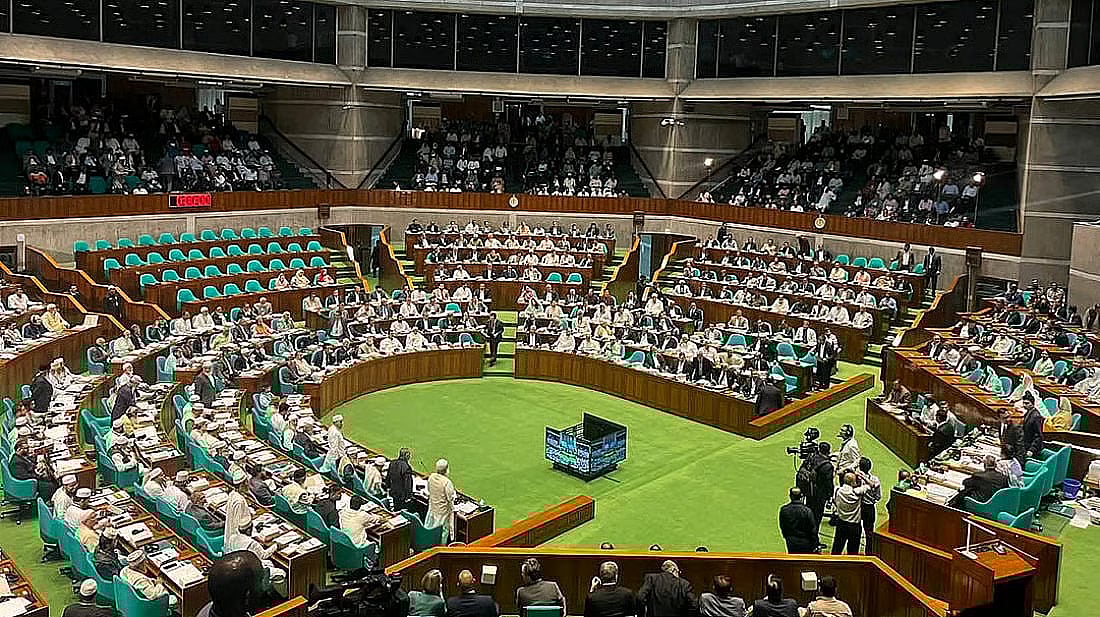
The Jatiya Muktijoddha Council (Amendment) Bill, 2026 was passed in the Parliament today to modernise the existing laws as well as enhance the state’s recognition of those who contributed during the Great War of Liberation in 1971.
The proposed legislation seeks to amend the Jatiya Muktijoddha Council Act of 2022 to officially categorise and honor "Associates of the Liberation War" alongside "Bir Muktijoddhas."
The bill, placed and moved by Liberation War Affairs Minister Ahmed Azam Khan, emphasises the preservation of the ideals of the Liberation War and the realisation of its core goals: equality, human dignity, and social justice.
A significant highlight of the amendment is the formal distinction between those who fought on the front lines and those who provided critical support from within the country or abroad.
According to the draft, "Bir Muktijoddha" remains the designation for those who actively engaged in combat or military training against the Pakistani occupation forces and their local collaborators between 26 March and 16 December, 1971.
This category specifically includes women who were repressed by the occupation forces (Biranganas), as well as medical staff who served in field hospitals.
The Bill said: "Bir Muktijoddha" means those who have undergone war preparation and internal training in villages and towns within the country from 26th March to 16th December 1971 and those who have crossed the borders of Bangladesh and enrolled in various training camps in India with the aim of participating in the Liberation War and have actively participated in the Liberation War against the invading and occupying Pakistani armed forces and their domestic allies in order to achieve the great independence of Bangladesh.
As per the bill, "Associates of the Liberation War" means those who, from 26 March to 16 December 1971, were present in the country or abroad, to inspire the brave freedom fighters and to accelerate the liberation war and the achievement of Bangladesh''s independence, to play the role of organizers, to form world public opinion, to obtain diplomatic support and to gain psychological strength.
Financial management of the Council is also addressed in the bill. It provides for the establishment of a dedicated "JAMUKA Fund" which will be maintained through government grants, private donations, and international aid.
The fund will be managed via a Personal Ledger account under the government’s public account system, with provisions for the Council to take out loans with prior government approval for necessary expenditures.
The bill also grants JAMUKA the authority to appoint administrators or form 11-member ad-hoc committees for organizations related to freedom fighters if their executive committees are canceled or dissolved.
The statement of the bill notes that while previous laws in 2002 and 2022 focused on listing and welfare, this 2026 amendment is necessary to ensure the "ideals of the Liberation War remain upheld in national life" and to provide distinct recognition to those who accelerated the victory through non-combat support roles.
This bill follows the Jatiya Muktijoddha Council (Amendment) Ordinance of 2025, which is set to be repealed and replaced by this comprehensive act upon passing.
Paying tribute to freedom fighters while opposing the bill Bangladesh Jamaat-e-Islami Ameer and Leader of the Opposition Md Shafiqur Rahman prayed for the souls of those who led the bloody war of independence.
He stated that while the country became independent with hopes of humanity and justice, the reality after liberation was the opposite.
He argued that the Liberation War became inevitable because the mandate of the people was denied, yet the post-independence rulers quickly forgot this.
Shafiqur Rahman noted that multi-party democracy was eventually replaced by a one-party BAKSAL system.
He highlighted that in 1975, Parliament abolished multi-party democracy after only seven minutes of debate, banning all political parties.
He commented that multi-party democracy only returned to Bangladesh after 1975 under President Ziaur Rahman, whom he described as a leader loved by the people.
Regarding the JAMUKA act, the opposition leader claimed the current definitions were not introduced by post-independence governments or during the tenures of Ziaur Rahman and Khaleda Zia.
Instead, he attributed the specific inclusion of certain definitions to the previous Awami League administration, which he labeled as ‘fascist.’
He concluded by calling for national unity and a political culture rooted in responsibility and compassion rather than division.
Later, Speaker Hafiz Uddin Ahmad said that the NCP has no objection to the Jamuka bill and requested the Parliament to bring it to the attention of the Parliament.
Then, he put the bill to a vote and it was passed by voice vote.