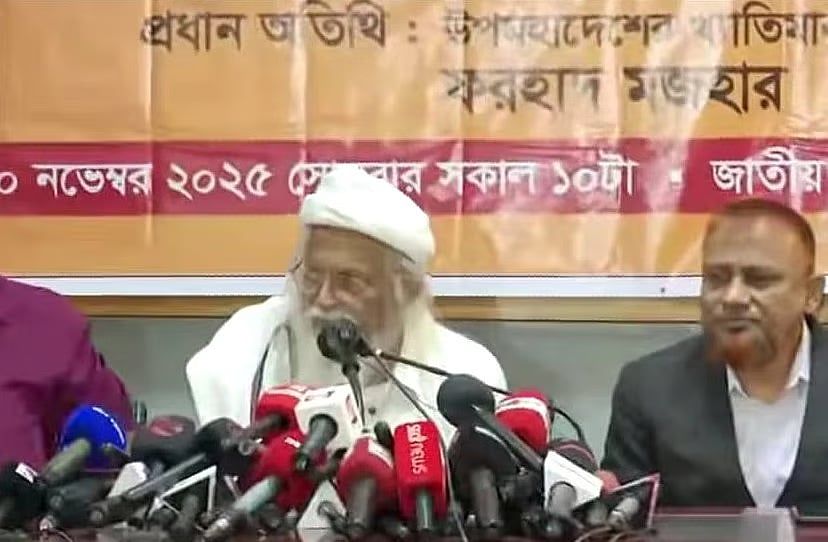
Does this govt have mandate to hold a referendum?, Farhad Mazhar asks
Poet and political thinker Farhad Mazhar has questioned whether the interim government, which took oath under the existing Constitution, has the authority to hold a referendum. Mazhar had earlier argued, after the July uprising, that this Constitution itself should be annulled.
He raised the issue at a discussion titled “Challenges of Building a New Bangladesh”, organised by a platform named the Centre for Democracy and Peace Studies at the National Press Club today, Monday, at a time when the government appears to be moving towards holding a referendum as part of constitutional reforms.
Joining the event as chief guest, Farhad Mazhar said, “Who will organise the referendum? Does this government have the authority to do that? The chief adviser has said that he is upholding the Constitution. Then what is this referendum about?”
Arguing that a “new Bangladesh” could not be built while retaining the old Constitution, he added, “You cannot simultaneously preserve the Constitution and act against its fundamental premises. Both positions cannot stand together.”
Mazhar had immediately objected to the oath of interim administration from president Md Shahabuddin at Bangabhaban after the July uprising—despite the fact that his wife, Farida Akhter, joined the government as a member of the advisory council.
According to Mazhar, a “constitutional counter-revolution” took place in the country on 8 August last year. He argued that those now being referred to as an interim government effectively forfeited that status the moment they took oath under the Constitution framed under Sheikh Hasina’s government.
Therefore, he said, only a Constituent Assembly could legitimately approve a referendum.
Farhad Mazhar also stated, “This government is not an interim government. It is an advisory government. The sole function of an advisory government is to provide advice—nothing more. One should not expect too much from them. If they have anything worthwhile to offer, they should deliver it swiftly.”
He reiterated that only a Constituent Assembly, once formed, could authorise and oversee a lawful referendum.
Mazhar further alleged that following the victory of the uprising on 5 August last year, “a grave betrayal” took place within the next three days. While the army had played a role in the July uprising, he claimed that their contribution was later denied.
Speaking at the discussion, Helal Uddin, nayeb-e-ameer of Jamaat-e-Islami’s Dhaka city unit, said that the demands for justice raised by the students would never be realised without honest leadership. “Tender-rigging and extortion have still not stopped,” he added.
Meanwhile, Gobinda Chandra Pramanik, general secretary of the Jatiya Hindu Mohajote (a platform of Hindu community), claimed that the concerns of religious minorities had been excluded from the talks of the Consensus Commission on reforms.
He said, “The minority population that was 33 per cent in 1947 is now on the verge of extinction. Yet they were not even heard.”
The discussion was moderated by Sadek Rahman, executive director of the Centre for Democracy and Peace Studies.
Other speakers included Bangladesh Natun Dhara Janatar Party chairman Muhammad Abdul Ahad Noor, Ganamukti Jote chairman Shahriar Iftekhar, youth leader ABM Yusuf, former army officer Hasinur Rahman, Jamal Haider, Ferdous Aziz, professor Dewan Sajjad and AR Khan, among others.