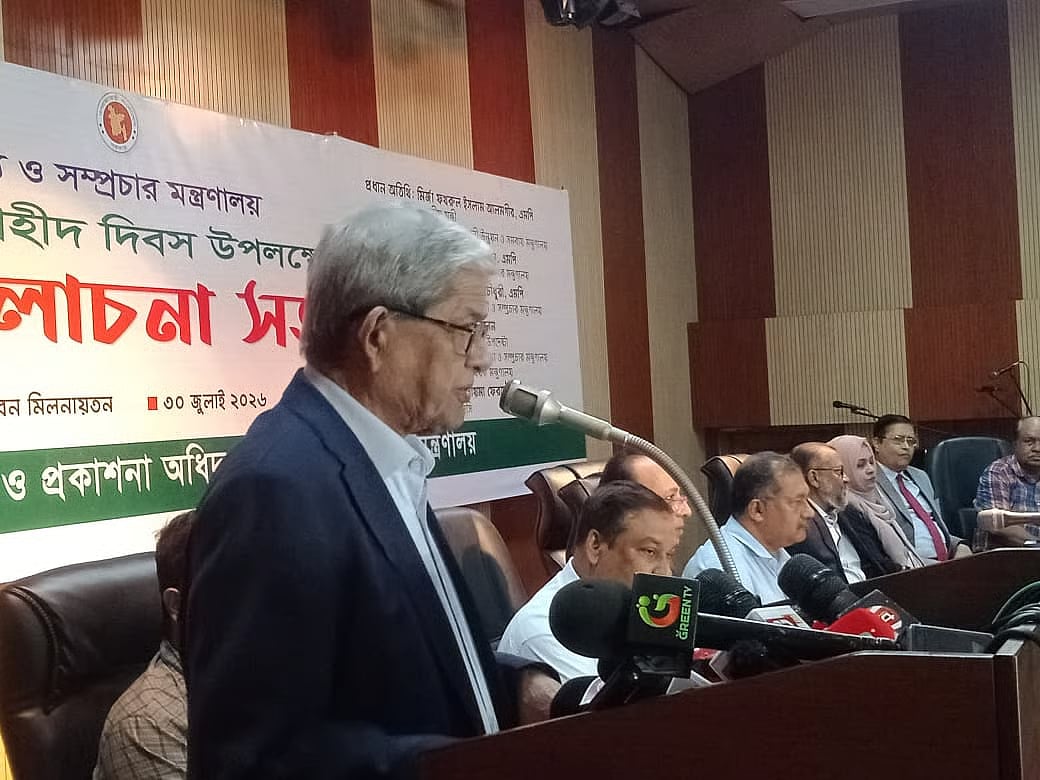
Mirza Fakhrul laments lack of desired change in state-administration, says 'nothing has changed'
Bangladesh Nationalist Party (BNP) Secretary General Mirza Fakhrul Islam Alamgir has expressed disappointment that the desired changes in the state and administration have not materialised despite the people's sacrifices during the July Mass Uprising and the subsequent election.
Sharing his experience of serving as the Minister for Local Government, Rural Development and Cooperatives after the formation of the government following the 12 February election, Mirza Fakhrul said, "I see that nothing has changed."
He made the remarks while speaking as the chief guest at a discussion organised by the Ministry of Information and Broadcasting to mark July Mass Uprising Day. The event was held on Thursday morning at the auditorium of the Information Building in the Circuit House area of the capital.
On the occasion, publications of the Department of Information were unveiled, and a photography exhibition was inaugurated. The programme began with a one-minute silence in memory of those killed in the July Mass Uprising, followed by prayers.
Expressing his disappointment, Mirza Fakhrul spoke about various issues. He said those who used to take bribes are once again finding ways to do so. Likewise, those who used to obstruct good initiatives continue to do the same.
People are merely changing their appearance, he said, adding that many of those who have changed sides have now become the loudest claimants of being July fighters.
The BNP secretary general said, "I am saying these things out of disappointment. I say this because I am old. I truly wanted to witness real change this time. So far, I have not seen that change among us."
Referring to the persistence of the old administrative culture, the local government minister said it is not only the government or political leadership that must change; every member of society must also change their mindset. Otherwise, he warned, the sacrifices of July would fail to produce the desired outcome.
Although he admitted to feeling disappointed, Mirza Fakhrul said he still sees hope in the efforts of Prime Minister Tarique Rahman. The BNP secretary general said he remains optimistic because he has seen change in one individual—Tarique Rahman.
According to him, the prime minister is trying to establish new precedents. If everyone works together to carry those precedents forward, meaningful change may still be possible. For that reason, he said, everyone should support the prime minister.
Mirza Fakhrul said Bangladesh's history is essentially a history of change. From the Language Movement and the Liberation War to the July Mass Uprising of 2024, every major transformation has required people to sacrifice their lives.
The July Mass Uprising, led by young people, initially began over a specific demand but later evolved into a movement to transform the state and society. Many young people lost their lives during the uprising, while countless families continue to bear the grief of losing their children. Those sacrifices, he said, will only be meaningful if genuine change is established in the state and society, he added.
He also said some initiatives for change are now visible through political leadership. To make those efforts successful, he urged everyone to cooperate.
Mirza Fakhrul called for building a democratic, non-communal, merit-based and youth-friendly Bangladesh. He said the true tribute to the spirit of July would be to build a state where people's sacrifices are not in vain and where the desired transformation becomes a reality.
'The spirit of July is rooted in the spirit of the Liberation War'
Information and Broadcasting Minister Zahir Uddin Swapan presided over the event.
He said leaders and activists of the opposition had endured imprisonment, torture and false cases during the 17-year political struggle. It was through the continuity of that long movement that the July Mass Uprising took place. Through the political leadership's strategy and the participation of students, the movement took on a nationwide character, ultimately paving the way for the fall of authoritarian rule.
The information minister said that just as the Liberation War should not be turned into a personal or commercial project, the spirit of the July Mass Uprising must not be allowed to become part of any vested-interest agenda.
He said the Liberation War and the July Mass Uprising represent the same democratic aspiration. That spirit, he added, should serve as the guiding principle for political practice in Bangladesh in the future.
Zahir Uddin Swapan said the principal objective of the 1971 Liberation War was to establish a prosperous, democratic and developed Bangladesh. However, because that aspiration was never fully realised, people once again had to shed blood in July 2024. The spirit of July, he said, is rooted in the spirit of the Liberation War. It is from that legacy that the strength to resist injustice, oppression and authoritarianism has emerged.
'We must remain vigilant against attempts to distort the spirit of July'
Bangladesh Press Council Chairman AKM Abdul Hakim said fair and impartial justice must be ensured for the killings and human rights violations committed during the July Mass Uprising.
Bangladesh Federal Union of Journalists (BFUJ) Secretary General Kader Gani Chowdhury said a section of the media had played a role in sustaining fascist rule in the past. He also called for the construction of a "July Martyrs Memorial," dignified support for the families of those killed, and visible justice for the killings.
National Press Club President Hasan Hafiz said the July Mass Uprising did not emerge suddenly within 36 days. Behind it lay 17 years of repression, enforced disappearances, killings and political persecution. Ignoring that history, he said, would obscure the true context of the movement.
He added that the July movement and the Liberation War are not contradictory; rather, they represent the continuation of Bangladesh's aspiration for democracy, social justice and freedom of thought. Therefore, he urged everyone to remain vigilant against any conspiracy to distort or weaken the spirit of July.
Mir Mahbubur Rahman Snigdha, Deputy Chief National Commissioner of Bangladesh Scouts and brother of July martyr Mir Mahfuzur Rahman Mugdha, said the young people who participated in the July movement did not retreat even after witnessing the deaths of their fellow protesters.
Their determination, he said, was driven by a deep desire to free the country from the fascist state structure that had existed for 17 years.
Also speaking at the discussion were Md Shah Alam, Additional Secretary (Routine Charge) of the Ministry of Information and Broadcasting; Chowdhury Sayma Ferdous, member of the Bangladesh Public Service Commission (PSC); and Maruf Kamal Khan, editor of Protidiner Bangladesh, among others.
Exhibition
A day-long special photography exhibition has been organised on the premises of the Information Building to mark July Mass Uprising Day.
The exhibition features photographs published in various media outlets and on social media documenting the sequence of events during the July 2024 Mass Uprising.
It also includes the front pages of several national daily newspapers published on 6 August 2024, carrying the news of Sheikh Hasina's flight from the country following her ouster during the mass uprising.