Jamaat could have resolved many questions if Razzaq’s 2016 statement were signed: Law minister
In 2016, the top leadership of Jamaat-e-Islami asked Barrister Abdur Razzaq to prepare a draft statement on the party’s role in 1971. The statement is discussed in Razzaq’s book.
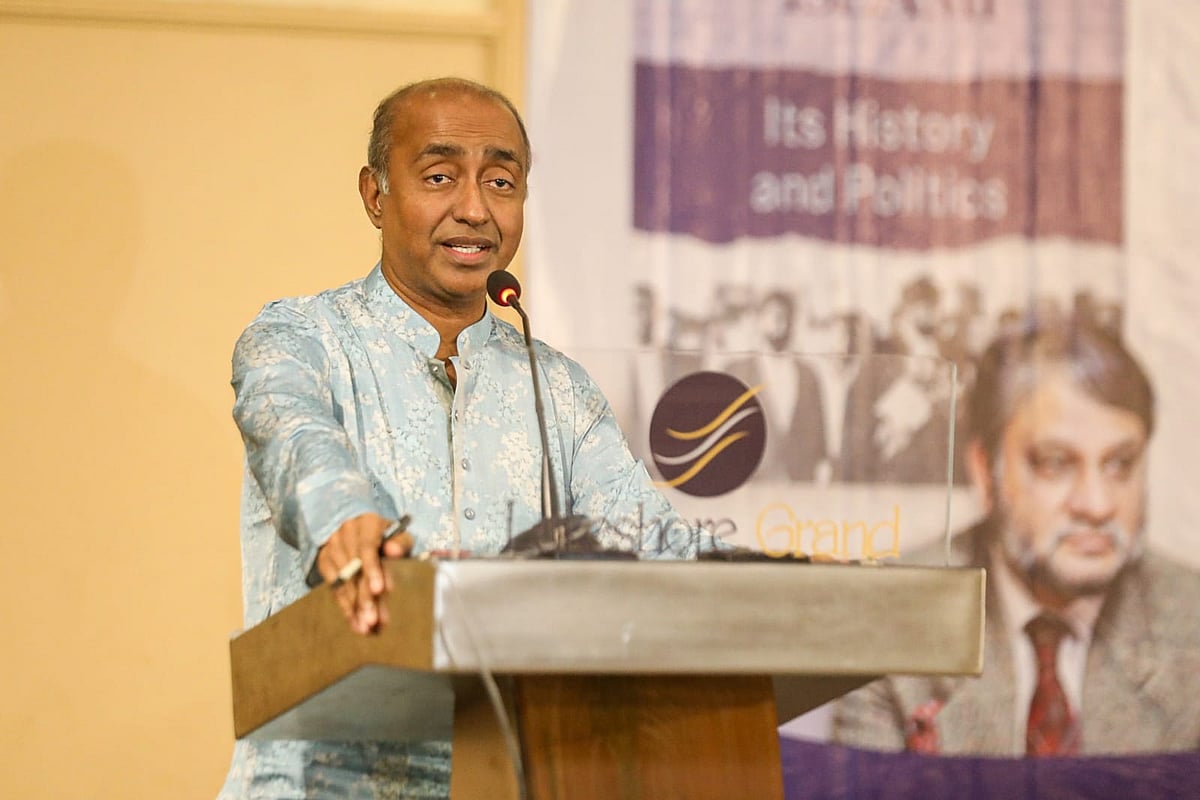
Speaking at a discussion on the book, Law, Justice and Parliamentary Affairs Minister Md Asaduzzaman said, “In 2016, following his political philosophy and principles, Barrister Razzaq drafted a statement to present Jamaat’s role in 1971 before the nation. If Razzaq Sahib’s statement had been signed in 2016, many questions surrounding Jamaat would have been resolved.”
The publication ceremony of the late Barrister Abdur Razzaq’s book, Bangladesh Jamaat-e-Islami: Its History and Politics, was held at a hotel in Gulshan, Dhaka, this Friday morning.
Organised by the book’s publisher, University Press Limited (UPL), the law minister delivered the closing remarks at the event.
Two of Abdur Razzaq’s sons, along with many of his well-wishers and representatives of civil society, attended the programme.
Taking part in the discussion, Law Minister Md Asaduzzaman said, “Ideologically, I was never on the same side as Barrister Abdur Razzaq. But I had a personal relationship with Razzaq Sahib. When I was his junior colleague in the legal profession, whenever I went to appear in a case in any court, I would quietly sit beside him, or he would quietly come and sit beside me. Particularly at a time when fascism was beginning to raise its head, Razzaq Sahib’s guidance was like a guiding light to me, showing me the way. Razzaq Sahib dreamed, and he inspired others to dream.”
“Having read his book, I feel that it is an expression of his sustained vision and efforts to break Jamaat out of the circle of reactionary politics and transform it into a progressive Islamic party,” he added.
Asaduzzaman further said, “He (Abdur Razzaq) considered the idea of imposing Islamic rule from above to be a misguided policy. Rather, he believed that a state should be formed and governed on the basis of Islamic values emerging from society, and that this was the proper way to establish a truly Islamic system of government. This is reflected in his book. … The book did not strike me as a work of literature, nor did it seem to me to be a work of research. It seemed like the living encyclopaedia of a person. It is a true reflection of how Razzaq Sahib saw a society through his life and of what his philosophy of life was.”
Referring to his expectation that people known as Jamaat-leaning lawyers would attend the event, the law minister said, “Their inability to be here reflects their weakness, failure, narrowness and limitations. They could have attended and disagreed with Razzaq Sahib’s book. Because this is democracy. It is not true that you have to agree with everything Razzaq Sahib said in the party forum; nor is it right to refuse to accept his critical points.”
In his closing remarks, Law Minister Asaduzzaman said Abdur Razzaq had spoken of making a statement to the nation on his assessment of Jamaat’s role in 1971. “If Razzaq Sahib’s statement had been signed in 2016, many questions surrounding Jamaat would have been resolved. Jamaat has, however, accepted that very question. Jamaat’s position today is based on that statement,” he stated.
The minister further said that, in this connection, Jamaat had not voted against an amendment to the Jatiya Muktijoddha Council-Jamuka (National Freedom Fighters Council) Act that added the words “the war also fought against the then Jamaat-e-Islami” to the definition of a freedom fighter.
The law minister said, “In 2016, following his political philosophy and principles, Barrister Razzaq drafted a statement to present Jamaat’s role in 1971 before the nation. By participating in the parliamentary process and indirectly refraining from voting against it, Jamaat conceded that role in 1971. This is where Razzaq Sahib’s foresight becomes evident. This is where Razzaq Sahib was unique. Here, Razzaq Sahib took a step forward in leading a nation.”
Asaduzzaman also said that although Barrister Abdur Razzaq had served as Jamaat’s assistant secretary general, he had risen to become an institution in his own right.
“Razzaq Sahib had elevated himself to such a unique stature that he remains relevant even today. The last time I spoke to Razzaq Sahib, he told me, ‘Pray for me. May Allah fulfil my final wish—that I may be buried on the soil of Bangladesh.’ Through the July struggle, Allah fulfilled that wish of Razzaq Sahib. May Allah grant him a place in heaven. May his book become essential reading for all of us, particularly those involved in politics,” he said.
The event concluded with the unveiling of Barrister Abdur Razzaq’s book.
Besides the law minister, political analyst Professor Dilara Choudhury, Professor Ali Riaz, The Daily Star Consulting Editor Kamal Ahmed and former US diplomat Jon Danilowicz, who served in Dhaka, also took part in the discussion on the book.
The book, published by UPL, is a posthumous memoir examining Razzaq’s long involvement with Jamaat and his efforts to persuade the party to address its 1971 record.