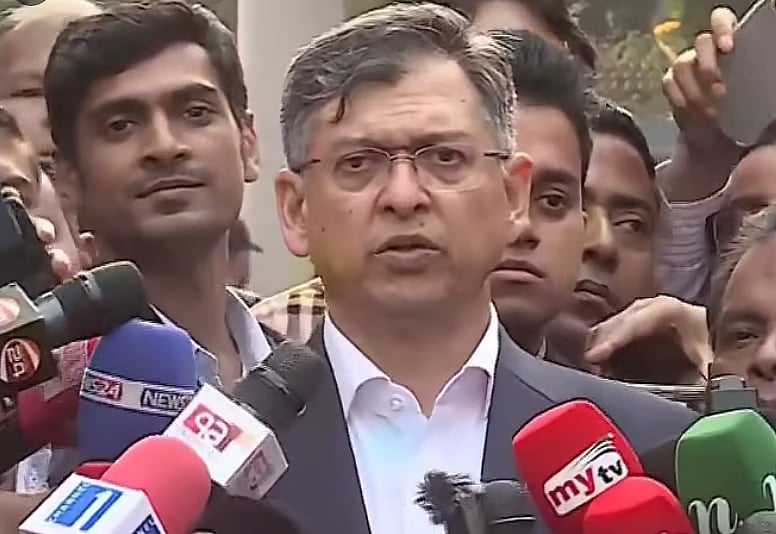
Home minister Salahuddin clarifies party stance on ‘July National Charter’
Amid ongoing debate over the ‘July National Charter’ and following his oath as a member of the Constitutional Reform Council, Bangladesh Nationalist Party (BNP) Standing Committee member and Home Minister Salahuddin Ahmed has clarified his party’s position on the issue.
He said the BNP embraces every word and letter of the July National Charter and remains committed to its implementation.
At the same time, he noted that beyond this pledge, the party will also implement the promises outlined in its election manifestos for which it has received the people’s mandate.
He made these remarks today, Tuesday, at a discussion meeting and iftar gathering held at the auditorium of the Supreme Court Bar Association.
The programme, titled “Expectations of the Legal Community from the Present Government in Establishing Democracy, Rule of Law, Protection of Human Rights and Good Governance,” was organised by the Bangladesh Jatiyatabadi Ainjeebi Forum.
We want to make it clear that we do not deny this charter. We are committed to the nation. Moreover, whatever is included in our election manifesto will also be implemented once we receive the people’s mandate.Salahuddin Ahmed, Home Minister and BNP Standing Committee member
Recently, two writ petitions were filed with the High Court division of the Supreme Court challenging certain provisions of the July National Charter (Constitutional Reform Order), the referendum ordinance, and the legality of the oath taken by members of the Constitutional Reform Council.
In response to the petitions, the court has issued a rule. Referring to these matters now under judicial consideration, the home minister presented his analysis within legal boundaries.
Salahuddin Ahmed said, “The July National Charter is a document of political consensus. Most political parties have signed it. Many of those now criticising it had signed the document after the election with reservations, depending on their convenience. But there is no scope to add or modify anything in the charter. What exists in it must either be signed or one must clearly explain why they are not signing.”
Questioning the oath taken by members of the Constitutional Reform Council, he said respecting the outcome of a referendum would first require going to the national parliament.
There, legislation must be enacted through discussion and then incorporated into the constitution. The format of the oath and who administers it should be specified in the Third Schedule, he added.
“Whether the process followed this time adhered to proper legal procedures is a matter for the Supreme Court to examine,” he said.
Salahuddin Ahmed further said some have threatened to take to the streets if the July National Charter is not implemented.
“We want to make it clear that we do not deny this charter. We are committed to the nation. Moreover, whatever is included in our election manifesto will also be implemented once we receive the people’s mandate,” he stressed.
Leaders from various levels of the BNP, along with representatives of the legal community, attended the event. Speakers at the programme emphasised the importance of the judiciary’s role in upholding democracy and the rule of law in the current national context.