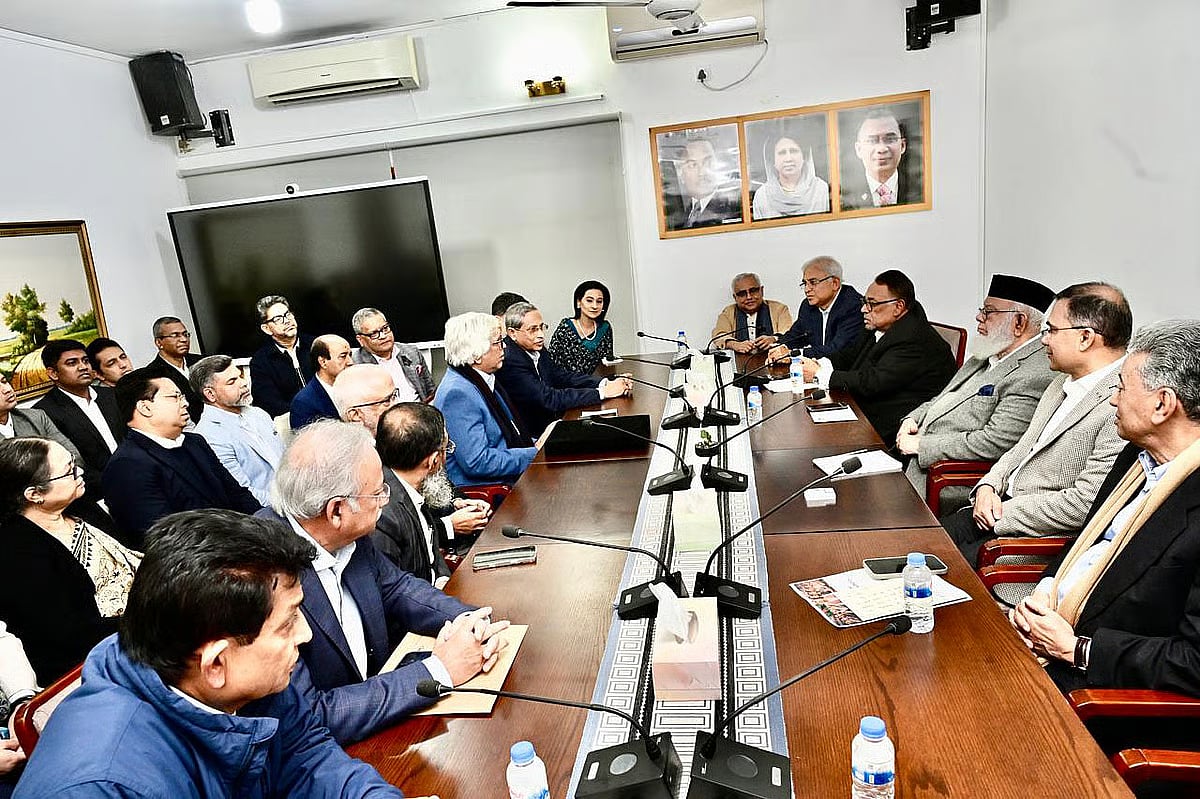
Meeting with leading business leaders
Business community raises concerns, Tarique Rahman offers assurance
Leading businesspersons and industrial entrepreneurs of the country met with BNP acting chairman Tarique Rahman and informed him of the existing problems and challenges facing trade and commerce.
In particular, they highlighted issues relating to the law and order situation, shortages of gas and electricity in the industrial sector and bureaucratic harassment.
After listening to the concerns raised by the business community, Tarique Rahman gave assurances that if his party comes to power in the next election, initiatives will be taken to resolve these problems in consultation with business leaders.
The meeting was held on Sunday evening from 7:00 pm to 9:30 pm at the BNP chairperson’s political office in Gulshan, Dhaka.
At present, businesspersons in the country are facing serious difficulties, as a result of which investment is declining, employment opportunities are shrinking and overall economic progress is being hampered.
There are severe crises in the banking sector, the stock exchange and the capital market. These issues were discussed in detail between Tarique Rahman and leading business and industrial entrepreneurs.
Business leaders are expecting that if the BNP comes to power through a popular mandate, these problems will be resolved. In this regard, Tarique Rahman has given them his assuranceAmir Khasru Mahmud Chowdhury, BNP standing committee members
After the meeting, these matters were briefed to journalists by BNP standing committee member Amir Khasru Mahmud Chowdhury.
The BNP acting chairman listened attentively to the business leaders for an extended period.
He not only assured them of solutions to the problems raised, but also sought their views on what types of solutions could be adopted for each issue.
At the same time, he shared his own perspectives on measures he considered realistic and necessary.
Those present at the meeting included: Mahbubur Rahman, president of International Chamber of Commerce (ICC) Bangladesh; Alihussain Akberali, chairman of BSRM; former FBCCI presidents Mir Nasir Hossain and AK Azad; Tapan Chowdhury, managing director of Square Group; former BTMA president Matin Chowdhury; Anwar-ul-Alam Chowdhury Parvez, president of Bangladesh Chamber of Industries (BCI); Mostafa Kamal, chairman and managing director of Meghna Group of Industries; Matiur Rahman, chairman of Uttara Motors; Kamran T Rahman, president of MCCI; former BGMEA president Kutubuddin Ahmed; former BKMEA president Fazlul Haque; former MCCI president Nihad Kabir; BGMEA president Mahmud Hasan Khan; BTMA president Showkat Aziz; BKMEA president Mohammad Hatem; Jahangir Alam, president of the Steel Mill Owners Association; ICC Bangladesh Executive Member and Transcom Group CEO Simeen Rahman; and Ahsan Khan Chowdhury, chairman and CEO of PRAN Group.
Also present were: Aziz Al Kaiser of Partex Group; former DCCI president Hossain Khaled; DCCI president Taskeen Ahmed; BGAPMEA president Md Shahriar; BCMEA president Moynul Islam; president of the Bangladesh Association of Pharmaceutical Industries (BAPI) Abdul Muktadir; BAB president Abdul Hai Sarker; Amirul Haque, managing director of Sikder Group; Priti Chakraborty, senior vice-president of BCI; Fazle Shamim Ehsan, president of the Bangladesh Employers’ Federation; and Sharif Zahir, chairman of UCBL.
BNP standing committee members Amir Khasru Mahmud Chowdhury and Iqbal Hasan Mahmud are also present at the meeting.
What the business leaders said
After the meeting, Mir Nasir Hossain and Anwar-ul-Alam Chowdhury spoke to journalists on behalf of the business community.
Mir Nasir stated that the policy of Khaleda Zia and former president Ziaur Rahman were to promote the private sector. They were pioneers in nurturing the growth of the private sector in the country.
He said that Tarique Rahman wanted to hear directly about the problems faced by businesspeople and sought an understanding of what could be done if he were to come to power.
Mir Nasir added that business leaders raised issues related to energy shortages, law and order, shortcomings in the education system and risks faced by the media.
They also discussed reducing the cost of doing business, strengthening the stock market and reducing over-reliance on banks.
Speaking to journalists, Anwar-ul-Alam Chowdhury said that the economy is the main foundation of national development. Therefore, to stabilise the economy, the government must work together with the business community.
He stated that Tarique Rahman had also expressed the view that, if they are able to form a government, policies would be formulated in consultation with business leaders.
He assured that efforts would be made to ensure transparency and to create a business friendly environment.
Tarique Rahman assures resolution of problems
Amir Khasru stated that business leaders placed particular emphasis on reducing the cost of doing business. According to them, high bank interest rates and various policy-related constraints are increasing business costs.
As a result, ordinary people are having to pay higher prices, which is ultimately contributing to rising commodity prices. Due to these adverse conditions, businesspeople are unable to operate their businesses effectively, nor are they able to increase investment.
The question was also raised at the meeting that if domestic entrepreneurs are unable to invest, how foreign investors would be encouraged to invest in Bangladesh.
Amir Khasru said that the BNP is a business-friendly party and that there is a significant level of confidence among businesspeople in the BNP. This is because almost all major reforms in Bangladesh’s economy were carried out during periods of BNP governance.
Business leaders are therefore expecting that if the BNP comes to power through a popular mandate, these problems will be resolved. In this regard, Tarique Rahman has given them his assurance.
At the meeting, Tarique Rahman said that he is aware that businesspeople have high expectations. While the BNP has undertaken important initiatives in the past, the present context requires even greater change.
There is a need for major reforms, deregulation and liberalisation. To this end, the BNP has already begun preparing policy frameworks and these will be implemented if the party comes to power.
After the meeting, Mostafa Kamal, chairman and managing director of Meghna Group of Industries, said that Tarique Rahman had also listened in detail to views on how further development could be achieved despite limited resources and existing infrastructure constraints.
He also drew the attention of business leaders to the importance of ensuring a smooth supply of essential commodities during the upcoming month of Ramadan.
Media issues
At the meeting, former FBCCI president and president of the Newspaper Owners Association of Bangladesh (NOAB), AK Azad, raised the issue of past interference by various intelligence agencies in the work of the media.
AK Azad stated that, in the past, attempts had been made to change the ownership of Prothom Alo by using intelligence agencies.
As a result, the owners of the newspaper had to endure various forms of harassment. Such incidents, he said, pose a serious threat to independent journalism and create major obstacles to freedom of expression.
He expressed the hope that if the BNP comes to power, it will ensure that the media can operate and express opinions freely.
In response, Tarique Rahman said at the meeting that just as the media were able to operate freely during previous periods of BNP governance, they would be able to do so in the future as well.
He then asked whether any intelligence agency had interfered in media operations when the BNP was previously in power. AK Azad replied that no such incidents had occurred during BNP rule.
Tarique Rahman then said that if the BNP had not interfered in media activities in the past, the same approach would be maintained in the future.