Awami League till now has not taken any initiative to reach any form of compromise with the major opposition party BNP. On the contrary, it continues with its counter programmes in response to the opposition movement. It has been learnt that the ruling party has even drawn up a road map to ensure its control of the political field till the coming election. Awami League leaders cite their mistrust in BNP as the reason for this stand. Awami League has expressed various apprehensions concerning the opposition parties' simultaneous movement.
BNP is not making any compromises in its movement either. The programmes and counter programmes are placing the two parties at loggerheads in the political arena. If Awami League goes ahead towards a one-sided election, mistrust in politics will grow further and any chances of a compromise will diminish. This is likely to exacerbate the unrest and turmoil and could easily lead to clashes and conflict, analysts feel.
BNP has been out of power for the last 16 years and, by the looks if it, they have taken this election as a fight for survival
Meanwhile, Awami League refuses to term its programmes as 'counter programmes'. But the explanations offered by the party leaders make it clear that their targets are the programmes of the opposition. Several senior leaders of Awami League have said a mistrust towards BNP has grown further within their party and within the government too. They say they are apprehensive of BNP's movement taking a violent turn.
The Awami League leaders use the example of violence that broke out during the 2014 election and the year that followed. Presidium member of the ruling party, agriculture minister Abdur Razzak, has said, while speaking to Prothom Alo, that unless Awami League remains alert in the field, BNP will once again resort to violence. That is why they are holding political programmes, he said.
BNP leaders have termed Awami League's programmes as instigative. Speaking to Prothom Alo, BNP secretary general Mirza Fakhrul Islam Alamgir said they are carefully avoiding the instigation.
Awami League's challenge
Awami League will not move away from countering BNP's programmes. It has drawn up a roadmap of programmes to continue for one year till the next election. It would be quite natural for Awami League, as a political party, to also take up programmes. But the questions arise when the ruling party's programmes target those of the opposition. Actually, during its long stint in power, Awami League had not faced any tangible challenges.
Now as the election comes closer, BNP and other parties have taken up a simultaneous movement, demanding the resignation of the government and elections under a non-partisan government. It seems that Awami League has taken the opposition efforts to remain strong in the political fray, as a challenge.
Certain analysts feel that having stayed in power for three terms at a stretch, Awami League no longer enjoys people's support as before. Also, with the Russia-Ukraine war coming on the heels of the Covid pandemic, Bangladesh's economy too has been impacted like that of the rest of the world. The spiralling cost of living has created anger among the people.
The ruling party fears that these circumstances may give BNP an upper hand in the political arena, so they are taking these counter measures accordingly. Also, the leaders may be taking into consideration the possible situation they could face if they have to leave power after such a long stint at the helm. But they, for the time being, are not giving any consideration to the fact that counter programmes may instigate unrest.
BNP in a fight of survival
BNP has been out of power for the last 16 years and, by the looks of it, they have taken this election as a fight for survival. BNP's movement to thwart the 5 January 2014 election failed. Awami League had held a one-sided election at the time. BNP took part in the 2018 election, but it had many allegations and questions concerning that election. Given past experience, this time BNP is endeavouring to take its movement towards a conclusion of ensuring elections under a non-partisan government.
But Awami League may keep the political arena in its control and once again head towards a one-sided election. BNP feels that under these circumstances, the Awami League government will become even more determined to suppress any opposing views. BNP will not take part in elections under the Awami League government. If their movement fails, then their every existence will be threatened. And so BNP is determined to remain in the field till the very end.
Till now the party maintains this firm stance, leaders of the party have confirmed. And so at one point of the movement, they may even take up long march and blockade programmes.
With the election ahead, Awami League and BNP are facing different circumstances. As the election looms larger, both the parties are stepping up their activities on the streets. If BNP takes up a long march or blockade programme to step up their movement and put pressure on the government, the government will undoubtedly take this as a challenge. It will most likely increase its use of state machinery against the opposition movement. And Awami League will also increase its clout in the political field, BNP leaders apprehend.
As the ruling party, Awami League bears more responsibility to display tolerance and take initiative for an understanding. But it does not look like that the ruling party has this in mind
Which way will politics proceed?
After its rallies in the divisional towns, BNP held a Dhaka mass rally on 10 December last year. On the same day, the ruling Awami league staged a counter programme in the capital city. Since then, it has been holding programmes to counter each and every programme of the opposition's simultaneous movement. Awami League leaders, however, claim that they keep their leaders and activists alert on the streets to ensure that the opposition does not resort to violence.
They have even called their programme 'peace rally'. But reality is quite different. BNP had to run repeatedly to the police for permission to hold its 10 December rally and also to confirm its venue. They say that Awami League leaders and activists had also taken position in various points of the city, obstructing BNP's leaders and activists from joining the rally.
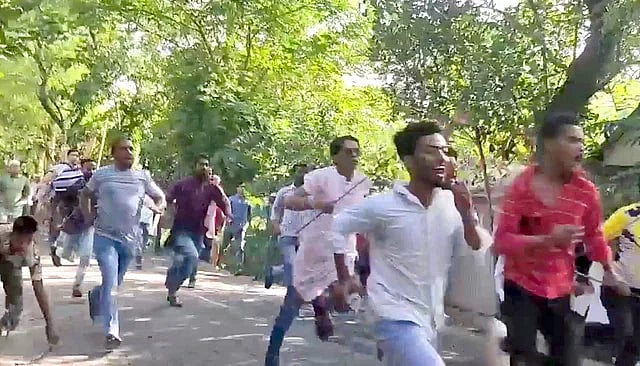
In the latest incident, of the day of BNP's rallies in 10 large cities including Dhaka, Awami League held counter programmes, leading to unrest in Rangpur, Khulna and Barishal. A convoy of 12 buses carrying BNP men from Kushtia to join the rally in Khulna was halted in Jhenaidah by Awami League men. They mercilessly beat up the BNP men, it is alleged.
Awami League leaders claim these were isolated incidents. But politicians can clearly see how tensions are spiralling along with the counter programmes. And these political tensions are now being taken to the villages. Awami League is taking up programmes to counter the opposition marches at the union level.
A review of past anti-government programmes reveals that when both sides are in the field at the same time, the leaders often lose control of their people participating in the programmes. The situation then turns to clashes and violence.
Leaders of both Awami League and BNP still believe that tensions on the streets will increase steadily. If no compromise can be reached, there is all likelihood that the situation will turn violent.
Under these circumstances, as the ruling party, Awami League bears more responsibility to display tolerance and take initiative for understanding. But it does not look like that the ruling party has this in mind.
* This report appeared in the print and online editions of Prothom Alo and has been rewritten by Ayesha Kabir for the English edition.