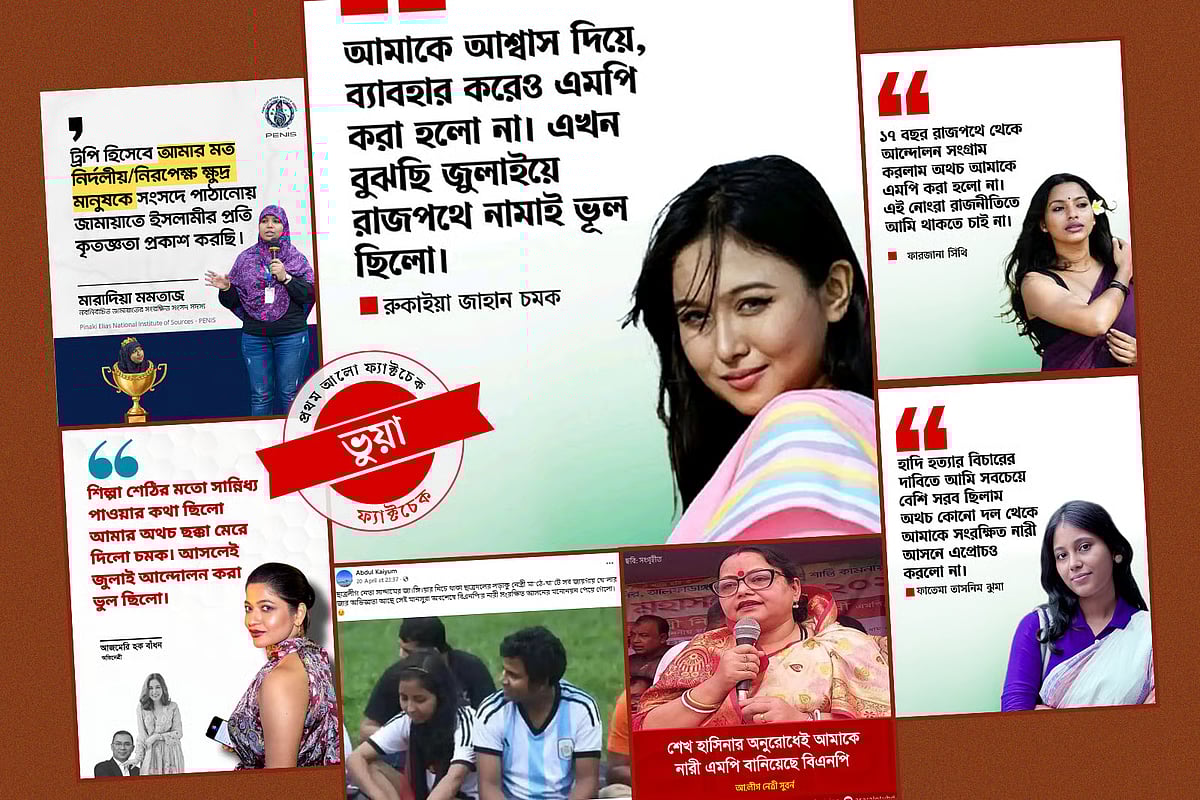
Fact check
Disinformation through fake images, statements targeting candidates for reserved women’s seats
A photograph was circulated on Facebook with the caption: “Even if there is no Momtaz of the Awami League, a jeans-wearing Momtaz from Jamaat is coming to Parliament…”. The image depicts Mardia Mumtaz wearing jeans. However, the image is fabricated.
Mardia Mumtaz is a nominated candidate of Jamaat-e-Islami for a reserved women’s seat in the 13th Jatiya Sangsad (national parliament).
She is not alone—similar fabricated images and misleading information are being circulated about other female candidates and aspirants on social media.
This is not an isolated incident. Disinformation campaigns targeting women have been observed previously. Concerned individuals warn that such trends risk pushing women out of public life, which is deeply troubling.
The image shared of Mardia Mumtaz prompted mocking comments, and misleading information about her personal identity was also disseminated. The same image was used by a Facebook group named “Kathherkella” to create a satirical photo card.
There too, a fabricated statement was attributed to her: “I express my gratitude to Jamaat-e-Islami for sending a minor independent/neutral person like me to Parliament as a trophy.”
A reverse image search shows Mardia Mumtaz in similar attire, including a hijab, in various news outlets, but no authentic image of her wearing jeans exists.
When the image was analysed using the AI detection tool “Hive Moderation”, it indicated an almost certain likelihood of being AI-generated.
Google’s SynthID tool also found that the image had been created or manipulated using Google’s AI tools. Therefore, the image is not genuine.
Similarly, a photo card attributed to Subarna Shikdar Thakur, a BNP-nominated female candidate, has also circulated. It falsely quotes her as saying, “BNP made me a female MP at the request of Sheikh Hasina.”
Verification confirms that Subarna Shikdar Thakur did not make this statement. The claim originated from a satirical page named “Ashar Alo”, and the content was edited and misrepresented as factual.
Rukaiya Jahan Chamak, an actress and aspirant for a reserved women’s seat from BNP, has also been targeted with disinformation.
After she was not nominated, a fabricated quote circulated in her name, “BNP removed me from the reserved MP list at the last moment because I demanded justice for Hadi’s murder.”
Fact-checking reveals that this claim originated from a satirical page called “Dainik Mollar Desh”, whose humorous content was misrepresented as real news.
Additional false statements attributed to Rukaiya Jahan Chamak also spread from another satirical page named “Gupto Television”.
The same page used an image of Fatima Tasnim Juma, the Liberation War and Democracy Secretary of DUCSU, claiming she said: “I was the most vocal in demanding justice for Hadi’s murder, yet no party even approached me for a reserved women’s seat.” However, no evidence supports this claim.
Model and activist Farzana Sithi has also fallen victim to similar misinformation. Statements falsely attributed to her include: “I spent 17 years on the streets in protest and struggle, yet I was not made an MP. I do not want to remain in this dirty politics,” and “It was a mistake to seek nomination from a foolish party like BNP. If Jamaat values me, I will join the party.”
Verification shows that these claims originated from a satirical page named “Gojob Vision”.
Overall, these incidents illustrate a concerning pattern of coordinated disinformation campaigns targeting women in politics, often using fabricated images and false statements to mislead the public.
A fabricated statement was also circulated using a photograph of actress Azmeri Haque Badhon, attributing to her the remark, “I was supposed to receive attention like Shilpa Shetty, yet Chamak hit a six and took it away. Truly, participating in the July movement was a mistake.”
Disinformation also targeted Mansura Alam, a BNP-nominated candidate for a reserved women’s seat and Joint General Secretary of the Jatiyatabadi Chhatra Dal central committee. A photograph was circulated showing her alongside Saddam Hossain, president of the banned Bangladesh Chhatra League.
However, verification confirms that the individual in the image is not Saddam Hossain; rather, he is the late Jubaer Kabir Tusher, former Counsellor at the Bangladesh Embassy in Lebanon.
The image had previously circulated in March 2025, when Rumour Scanner identified it as false.
Mansura Alam told Prothom Alo, “The photograph was taken in 2014 during the Football World Cup with Jubaer Kabir Tusher bhai. He supported Brazil, while I supported Germany. Tushar bhai was associated with the Prothom Alo Bondhusava and later served as a Counsellor at the Bangladesh Embassy in Lebanon. He passed away in September 2024. After his death, I posted the photograph on social media in remembrance. Subsequently, a known Shibir activist falsely claimed that it was taken with Chhatra League President Saddam Hossain. Although he later expressed regret for the incident, by then the disinformation had already spread and made an impact.”
An analysis of the disinformation surrounding nominations for reserved women’s seats reveals three primary tactics: the use of AI-generated or manipulated images, the portrayal of satirical content as factual, and the attribution of fabricated statements to individuals.
‘Deeply concerning’
Tanvir Mahatab Abir, senior fact-checker at Rumor Scanner, stated that the spread of false information targeting politically active women not only creates confusion but also carries far-reaching and alarming consequences.
Speaking to Prothom Alo, Tanvir Mahatab Abir further said that Rumor Scanner has consistently observed that in Bangladesh, women—particularly those who remain visible in online spaces—frequently become targets of disinformation, especially in political contexts.
Women involved in the nomination process for reserved seats have likewise become targets.
“This trend is not merely isolated disinformation; rather, it is paving the way for a structural and targeted form of digital violence. The continuous spread of fabricated images, AI-driven content, and distorted statements is damaging the social acceptability of female candidates, discouraging their participation, and ultimately calling into question the transparency of the political process,” he said.
According to Tanvir Mahatab Abir, in the long term, this trend risks pushing women out of the public sphere, which is deeply concerning for democratic participation.
Touhidul Islam Rasho, research officer at Dismislab, noted that whenever elections or political events take place and women politicians are present, a pattern of misinformation targeting them emerges.
Touhidul Islam Rasho told Prothom Alo, “We have observed this in the case of female candidates during the DUCSU elections, and again among female candidates in the 13th National Election. Similar instances are now emerging concerning aspirants for reserved women’s seats.”
Regarding the impact, Touhidul Islam stated that such disinformation and negative campaigning also affect their personal lives. As a consequence, women may become reluctant to participate in politics.
Additionally, new female politicians may feel discouraged from expressing their views and opinions on social media.