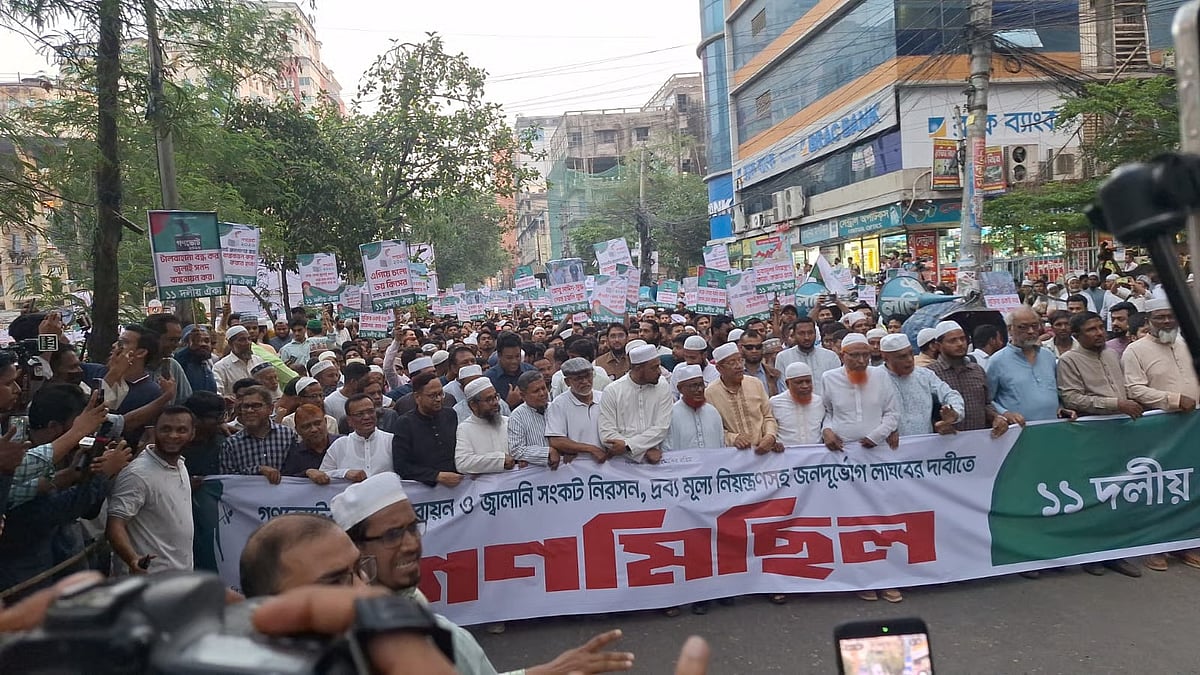
11 parties, including Jamaat, aim to start a major movement
An 11-party alliance led by Bangladesh Jamaat-e-Islami aims to launch a large-scale movement to press for the implementation of the referendum verdict.
After organising rallies, seminars, and leaflet distribution campaigns, the alliance now plans to hold gatherings in divisional cities, followed by a grand rally in the capital, with the objective of increasing political pressure on the ruling authorities.
Multiple sources at the policymaking level within the alliance have indicated that the current programmes primarily focus on building public opinion and strengthening organisational preparedness.
They intend to expand the scope of activities in the next phase after assessing the ground situation and political response.
Discussions are also under way regarding the possibility of adopting tougher programmes if necessary.
The alliance observed a week-long programme from 9 to 15 April, during which it distributed leaflets nationwide, staged protests at metropolitan and district levels, and held a national seminar in Dhaka on 13 April.
Subsequently, on 16 April, top leaders of the alliance convened a meeting at the Al-Falah Auditorium adjacent to Jamaat’s central office in Moghbazar, Dhaka.
Following the meeting, they announced a series of programmes from 18 April to 2 May at a press conference.
The programmes being announced in phases will continue until the referendum verdict is implemented. If the government does not accept the referendum verdict, the 11-party alliance will move towards more stringent programmes.Hamidur Rahman Azad, assistant secretary-general of Jamaat
A mass procession was held in Dhaka on 18 April; further processions are scheduled for divisional cities on 25 April and district towns on 2 May.
In addition, seminars and leaflet distribution activities will continue in divisional and key district cities during this period.
Sources within the liaison committee of the 11-party alliance have stated that preparations are currently under way for the processions in divisional and district cities. They are also finalising seminar topics and selecting speakers.
On 12 February, alongside the 13th parliamentary election, a referendum was held to implement 48 constitutional proposals outlined in the July Charter.
Approximately 70 per cent of voters supported the proposals. According to the implementation order of the July National Charter, elected members were required to take two oaths: one as members of parliament and another as members of the Constitutional Reform Council.
However, at the oath-taking ceremony on 17 February, members of the opposition—including those from Jamaat and the National Citizen Party (NCP)—took both oaths, whereas members of the Bangladesh Nationalist Party (BNP) did not take the second oath. Consequently, the Constitutional Reform Council has yet to be formed.
Leaders of Jamaat have alleged that although the BNP signed the July Charter, it is reneging on its commitments after assuming power, thereby creating a political and constitutional crisis.
The BNP, however, maintains that it is implementing most provisions of the July Charter, while it had previously recorded a “note of dissent” on certain issues and is therefore not obligated to implement those particular provisions.
A mass procession was held in Dhaka on 18 April; further processions are scheduled for divisional cities on 25 April and district towns on 2 May. In addition, seminars and leaflet distribution activities will continue in divisional and key district cities during this period.
Meanwhile, opposition MPs have taken an active role in Parliament in demanding the implementation of the referendum verdict.
In parallel, they have embarked on field-level programmes as a strategy to maintain pressure on the government.
Hamidur Rahman Azad, assistant secretary-general of Jamaat and coordinator of the 11-party alliance told Prothom Alo on 17 April, “The programmes being announced in phases will continue until the referendum verdict is implemented. If the government does not accept the referendum verdict, the 11-party alliance will move towards tougher programmes.”
Next plans
Multiple sources at the policymaking level within the 11-party alliance state that they had expected reform initiatives to commence promptly in line with the referendum results.
However, despite the passage of time, there has been no visible progress on the issue. This has created uncertainty among the public, which is now serving as a backdrop for the ongoing political programmes.
According to the sources, the opposition intends to gradually increase political pressure on the government, and it is structuring its programmes accordingly.
A preliminary outline for activities beyond 2 May has already been prepared. The dates and specifics will be finalised at a meeting of the alliance’s liaison committee, which may take place next week.
It is difficult to keep activists consistently engaged over an extended period. Also, issues related to law and order, as well as public inconvenience, may arise. For this reason, the parties intend to proceed in phases, carefully considering the prevailing circumstances.
At a press conference on Thursday, Mia Golam Porwar, secretary-general of Bangladesh Jamaat-e-Islami, stated that the 11-party alliance would continue to announce programmes in phases until the referendum verdict is implemented.
He also issued a warning to the government, saying, “If there is any attempt to suppress the protest, the consequences will not be favourable.”
Relevant sources further indicate that, much like the period prior to the 13th parliamentary elections, when top leaders of Jamaat and the allied parties actively participated in public rallies, central and senior opposition leaders will similarly attend upcoming programmes in divisional and district cities.
For the planned national grand rally, they are considering bringing leaders and activists from across the country to the capital, Dhaka.
A senior leader from one of the parties within the alliance told Prothom Alo that the opposition expects the government to accept their demands.
However, he added that if the government fails to respond, future programmes will become more stringent.
Active in parliament, mobilised on the streets
Several sources associated with the alliance note that sustaining a prolonged movement presents significant challenges.
Firstly, it is difficult to keep activists consistently engaged over an extended period. Secondly, issues related to law and order, as well as public inconvenience, may arise.
For this reason, the parties intend to proceed in phases, carefully considering the prevailing circumstances.
They are taking into account factors such as Eid ul-Azha, the SSC and HSC examinations, weather conditions, and the overall national situation when planning their programmes.
According to these sources, the subsequent phases of the programmes will likely extend into the monsoon season. During this period, the alliance also plans to remain vocal on matters of public interest as they arise.
Altogether, the current sequence of programmes may continue until the end of August. If their demands remain unmet, leaders are already considering more stringent actions from September or October.
Leaders of the constituent parties believe that broader political unity is necessary on the issue of the referendum.
To that end, they have initiated informal contacts with additional political groups outside the 11-party alliance. They argue that the wider the scope of the programmes, the greater the pressure on the government.
Another key aspect of their strategy involves applying parallel pressure both inside Parliament and on the streets.
Parties with parliamentary representation will raise the issue within the legislature, while allied groups will continue field-level programmes.
Mostafizur Rahman Iran, chairman of the Bangladesh Labour Party, which is part of the 11-party alliance told Prothom Alo on 17 April, “The BNP government is not respecting the value of the people’s vote. The referendum verdict is not being implemented. As a result, public support for the opposition alliance is increasing. In support of the demand to implement the referendum verdict, it is the people themselves who will take to the streets for their voting rights.”
Analysts believe that the success of the opposition alliance will depend on how peacefully, consistently, and inclusively it can sustain its protest.
The political developments over the coming weeks are likely to determine the nature and direction of its future programmes.