Amendment vs. Reform
Govt pushes ahead with constitutional amendment; opposition stands firm
The government is moving ahead with plans to amend the Constitution through a special parliamentary committee, rejecting calls to establish a Constitutional Reform Council. It says the necessary changes should be made within the framework of the existing Constitution.
The committee will consult political parties and other stakeholders before submitting recommendations, which will form the basis of the proposed 18th amendment of constitutional of Bangladesh bill.
The opposition, meanwhile, walked out of Parliament after rejecting the committee and is now preparing its next political steps. It plans to continue opposing the committee inside Parliament while stepping up street protests demanding the creation of a Constitution Reform Council and the implementation of the July National Charter and the referendum verdict. Opposition leaders say they remain firm on this demand.
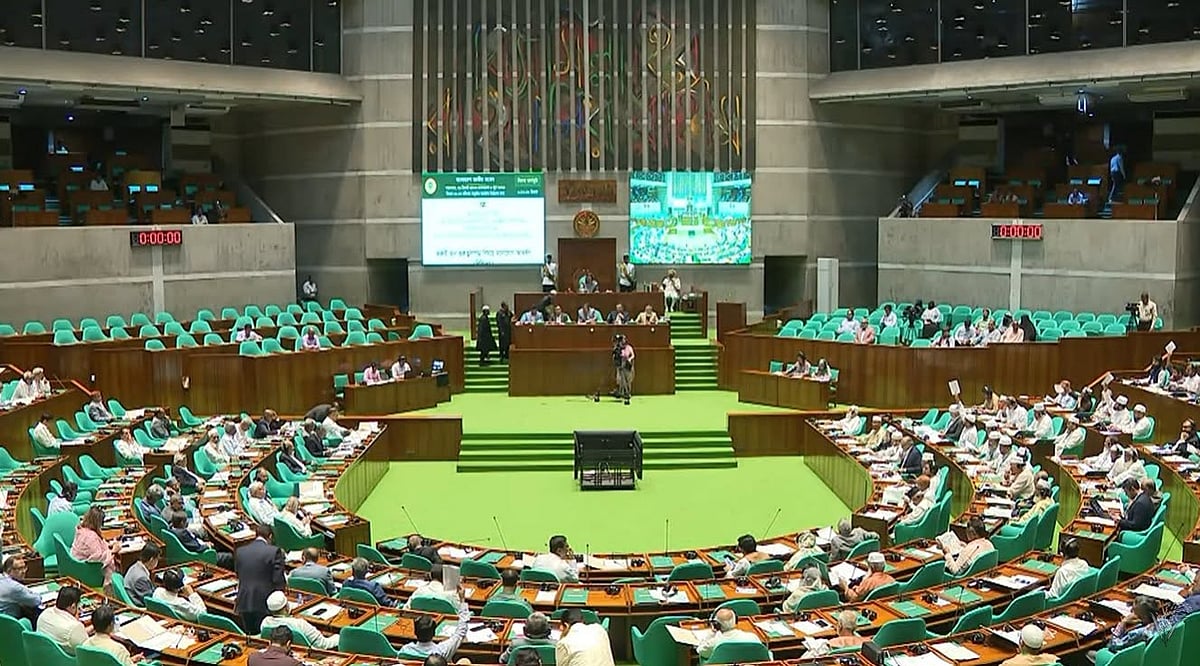
Last Monday, Parliament formed a 12-member special committee, headed by Home Minister Salahuddin Ahmed, to work on constitutional amendments. The opposition rejected the proposal and staged a walkout, after which the motion was passed without them.
The committee was originally supposed to have 17 members. The opposition was invited to nominate five representatives but declined, leaving those seats vacant. In addition to eight BNP lawmakers, the committee includes Zonayed Saki of Ganosamhati Andolon, Andaleeve Rahman Partho of the Bangladesh Jatiya Party (BJP), Nurul Haque of Gono Odhikar Parishad, and Oli Ullah of Islami Andolan Bangladesh.
However, Oli Ullah—like lawmakers from Jamaat-e-Islami and the National Citizen Party (NCP)—had already taken an oath as a member of the Constitution Reform Council.
He told Prothom Alo on Tuesday that his name had been added to the committee without his knowledge. He was not present in Parliament when it was formed and only learned about it through media reports.
Reaffirming his party’s support for implementing the July Charter and establishing the Reform Council, Oliullah said, “We cannot ignore the verdict of 70 per cent of the people. The way the government is proceeding amounts to rejecting the referendum result.”
Earlier on Monday, Opposition Leader Shafiqur Rahman told Parliament that opposition lawmakers had taken their oath not only as members of Parliament but also as members of the Constitution Reform Council in line with their commitment to implement the referendum verdict. For that reason, they rejected the proposal to form the special committee.
Later that evening, he told reporters that the will of the people is the highest law. While the government had accepted the public’s vote to form the government, he said, it was ignoring the referendum result supporting constitution reform.
He urged the government to honour both the July Charter and the referendum verdict, warning that otherwise the opposition would continue its street protests.
Presenting the government’s position, Home Minister Salahuddin Ahmed argued that the Constitution must first be amended. Once political consensus is reached and provisions for a Constitution Reform Council are incorporated into the Constitution, further steps can be taken. He added that even implementing the referendum verdict requires constitution amendment, and that the parliamentary special committee is the proper forum for those discussions.
Earlier, on 29 April, Law Minister Asaduzzaman had proposed forming the special committee on constitutional amendment. The opposition was asked to nominate five members but declined.
Opposition Chief Whip and NCP Convener Nahid Islam told Prothom Alo that meaningful and lasting changes to the state structure are impossible without a Constitutional Reform Council.
He argued that by refusing to move in that direction, the BNP had pushed the country toward a serious political and constitutional crisis. He called on the government to immediately establish the Reform Council in accordance with the referendum, in which nearly 70 per cent of voters supported the proposal.
Pressure Inside Parliament and on the Streets
Opposition leaders say their resistance will not be limited to Parliament. Alongside continuing to oppose the special committee in the legislature, they plan to intensify protests and political activities across the country.
Jamaat-e-Islami lawmaker and Opposition Whip Rafiqul Islam Khan told Prothom Alo that after the referendum, forming the Constitutional Reform Council had become a national commitment.
However, he said, the government had backed away from that commitment. As a result, the opposition would continue raising the issue in Parliament while organizing grassroots movements demanding implementation of the July Charter and the referendum verdict.
Another Jamaat lawmaker, Saiful Alam Khan, questioned why a special committee was needed this time when previous constitutional amendments had not required one. He noted that several earlier amendments had later been struck down by the courts. For that reason, the opposition had supported forming a Reform Council to bring about fundamental constitutional change, but the government chose another path.
The Bangladesh State Reform Movement also criticized the government’s decision to form a special committee instead of a Constitutional Reform Council. In a statement issued yesterday, the party said the July mass uprising and the referendum had given the government a clear mandate for fundamental constitutional reform. Ignoring that verdict, it argued, sets a new example of political deception.
Two Competing Approaches
Under the current Constitution, Parliament can amend the Constitution with a two-thirds majority vote. The government intends to follow that constitutional process by introducing an amendment bill based on the recommendations of the special committee.
However, the July National Charter Implementation Order states that a Constitution Reform Council made up of elected representatives should be established to implement the Constitution-related proposals.
The opposition alliance, including Jamaat-e-Islami and the NCP, wants the Constitution-related provisions of the July Charter to be implemented in full through the Constitution Reform Council. They argue that this is not merely a constitution amendment but a broader constitutional reform process.