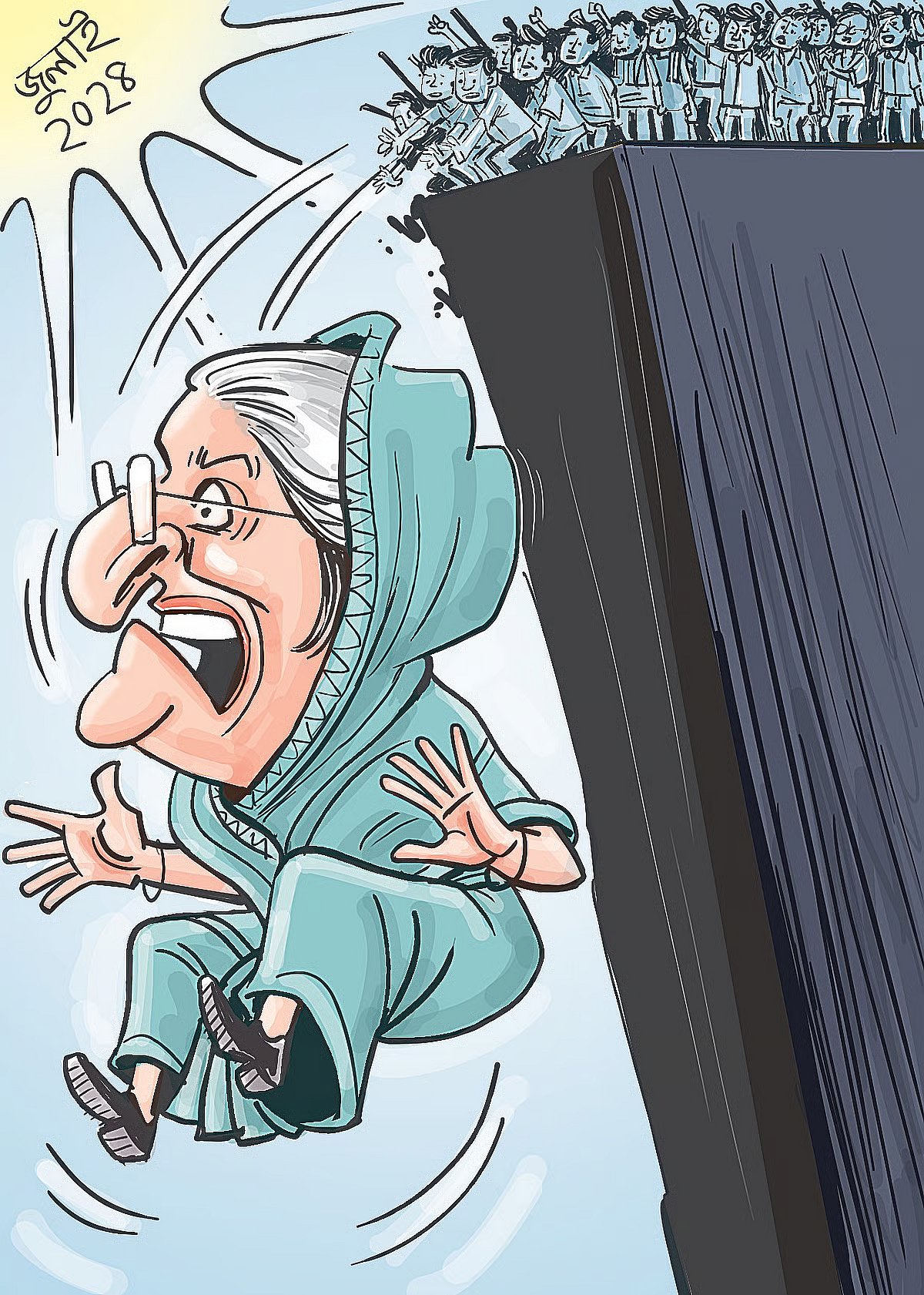
Sheikh Hasina was forced to relinquish power and flee the country on 5 August, 2024 in the face of a nationwide student-led mass uprising centered in Dhaka. However, the decision to leave was not made at a single moment. In the days leading up to her departure, the situation within the state apparatus changed rapidly. The positions of the security forces, internal discussions within the Awami League, and the military leadership's final assessment of the situation all contributed to decisions that shifted by the hour.
On 3 August, 2024, Army Chief General Waker-Uz-Zaman met with army officers at Army Headquarters. It was there that the army's position became clear. Even so, a series of meetings continued at the Ganabhaban, the prime minister's official residence, until late on 4 August. At the same time, discussions continued over possible resignation, the declaration of a state of emergency, and various strategies to suppress the movement. But with each passing hour, the situation on the streets slipped further beyond the government's control. Ultimately, on the morning of 5 August, following messages from military officials, a realistic assessment of the capabilities of the law enforcement agencies, and the influx of protesters heading toward Dhaka, Sheikh Hasina left the country.
Interviews with multiple sources familiar with the developments have provided a picture of the discussions that took place among the Ganabhaban, Army Headquarters, and various security agencies, how key decisions changed, and how the path was ultimately paved for Sheikh Hasina's departure.
The student movement had gathered momentum peacefully from 1 July, 2024. However, the government's use of force, indiscriminate gunfire, and killings of protesters made the situation increasingly volatile. People from all walks of life gradually joined the movement. Against this backdrop, Army Chief General Waker-Uz-Zaman convened the meeting of senior officers on 3 August. According to the sources, it was after that meeting that Sheikh Hasina's grip on power began to weaken. The events of the following two days would determine the manner of her departure.
According to people familiar with the meeting, army officers made it clear that they would not fire on civilians. They argued that the army's weapons were too lethal to be used against the public. The army's armored personnel carriers (APCs) are equipped with 14.5 mm ammunition, and a single round could kill five to seven people.
At the same time, ordinary citizens, both on the streets and on social media, were calling on the military to intervene in the national crisis. Retired military officers also joined the movement in solidarity. In that context, the army decided it would not stand against the people.
Sources also said the military leadership realised on the night of 4 August that Sheikh Hasina's government could no longer survive. Even then, she made one final attempt to remain in power. Meetings continued late into the night at the Ganabhaban, attended by cabinet ministers, ruling party leaders, and senior law enforcement officials. Participants offered various suggestions on how to suppress the movement.
Multiple sources close to the Ganabhaban said Sheikh Hasina did not clearly indicate what she intended to do after resigning, nor did the army chief discuss the matter with her in detail. Before and after the army chief's visit, Sheikh Hasina held telephone conversations with various levels of the Indian government.
According to multiple sources, Army Chief General Waker-Uz-Zaman spoke privately with Sheikh Hasina later that night in the presence of her younger sister, Sheikh Rehana. His message, according to the sources, was essentially: "Sir, you have no time left." He also advised her to engage with political parties in search of a political solution.
The following morning, 5 August, Sheikh Hasina summoned the army chief again at around 10 am. A source familiar with the meeting said that when he arrived at the Ganabhaban, she appeared dejected and was holding a handwritten resignation letter. After learning of her decision to resign, the army chief returned to Army Headquarters. Concerned that the government's collapse could trigger widespread disorder, he initiated discussions with political party leaders.
A source close to Army Headquarters said that at dawn on 5 August, the army chief instructed then Director General of the Directorate General of Forces Intelligence (DGFI), Hamidul Haque, to contact political parties and invite their leaders to a meeting at Army Headquarters that morning. Although the meeting involving all political leaders did not begin until after noon.
Sheikh Hasina decides to leave the country
Multiple sources close to the Ganabhaban said Sheikh Hasina did not clearly indicate what she intended to do after resigning, nor did the army chief discuss the matter with her in detail. Before and after the army chief's visit, Sheikh Hasina held telephone conversations with various levels of the Indian government.
On 6 August, 2024, Indian External Affairs Minister S Jaishankar told the Rajya Sabha that Sheikh Hasina had requested permission to enter India at very short notice on a temporary basis. He also said India had received a request from the Bangladeshi authorities for overflight clearance for the aircraft carrying her. His remarks were reported the same day by Indian newspapers, including The Indian Express and The Times of India.
According to a senior source familiar with the matter, Army Chief Waker-Uz-Zaman left the Ganabhaban on the afternoon of 5 August and was meeting political leaders at the cantonment when then DGFI chief Major General Hamidul Haque informed him that Sheikh Hasina was leaving the country. At that point, the aircraft carrying her was already on the runway. The army chief attempted to call her, but the conversation could not take place. The aircraft then took off for India.
Awami League leaders familiar with the events believe that had Sheikh Hasina remained in Bangladesh, she could have been attacked by angry protesters. They also said she did not consider staying inside the military cantonment to be safe.
The aircraft landed at the Indian Air Force's Hindon Air Base near Ghaziabad, outside New Delhi, at 5:36 pm local time. Indian media reported at the time that India's National Security Adviser Ajit Doval received Sheikh Hasina upon her arrival.
Sources said that from the morning of 5 August, waves of protesters from Uttara, Jatrabari, and Savar began marching toward Dhaka, with the Ganabhaban as their destination. Preparations for Sheikh Hasina's departure began that morning. She hurriedly gathered her personal belongings, leaving so quickly that she was unable even to eat the meal that had already been prepared.
At around 2:25 pm, Sheikh Hasina and her younger sister Sheikh Rehana boarded a Bangladesh Air Force helicopter from the former Dhaka International Trade Fair grounds behind the Ganabhaban. The helicopter flew them to the Air Force base at Kurmitola. After arriving there, Sheikh Hasina waited in the lounge for more than an hour while an Air Force C-130 transport aircraft was prepared. Images and videos showing her walking from the helicopter to the lounge later circulated widely on social media.
Shortly after 3 pm, the C-130 carrying Sheikh Hasina took off. Accompanying her were Sheikh Rehana and her defense adviser Tarique Ahmed Siddique. Her military secretary also traveled with her but later returned to Bangladesh on the same aircraft. An unconfirmed source said Siddique's daughter and son-in-law were also on board.
The aircraft landed at the Indian Air Force's Hindon Air Base near Ghaziabad, outside New Delhi, at 5:36 pm local time. Indian media reported at the time that India's National Security Adviser Ajit Doval received Sheikh Hasina upon her arrival.
At a hearing on 25 May last year, former International Crimes Tribunal Chief Prosecutor Tajul Islam said that as the "March to Dhaka" program called by the Anti-Discrimination Student Movement drew massive processions toward the Ganabhaban from across the capital, military leaders tried to persuade Sheikh Hasina to resign through her sister, Sheikh Rehana. According to his account, Sheikh Hasina initially refused.
Senior military officials then spoke by phone with Sheikh Hasina's son, Sajeeb Wazed Joy, telling him that resignation was the only way to save his mother's life and that an immediate decision was essential. After speaking with his mother, Joy convinced her to relinquish power.
In an interview with the BBC World Service on 5 August, after Sheikh Hasina had left Bangladesh, Sajeeb Wazed Joy said his mother would not return to politics. He said she had already been considering resignation the previous day and ultimately left the country at the strong urging of her family for her own safety.
Control loosens
As the indiscriminate killing of protesters intensified during the July movement, discussions began within internal communication groups used by different batches of police officers. From 3 August onward, officers debated whether it was appropriate to continue firing directly at civilians. By the night of 3 August, many of these groups had reached the view that opening fire on people was no longer justified.
According to several Awami League leaders, the party then decided to deploy its own armed cadres to suppress the movement. On 4 August, armed supporters were mobilised in Dhaka and several other districts, where they allegedly opened indiscriminate fire on students and protesters.
Even then, the movement could not be contained. Some Awami League leaders advised Sheikh Hasina to declare a state of emergency, an option she was also considering. But despite imposing a curfew and deploying the army from 19 July onward, the situation had already spiraled beyond government control, raising doubts about whether emergency rule would make any difference.
Several Awami League leaders who were close to Sheikh Hasina and frequently present at the Ganabhaban, speaking to Prothom Alo on condition of anonymity, said she understood the severity of the crisis but was unwilling to relinquish power. As a result, every major decision came too late to have any meaningful effect.
Former Inspector General of Police (IGP) Chowdhury Abdullah Al-Mamun, who is currently imprisoned, told Bangladesh's International Crimes Tribunal in testimony about an August 4 meeting at the Ganabhaban, "We tried to provide the government with accurate information. The government was not prepared to hear about its weaknesses. While we were in that meeting, the situation deteriorated rapidly and problems emerged in various places. The meeting was eventually adjourned."
Resignation decision came too late
According to Awami League sources, former Law Minister Anisul Huq met with a diplomat from an influential Western country on the afternoon of 4 August. During the meeting, they discussed the possibility of Sheikh Hasina's resignation and the formation of an interim government, concluding that such a move could help resolve the crisis.
Later, former Prime Minister's adviser Salman F Rahman and former Education Minister Mohibul Hassan Chowdhoury met at Anisul Huq's residence in Gulshan. After evening prayers, they headed to the Ganabhaban. Before leaving, Anisul Huq phoned Sheikh Hasina to brief her on his discussion with the foreign diplomat, saying he would explain the rest in person.
According to the sources, their proposal was that Sheikh Hasina would resign, then-Speaker Shirin Sharmin Chaudhury would assume constitutional responsibility, form a national government through consultations with all political parties, and oversee a transfer of power through elections.
When Anisul Huq and the others arrived at the Ganabhaban, they learned that Sheikh Hasina was upstairs, where access was restricted. Sheikh Rehana and Speaker Shirin Sharmin Chaudhury were accompanying her.
Waiting downstairs to speak with her were then Local Government Minister Tajul Islam, State Minister for Cultural Affairs Nahid Izhar Khan, State Minister for Information Mohammad A Arafat, and several others. Later, Awami League leaders Jahangir Kabir Nanak, AFM Bahauddin Nasim, Biplab Barua, and others also arrived from the party's Dhanmondi office.
Sources said Sheikh Hasina came downstairs at around 8:00 pm. She told those present that a nationwide "lockdown" would begin on 5 August and that no one would be allowed to leave their homes. She also instructed that party cadres who had taken to the streets with weapons on 4 August would not need to do so again.
She then called the Cabinet Secretary and instructed him to invite the Home Minister and the chiefs of the various security forces to another meeting at the Ganabhaban.
In his tribunal testimony, former IGP Abdullah Al-Mamun said the second meeting began around 10:00 pm. According to his account, Sheikh Hasina, Sheikh Rehana, then Home Minister Asaduzzaman Khan Kamal, Law Minister Anisul Huq, the chiefs of the three armed services, the director general of the Rapid Action Battalion (RAB), the IGP, and Lieutenant General Mujibur Rahman—then Quartermaster General and considered one of Sheikh Hasina's closest military associates—were present.
The discussion focused on how to suppress the protests and mass gathering planned for 5 August.
Al-Mamun testified, "After the meeting at the Ganabhaban, we went to the army's operations control room. The chiefs of the three services, Lt. Gen. Mujib, the RAB director general, intelligence officials, Dhaka Metropolitan Police Commissioner Habibur Rahman, and I were there. We discussed troop deployments."
The meeting ended around 12:30 am, with a decision to take a hardline position throughout Dhaka and at the city's entry points.
However, according to a senior source, a high-ranking army officer told Sheikh Hasina that night that none of the plans being discussed would work because "time had run out."
Meanwhile, diplomatic sources from an influential country said that at around 2:30 am on 5 August, Anisul Huq and Salman F Rahman informed a Western diplomat that Sheikh Hasina had decided to resign and would do so the following day.
Ministers and leaders left in disarray
According to later accounts from Awami League leaders, most ministers and senior party figures believed—based on Sheikh Hasina's various messages on 4 and 5 August —that the government would either impose emergency rule or restore order through force. Those who regularly visited the Ganabhaban remained uncertain. At times they believed Sheikh Hasina would resign to avert the crisis; moments later they thought the government would regain control through force.
However, after Sheikh Hasina fled the country on the afternoon of 5 August, most cabinet members, lawmakers, and Awami League leaders were left bewildered. One state minister, who had stayed awake all night, was still asleep at home until noon and left only after repeated calls from close associates. Another senior minister narrowly avoided encountering crowds of protesters near Matsya Bhaban. A different minister remained at his private residence until late afternoon, calling confidants to express his sense of helplessness.
One member of parliament fled from the NAM Building on Manik Mia Avenue with his wife and two daughters, wearing masks as they blended into the crowds in search of safety.
Multiple sources familiar with events inside the Ganabhaban said that just before Sheikh Hasina departed, Sheikh Rehana telephoned Salman F Rahman and several others, urging them to seek safe shelter. Awami League Office Secretary Biplab Barua also called numerous party leaders, advising them to move to secure locations. Awami League General Secretary Obaidul Quader was at his official residence near the parliament complex. After receiving Barua's call, he hurriedly took refuge at the nearby home of an engineer.
Speaker Shirin Sharmin Chaudhury remained in her office inside the parliament building. When protesters entered the parliamentary complex, she, then State Minister Junayed Ahmed Palak, and Whip Iqbalur Rahim hid in a room before being evacuated under army protection late that night.
A senior Awami League leader, speaking anonymously to Prothom Alo, said he had received reports at dawn indicating that the situation across Dhaka and the rest of the country remained under control. But as the day progressed, conditions deteriorated rapidly. Local Awami League leaders in Gazipur and later Savar called to report that waves of protesters were pouring into Dhaka. By midday, close associates urged him to leave his home. Once inside his car, he saw enormous crowds filling the streets.
Ultimately, Sheikh Hasina's removal from power and departure from Bangladesh were not the result of a single day's mass protest. They reflected years of political isolation, a lack of engagement with the opposition, excessive reliance on state coercive power, and a delayed recognition of the scale of the crisis.
The events between 3 and 5 August show that while the situation on the streets changed rapidly, decisions at the center of power—the Ganabhaban—shifted repeatedly. Plans ranged from violently suppressing the protests, to declaring a state of emergency, to considering resignation. Until the final hours, Sheikh Hasina was unable to settle on a single course of action.
Once the military made clear that it would not use lethal force against civilians, the government was left with few viable options. Yet the delay in making a final decision to resign allowed the situation to deteriorate even further.
When Sheikh Hasina's sudden departure was not communicated in advance, many ministers, members of parliament, and Awami League leaders were left bewildered. Some went into hiding, while others rushed at the last moment in search of safe refuge.