Jamaat moves closer to ‘admitting mistake’ on 1971
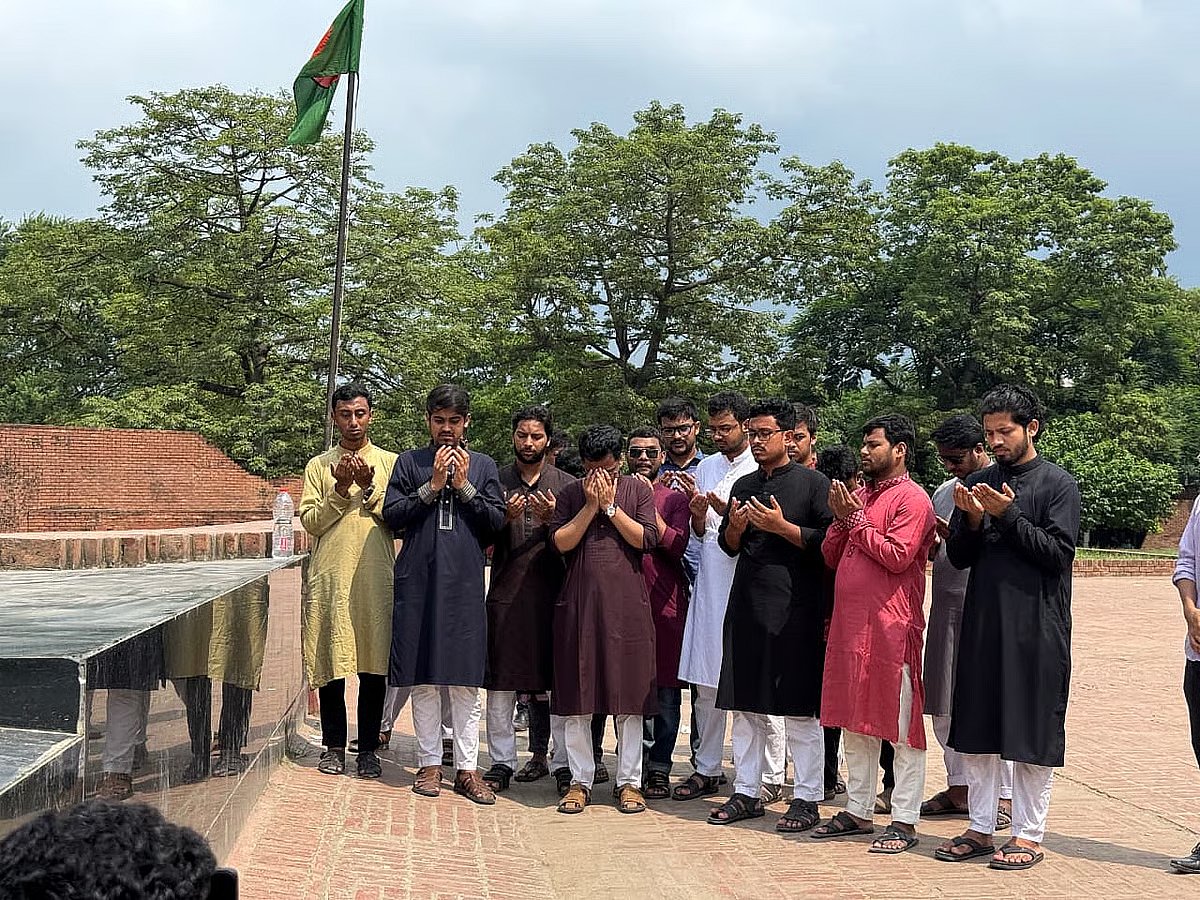
Following the decisions of Bangladesh Jamaat-e-Islami, the leaders of Islami Chhatra Shibir, who won in the DUCSU (Dhaka University Central Students’ Union) elections, offered prayers at the Martyred Intellectuals’ Memorial in the capital’s Rayerbazar on Thursday morning.
Islami Chhatra Shibir is the student wing of Bangladesh Jamaat-e-Islami.
It was the first time since the Liberation War of 1971 that any Jamaat-affiliated organisation had visited the memorial.
Analysts consider this as a sign of a possible shift in the party’s long-standing stance on its role against the Liberation War in 1971.
Sources suggest that there could be many more similar initiatives in the future, something the Jamaat-e-Islami has so far avoided.
According to a senior Jamaat source, the leadership is now paying more attention than ever to the ongoing debate over whether the party should acknowledge its “mistake” in opposing the Liberation War and formally seek apology.
Multiple high-level sources have indicated that there could be a positive decision soon. However, the top leadership and the party’s highest decision-making body, the Majlish-e-Shura, are weighing the timing and favourable political environment before taking such a step.
Earlier, the party’s two former assistant secretaries-general, Muhammad Kamaruzzaman and Barrister Abdur Razzaq, had both called for Jamaat to apologise for opposing the Liberation War. Abdur Razzaq even resigned in protest over the party’s inaction and died recently in London, while Kamaruzzaman was executed for crimes against humanity committed in 1971.
From the Dhaka central jail, he had written a lengthy letter to the then Jamaat Ameer, advising him to introduce reforms in the party.
We recognise and honour the contributions of those who fought in the Liberation War and for the building of Bangladesh. We are grateful for their sacrifices. That is why the victorious student leaders of DUCSU paid their respects through prayer at the memorial.Syed Abdullah Mohammad Taher, Jamaat’s Nayeb-e-Ameer
It has been learned that the issue of apology has been discussed in multiple meetings of the Majlish-e-Shura, but no decision was reached due to internal disagreements.
Wishing not to be named, a senior Jamaat leader told Prothom Alo, “We are considering an expression of regret. Positive discussions are taking place within the party.”
Abdur Razzaq’s resignation
In 2019, Abdur Razzaq resigned in frustration after failing to secure support for reforms, particularly an official apology for Jamaat’s role during the country’s Liberation War in 1971.
In his resignation letter, he wrote, “I had often thought of resigning in the past, but refrained in the hope that I might bring about internal reform and that Jamaat would apologise to the nation for its role in 1971. That would have been a historic achievement. But the party’s latest steps in January (2019) left me disheartened.”
In his resignation letter, Abdur Razzaq mentioned that following the 30 December 2018 general election, the party sought his advice on the next course of action. He advised the party to accept responsibility for its wartime actions, apologise, dissolve the name Jamaat, and re-emerge under a new name.
In response to growing demands from younger leaders, following the 30 December 2018 parliamentary election, Jamaat’s executive committee even took a policy decision to apologise for its mistakes in 1971 and rebrand the party for social service. However, the proposal was not approved by the Majlish-e-Shura.
Following this, Abdur Razzaq formally resigned from his post of assistant secretary general via email from London on 15 February 2019. He passed away on 4 May this year.
Kamaruzzaman’s letter
In November 2010, Muhammad Kamaruzzaman, then in prison, wrote a letter titled “Adopting new strategies in a changed context: The call of the time”.
In the letter, he analysed the 60 years struggle of Jamaat-e-Islami and urged leaders accused of war crimes to step aside and hand over control to a new generation.
Kamaruzzaman warned that Jamaat faced a “very fragile” situation and a “severe challenge”. Among three alternative paths he outlined, the third was like this: “Those of us facing allegations of war crimes should relinquish leadership and hand over the party to entirely new people, thus creating a new generation of Jamaat.”
Kamaruzzaman was arrested on 13 July 2010, sentenced to death by the International Crimes Tribunal on 9 May 2013, and executed on 11 April 2015.
In May 2020, frustrated by Jamaat’s refusal to apologise or adopt realistic reforms, Majlish-e-Shura member Mojibur Rahman Monju launched the Amar Bangladesh Party (AB Party).
Signs of shifting from previous stance
Conversations with Jamaat leaders from various levels suggest that the rethink is not limited to the 1971 question. The party has also decided to relax other long-held policies. For instance, previously only ‘rukon’ (oath-bound members) could be nominated for parliamentary elections. In the next parliamentary elections, Jamaat plans to nominate candidates who meet ethical standards, even if they are not rukon, including individuals from religious minorities.
One senior leader remarked that the party is steadily moving through a reform process.
The leader cited recent changes in the DUCSU elections, where Chhatra Shibir achieved a sweeping victory. Traditionally, Islami Chhatri Sangstha (the female students’ wing) and Islami Chhatra Shibir operated in separate spheres, with limited interaction for religious and moral reasons. Jamaat’s female wing oversees the activities of Islami Chhatri Sangstha.
The leader said, this time, however, women leaders were allowed to coordinate with Chhatra Shibir candidates for campaign purposes—a concession granted at the request of Abu Shadik Kayem (elected VP) and SM Farhad (elected GS), who assured the amir of strict adherence to religious guidelines.
On 11 September, the morning after the DUCSU results, the victorious alliance led by Shadik Kayem visited the Martyred Intellectuals’ Memorial at Rayerbazar to pray for those who were killed in 1971, the martyrs of the July Uprising, and Nawab Salimullah, a key founder of Dhaka University.
Shadik Kayem told newspersons, “We have prayed for the martyrs of the 1971 Liberation War, visited the mass grave of the July martyrs, and paid respects at the grave of Nawab Salimullah. Our freedom today exists because of the sacrifice of the martyrs, and remembering them is our first duty.”
We recognise and honour the contributions of those who fought in the Liberation War and for the building of Bangladesh. We are grateful for their sacrificesSyed Abdullah Mohammad Taher, Nayeb-e-Ameer, Jamaat e Islami
Since Islami Chhatra Shibir’s founding in 1977, this was its first-ever visit to Rayerbazar.
Asked about the decision, Jamaat’s Nayeb-e-Ameer, Syed Abdullah Mohammad Taher, confirmed, “Yes, we did this deliberately.”
He further said, “We recognise and honour the contributions of those who fought in the Liberation War and for the building of Bangladesh. We are grateful for their sacrifices. That is why the victorious student leaders of DUCSU paid their respects through prayer at the memorial.”