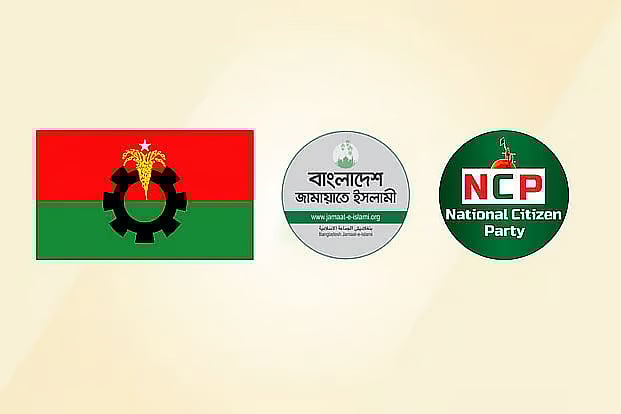
Although the political parties are in consensus about reinstating the election-time caretaker government system, they have differing views over what the framework of such a caretaker government should be.
BNP, Jamaat-e-Islam and National Citizen Party (NCP) have submitted their proposals in this regard to the National Consensus Commission, differing particularly on the process of appointing the chief advisor to the caretaker government.
The Constitution Reform Commission had proposed appointing the chief advisor of the caretaker government through a National Constitutional Council (NCC).
However, following discussions between the commission and political parties, the proposal for NCC was dropped by consensus. As a result, the commission's recommendation outlining the structure of the caretaker government was also dropped.
The consensus commission on Thursday came up with a new proposal regarding the framework for a caretaker government.
However, no consensus has been reached in this regard. Last Sunday, BNP put forward a proposal during discussions with the consensus commission.
The following day, on Monday, Jamaat submitted a separate proposal to the commission.
NCP had submitted its proposal back in May. These proposals may be discussed in the consensus commission’s upcoming meeting with political parties next week.
BNP's proposal
On Sunday BNP proposed a caretaker government framework. The proposal puts forward five alternatives regarding the process to appoint the chief advisor.
1. The president shall, as far as possible, appoint the chief advisor from among persons eligible for the post, in consultation with the parties represented in parliament.
2. If such an appointment is not possible, a committee shall be formed comprising the prime minister, the leader of the opposition, the speaker of the lower house, and the deputy speaker. The president shall chair the committee but shall not have voting rights.
3. If this too proves unworkable, a representative from the third-largest party in parliament shall be added to the committee. In this case, the president shall have voting rights.
4. If a decision still cannot be reached, the committee shall include the prime minister, the leader of the opposition, the speaker of the lower house, and one representative from each of the opposition parties (excluding the main opposition party) that received at least 5 per cent of the vote. Here too, the president shall have voting rights.
5. As a fifth option, the caretaker government system as outlined in the Thirteenth Amendment can be reinstated. All parties have already agreed that the president should not be part of this arrangement.
However, as a last resort, the possibility of involving the president may be considered.
Jamaat's proposal
Jamaat-e-Islami has come up with several propose frameworks. They say, the caretaker government will complete the national parliamentary and local government elections within 120 days. If that is not possible for any reason, the term may be extended by another 60 days.
The formation of a nonpartisan caretaker government must be finalised within 24 to 48 hours if parliament is dissolved for any reason other than the natural end of its term, or between 15 and 30 days before the expiry of the term.
In case of the natural expiry of parliament’s term, the first proposal for appointing the chief advisor states that a selection committee will be formed comprising the chief justice, the prime minister, and the leader of the opposition. The chief justice will chair the committee.
The committee must hold its meeting within three days of being formed. For the appointment of the chief advisor, the ruling party/alliance may propose five nonpartisan candidates, the main opposition party/alliance may propose five, and other opposition parties represented in parliament may each propose two candidates.
The committee will then select one candidate through internal discussion and recommend that individual to the president for appointment as chief adviser.
The second proposal states that between 15 and 30 days before the end of parliament’s term, a parliamentary committee will be formed under the supervision of the speaker and managed by the parliament secretariat.
This committee will include the prime minister/leader of the house/leader of the parliamentary party of the ruling party, the leader of the opposition, the speaker of parliament, the deputy speaker from the opposition, the deputy leader of the house, the chief whip of the ruling party, the deputy leader of the opposition, the chief whip of the opposition, and two representatives from each of the other opposition parties in parliament. The committee will select one individual as chief advisor through internal discussions.
If it is not possible to finalise a person as chief adviser through this method, then after three days have passed, the ruling party/alliance in parliament will propose five nonpartisan candidates, the main opposition party/alliance will propose five, and the other opposition parties will propose three, a total of 13 nonpartisan individuals in all. The committee will select one among these 13 to be appointed as chief adviser.
The third proposal says if consensus cannot be reached through the first two methods, the Thirteenth Amendment to the constitution will be reinstated to form a nonpartisan caretaker government. However, the option of assigning the president the additional responsibility of chief advisor will be excluded.
The Jamaat proposal says if the parliament is dissolved before the end of its term for any reason, the caretaker government must be formed with 24 to 48 hours of its dissolution.
NCP's proposal
NCP's proposal states that at least three weeks before the dissolution of the lower house of the legislature, an 11-member all-party committee will be formed. The number of members from each parliamentary party on this committee will be determined proportionally based on the percentage of votes received. To be included in the parliamentary committee, a party must have secured at least 5 per cent of the vote.
Members of either chamber of the legislature (upper or lower house) will be considered eligible to serve on the committee. The ruling party, the main opposition party, and other opposition parties may each propose three nonpartisan candidates for the position of chief adviser of the interim/caretaker government, totaling nine nominees. The names proposed by each party must be made public.
These proposed names will be sent to the all-party parliamentary committee for final selection. The committee will finalise the name of one individual as chief adviser through an 8–3 vote. If no consensus can be reached from the proposed candidates, the upper house will elect the chief adviser through a ranked-choice voting system.