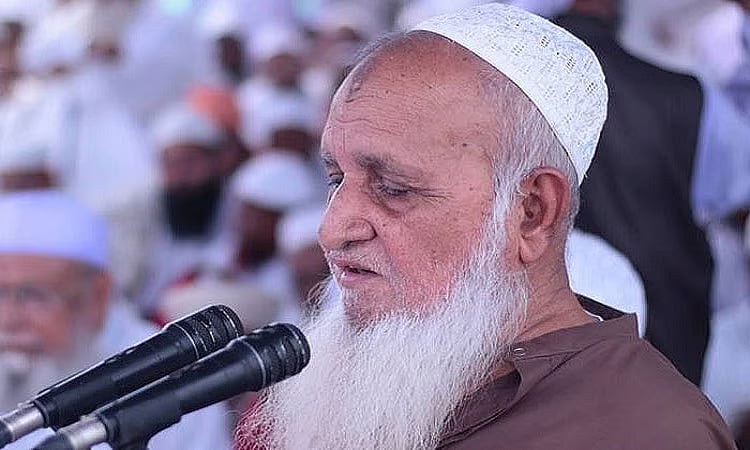
Although Hefazat-e-Islam is a non-political organisation, political efforts are underway to bring it closer ahead of the upcoming national election.
According to insiders, Jamaat-e-Islami, Islami Andolan, and several other Islamic parties are moving toward an electoral understanding.
Some of these parties are linked to Hefazat-e-Islam and are already carrying out joint programmes. Against this backdrop, the top leadership of the Qawmi madrasah-based Hefazat has become important to BNP, which has already increased its communication with Hefazat leaders. At the same time, Hefazat’s Ameer (chief) has recently made several remarks critical of Jamaat-e-Islami.
Overall, political parties are showing greater interest in Hefazat, aiming at the ‘vote bank’ tied to Qawmi madrasahs.
BNP standing committee member Salahuddin Ahmed and National Citizen Party (NCP) convener Nahid Islam met Hefazat Ameer Muhibbullah Babunagari in Dhaka last Thursday. Earlier, on 1 August, BNP leaders Salahuddin Ahmed and Nazrul Islam Khan also met him in Chattogram.
Meanwhile, among the seven parties that recently began joint programmes demanding the full implementation of the July Charter and elections under proportional representation (PR), five are Qawmi madrasah-based groups. These are Islami Andolan (Syed Muhammad Rezaul Karim), Bangladesh Khelafat Majlis (Mamunul Haque), Khelafat Majlis (Abdul Baset-Kader), Bangladesh Khelafat Andolan (Habibullah Miaji), and Nizam e Islam Party (Sarwar Kamal–Musa bin Izhar). Except for Islami Andolan, the other four have links with Hefazat.
Sources say Hefazat Ameer Muhibbullah Babunagari does not want Qawmi madrasah-based groups to join any electoral alliance with Jamaat. Since the beginning, he has opposed Jamaat on ideological grounds, rejecting the doctrines of its founder Syed Abul A’la Maududi.
In recent months, Babunagari has repeatedly spoken against Jamaat. In July, at an event, he said Jamaat is not a “true Islamic party,” claiming it seeks to establish Maududi’s version of Islam rather than the Islam of Medina. He warned that following Maududi’s ideology would jeopardise faith itself.
Most recently, last Thursday—the same day Jamaat and six other parties held joint rallies—Babunagari addressed the National Ulama-Mashayekh Conference 2025 at the Institution of Engineers, Dhaka. There he opposed alliances with Jamaat, telling Islamic parties that they must not unite in the upcoming election with groups whose “flawed beliefs” had long been warned against by respected Islamic scholars of the past.
Insiders say Babunagari’s position is currently favorable for BNP, especially as five Qawmi madrasah-based parties have just launched joint programmes alongside Jamaat.
However, Jamaat Secretary General Mia Golam Parwar dismissed Babunagari’s remarks as his personal opinion, not Hefazat’s official stance. Speaking to Prothom Alo, he said, “The Ameer of Hefazat is a respected and learned scholar. We honor him. The entire Islamic ummah sincerely wants unity among Islamic parties. He cannot say things that might damage that unity. Such statements are not expected from a true believer.”
Even within Hefazat, Babunagari’s continued anti-Jamaat remarks have sparked mixed reactions. Some question whether the leader of a non-political, religion-based organisation should openly attack a political party or oppose election alliances. Still, as a senior scholar and a highly respected figure among Qawmi madrasah teachers and students, no one has publicly challenged him.
A Nayeb e Ameer of a Qawmi madrasah-based party, speaking on condition of anonymity, said, “There are both supportive and opposing views about the Ameer’s statements. But as he is an elder, no one will publicly react.”
A leader from another Islamist party recalled that Babunagari was once an adviser to the Islami Oikya Jote under the late Mufti Fazlul Haque Amini. After Amini’s death, he was made a senior vice-chairman of the party in its 2016 council, when Islami Oikya Jote was a BNP-led four-party alliance partner that included Jamaat. At that time, Babunagari never spoke against Jamaat.
In 2016, Islami Oikya Jote left the BNP alliance. Under Amini’s son Abul Hasanat Amini, the party moved closer to the Awami League government. After the political change of 5 August, Hasanat Amini and others went into hiding. Now, Mufti Amini’s son-in-law, Sakhawat Hossain Raji, is trying to reorganise the party under his own name and register it officially, leading to conflict with Hasanat Amini.
The Ameer of Hefazat does not do politics. He is a renowned scholar and elder. I only met him to seek his prayers—nothing moreSalahuddin Ahmed, Standing Committee member of BNP
Some Islamist leaders say BNP is trying to use Hefazat ahead of the election, which explains why its leaders are frequently meeting Babunagari.
BNP leader Salahuddin Ahmed, however, told Prothom Alo last Saturday, “The Ameer of Hefazat does not do politics. He is a renowned scholar and elder. I only met him to seek his prayers—nothing more.”
Among Hefazat-linked parties, Jamiat-e-Ulama-e-Islam, Nizam e Islam Party, and a small faction of Islami Oikya Jote are aligned with BNP. Of these, Jamiat is the oldest political party and holds influence within Hefazat. Several of its leaders are holding occupy key posts in Hefazat, and some are seeking BNP nominations to contest the election.
Hefazat has a policy of not taking sides in political matters. But now it seems they have taken a sideGazi Ataur Rahman, senior joint secretary-general of Islami Andolan
On the other hand, leaders of Bangladesh Khelafat Majlis, Khelafat Majlis, Bangladesh Khelafat Andolan, and Nizam e Islam Party—who are currently allied with Jamaat in joint movements—also hold significant posts in Hefazat. Although Islami Andolan, led by the Charmonai Pir, is Qawmi madrasah-based, it has never been part of Hefazat.
Gazi Ataur Rahman, senior joint secretary-general of Islami Andolan, told Prothom Alo, “Hefazat has a policy of not taking sides in political matters. But now it seems they have taken a side. Given the backdrop of corruption, hooliganism, and terrorism in politics, unity among Islamic forces is the people’s expectation. Striking against that unity will not yield good results.”
Political analysts believe BNP is trying to increase its closeness with Hefazat to influence the Islamist vote bank. But if this creates major internal disagreements within Hefazat, the organisation’s position may become even more complicated.