13th parliamentary election
Islamist votes divided into three boxes
Islami Andolan Bangladesh has finally announced that it will contest the election independently. The party will contest in 268 constituencies where nomination papers have been submitted. In the remaining 32 seats, it will support candidates from parties of its choice. In effect, Islami Andolan will be involved in voting across all 300 seats.
People concerned say that this marks the failure of efforts to bring Islamist votes into “one box.” Islamist votes are now clearly divided into “three boxes.” How and to what extent this will affect the electoral field remains to be seen.
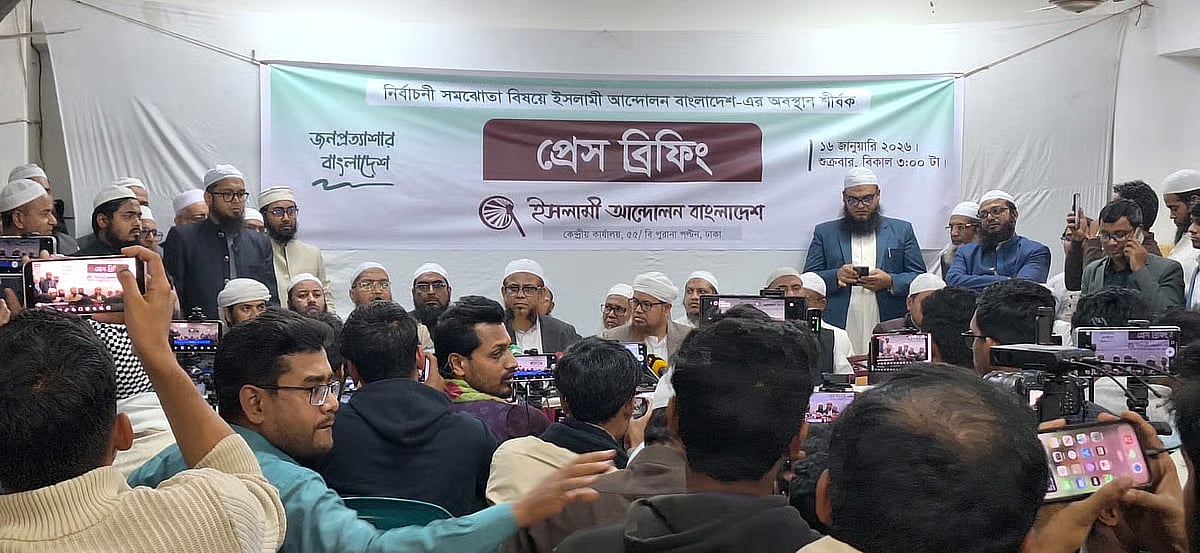
Islami Andolan held a press conference yesterday, Friday afternoon, at its central office in Purana Paltan in the capital, announcing its decision to contest independently. The party alleged that it had been ignored and disrespected by Jamaat-e-Islami.
The previous day, Thursday, top leaders of 10 parties under the leadership of Jamaat-e-Islami formally announced at a press conference that seat-sharing arrangements had been finalised in 253 parliamentary constituencies. They had kept 47 seats vacant for Islami Andolan. As the understanding failed, candidates will now be fielded in those seats.
Political analysts believe that Islami Andolan’s withdrawal from the “11-party electoral alliance” has effectively split Islamist politics into three distinct streams. On one side is the Jamaat-e-Islami–led “10-party electoral alliance,” which includes five Islamist parties.
On another side, Islami Andolan led by the Charmonai Pir has announced it will contest alone. The third stream consists of three Islamist parties—one registered and two unregistered—that are part of the electoral understanding under the BNP-led simultaneous movement.
People concerned say this division ahead of the election is not merely strategic; rather, it has once again brought to the surface long-standing crises of ideology, leadership, and mutual distrust.
Breakup over seat calculations
In effect, the split between Islami Andolan and the Jamaat-led 11-party electoral alliance occurred over seat-sharing calculations. From the outset, there was a competitive mindset between Jamaat and Islami Andolan regarding seat allocation. Islami Andolan aimed for 70–80 seats, while Jamaat sought to limit it to 30–35 seats—this was a decision of Jamaat’s central executive council.
Eventually, Jamaat agreed to concede 40, later 45 seats, but Islami Andolan did not accept this. This created suspicion within Jamaat’s policy-making circles—whether this was merely a demand for seats or something else politically. Ultimately, after analysing vote calculations, Jamaat decided that proceeding with 10 parties without Islami Andolan would be comparatively more advantageous.
On the other hand, Islami Andolan also attempted to form an alternative electoral front but was ultimately unsuccessful. There were internal differences within the party over the question of unity. While a large section, including the party’s ameer, favored staying with Jamaat, a powerful faction was internally opposed to it, according to relevant sources.
At yesterday’s press conference announcing the decision to contest alone, two top leaders of Islami Andolan—Syed Muhammad Rezaul Karim and Syed Muhammad Faizul Karim—were absent. They had left Dhaka on Thursday.
The party’s senior joint secretary general and spokesperson, Gazi Ataur Rahman, addressed the press conference. In essence, he said, “The reason for not being part of Jamaat’s electoral alliance is that we have faced discrimination on questions of principle and justice. A fear has arisen that the objective would not be achieved.”
Gazi Ataur Rahman said, “We acknowledge that Jamaat-e-Islami is a major force. But ideologically and morally, Islami Andolan is not weaker than anyone. We have been ignored and disrespected by Jamaat.”
In response, the coordinator of the “11-party electoral alliance” and Jamaat’s assistant secretary general, HM Hamidur Rahman Azad, told Prothom Alo last night, “We kept chairs vacant for them, we kept seats vacant for them. What more could we have done?”
Islami Andolan spokesperson Ataur Rahman also raised allegations against Jamaat’s ameer, claiming that if in power, Jamaat would run the state under existing laws rather than establishing Shariah law, and that Jamaat intends to join a national government with the BNP. However, he did not raise these issues at the press conference on seat-sharing.
Regarding the 47 seats kept vacant, Jamaat’s publicity and media department chief, Ahsanul Mahboob Zubair, told Prothom Alo last night that the seats had been allocated for Islami Andolan through discussions in the liaison committee, not through unilateral decisions.
He said party leaders would now meet to decide the next steps, and that there had already been some discussion on how to coordinate in the remaining seats.
Fears of a staged election
Numerically, the Jamaat-led 10-party electoral alliance includes five Islamist parties. These include Bangladesh Khilafat Majlis led by Maulana Mamunul Haque, Bangladesh Khilafat Andolan founded by Hafezzi Huzur, Khelafat Majlis of Ahmad Abdul Kader, and Nizam-e-Islam Party led by Sarwar Kamal Azizi.
Those concerned believe that amid opposition from Hefazat, Jamiat, and Islami Andolan, Bangladesh Khilafat Majlis under Mamunul Haque could play a “vanguard” role for Jamaat in the electoral field. Mamunul Haque has personal influence in the Qawmi madrasa-based vote bank. His late father, Shaykhul Hadith Allama Azizul Haque, is a revered figure among Qawmi madrasa students, teachers, and scholars.
Jamaat also views the inclusion of the NCP—formed by frontline leaders of the July mass uprising—and the LDP led by freedom fighter Oli Ahmed as major achievements for this front. These two parties serve as a “banner” to counter allegations of a “fundamentalist alliance.”
At yesterday’s press conference, Gazi Ataur Rahman mentioned a meeting between Jamaat’s ameer and Tarique Rahman. He said, “Jamaat’s amir has said that after the election, they will form a national government with the BNP. Our concern is that if there is already an understanding and coordination with a rival party before the election, then will the election actually be a fair election? Will it be an election, or will it be a selection? This concern has arisen before us. We do not want to be a partner in such a situation.”
In response to a question, Gazi Ataur Rahman said that Islamist parties aligned with Jamaat could join Islami Andolan’s “one-box policy” if they wished, and that the door remained open for them.
After Islami Andolan’s press conference, Jamaat issued a response regarding some allegations. In a statement, Jamaat’s media chief Ehsanul Mahbub Zubayer said that comments made by Islami Andolan spokesperson Gazi Ataur Rahman, citing a Christian organisation leader, were incorrect and misleading.
He said the matter had already been clarified during Jamaat’s press briefing and that the remarks were intended to create public confusion.
What impact could this split have?
After Jamaat, Islami Andolan holds the strongest position among Islamist parties nationwide, with both vote strength and organisational presence. Its separation from Jamaat’s front could harm both sides, though many believe the risk is greater for Jamaat. One reason cited is that Hefazat-e-Islam Bangladesh’s top leader, Allama Muhibullah Babunagari, has long opposed Jamaat-e-Islami.
Meanwhile, in this election, three Islamist parties—including Jamiat Ulema-e-Islam Bangladesh—are in an electoral understanding with the BNP. The BNP has conceded four seats to Jamiat Ulema-e-Islam.
In addition, the unregistered Bangladesh Jamiat Ulema-e-Islam and a faction of the Islami Oikya Jote led by Abdur Rakib are part of this understanding. BNP has nominated Mufti Rashid bin Waqqas, senior joint secretary general of the unregistered Jamiat, in Jashore-5 (Monirampur), where he is contesting with the sheaf of paddy symbol.
The Islami Oikya Jote founded by the late Mufti Fazlul Haque Amini may also soon align with the BNP. Sources say its leaders met BNP chairperson Tarique Rahman while signing the condolence book after Khaleda Zia’s death, during which election issues were discussed. Although this faction had long faced a leadership crisis, following political changes on 5 August 2024, Mufti Amini’s son Abul Hasanat Amini and Mufti Faizullah have remained absent from public view.
Recently, a new leadership—Amir Maulana Abdul Qader and Secretary General Mufti Sakhawat Hossain Razi—received Election Commission recognition, but due to the late recognition, the party could field candidates in only three seats.
Islami Oikya Jote Secretary General Sakhawat Hossain told Prothom Alo, “If we are to work with the BNP, we need clear commitments or declarations on certain Islamic issues. If that happens, we are willing to work with the BNP.”
In this context, political analysts believe that the distance between Islami Andolan and Hefazat, Jamiat, and Islami Oikya Jote could further intensify anti-Jamaat sentiment in the electoral field.
The dream of bringing Islamist votes into one box has shattered, giving way to a three-way contest. Despite the split, the Jamaat-led “10-party electoral alliance” remains strategically organised. How Islami Andolan’s organisational strength and the coordination of Islamist parties aligned with the BNP will influence the electoral field is now the key question.
Islamic writer and researcher Sharif Muhammad describes the split over seat-sharing as “sowing new seeds of bitterness in Islamist politics.” He told Prothom Alo, “This last-minute division will act as a shock for all sides in electoral politics. I would call it their lack of foresight. For so long they have been forming alliances, yet they did not even draft preliminary discussions on seat-sharing.”