Screening of “Bonolota Express” halted in Brahmanbaria
Stop patronising religious fascist groups: Anu Muhammad urges govt
Professor Anu Muhammad has said that, by remaining silent or inactive, the government is effectively supporting the group that halted the screening of the film Bonolota Express in Brahmanbaria.
Addressing the government he said, “Stop continuing the practice of previous governments of nurturing criminal elements on the one hand, appeasing imperialism on the other, and patronising religious fascist groups that oppose people’s consciousness, critical thinking, and activism in pursuit of your own political interests.”
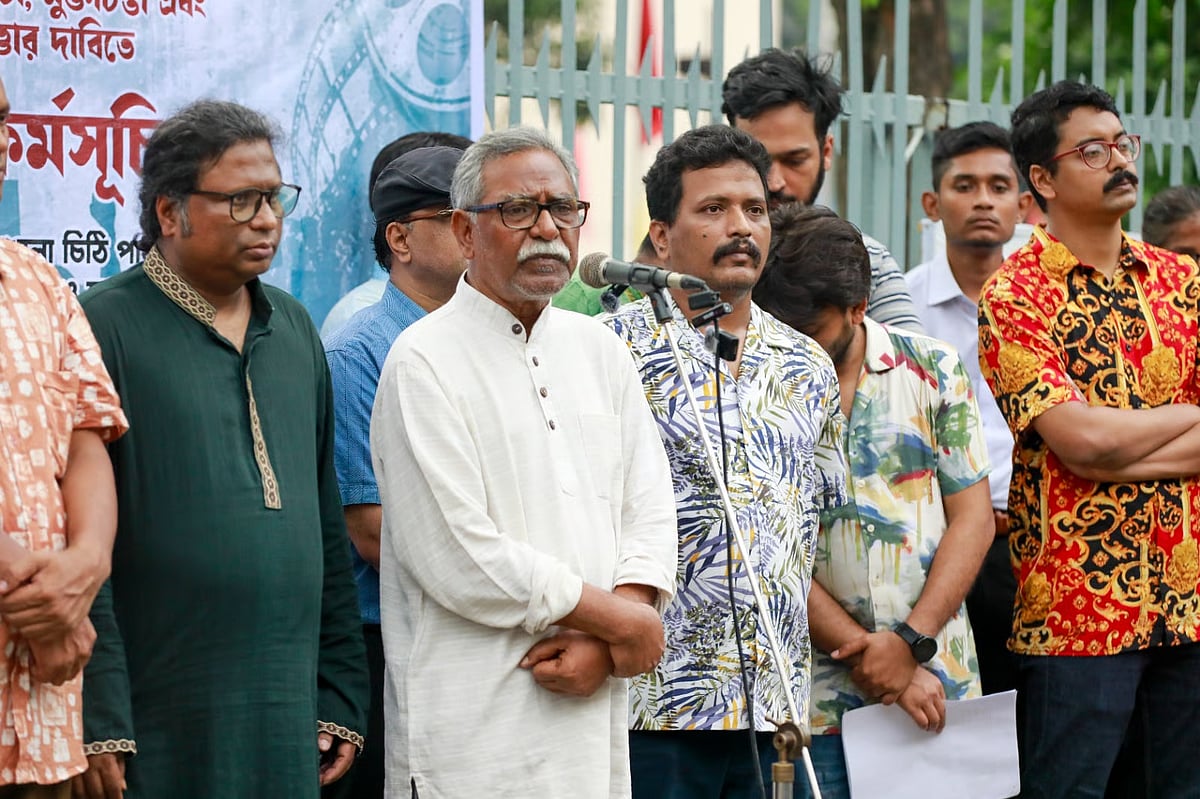
Anu Muhammad made these remarks on Friday afternoon while participating in a protest programme in front of the National Museum at Shahbagh in the capital.
Several organisations associated with the film movement organised the programme under the banner of demanding “the freedom to practise art and culture, freedom of thought, and cultural security” in response to the incident in Brahmanbaria.
Six organisations jointly arranged the protest programme: the National Film Movement, the Bangladesh Federation of Film Societies, the Asian Platform for Documentary Project Market, the Bangladesh Short Film Forum, Drishyamadhyam Samaj, and the Film Reform Roadmap.
Addressing the gathering, Professor Anu Muhammad said that whenever people face oppression in its various forms, film directors and film workers must protest not only through their films but also by taking to the streets.
He emphasised that everyone shares the same struggle and that people must resist such wrongdoers through collective action.
Anu Muhammad said, “One of the defining characteristics of a healthy society is that everyone can express their views, engage in debate and discussion, challenge opinions, and generate new ideas, new knowledge, and new forms of creativity. However, when someone faces attacks because of what they say or create, or when others threaten or attempt to suppress their creativity, that constitutes barbarism. We are witnessing signs of that barbarism in our society. The halting of the screening of Bonolota Express is one manifestation of it. Previously, people have shut down musical events, attacked shrines, targeted Baul music, and stopped various exhibitions, plays, theatre performances, poetry events, and folk music gatherings.”
Referring to the connection between these incidents, Anu Muhammad said that those responsible for the latest move to stop the screening of Bonolota Express in Brahmanbaria had cited obscenity as the reason.
He noted that a particular group had made the allegation without explaining what exactly they considered obscene.
He said, “The group making this claim regards anything that contains human creativity, innovation, or music as obscene. Yet the progress and advancement of human history have depended upon the development of creativity. Had this group been able to control humanity, such progress would never have been possible.”
Professor Anu Muhammad also commented that the government bears some responsibility for the incident in Brahmanbaria.
He said that when organisers attempted to arrange another screening elsewhere, the Deputy Commissioner (DC) reportedly stated that an “obscene film” could not be shown there.
He argued that the DC must explain and justify what form of obscenity he is responsible for preventing.
He questioned what action the official had taken to stop oppression, rape, looting, land grabbing, extortion, sexual harassment, and attacks on people within his jurisdiction.
He asked whether the DC considered those acts to be entirely decent and acceptable.
Referring to a recent interview given by the Minister for Cultural Affairs, Anu Muhammad, a member of the Democratic Rights Committee, said: “The minister said that he did not know where this incident (the stopping of Bonolota Express) had taken place. These developments are deeply concerning. Through its silence or inaction, the government is providing support to that group. The strength that the group possesses today has developed through the overt or covert support it has received from successive governments. The influence and dominance that it is displaying in Brahmanbaria today have been built up over many years.”
Discussing the group that has targeted films and other cultural activities, Professor Anu Muhammad said that the group remains silent on the widespread insecurity faced by women in homes and public spaces across Bangladesh, as well as sexual harassment, attacks, the severe insecurity experienced by children, rape and murder, and acts of occupation and plunder.
The halting of the screening of Bonolota Express is one manifestation of it. Previously, people have shut down musical events, attacked shrines, targeted Baul music, and stopped various exhibitions, plays, theatre performances, poetry events, and folk music gatherings.Professor Anu Muhammad
He continued, “On the contrary, they find shelter among the very oppressive and land-grabbing groups whose actions have left the country’s sovereignty and its people in a state of insecurity. A group has emerged that serves the interests of both domestic and foreign oppressors and dominant powers. It has no independent thinking, no capacity for reason, and no sense of sensitivity. They do not want people to engage with creative works or to exercise independent thought. They want people to listen only to them.”
The protest programme began with a musical performance by Prashanta Chakraborty, an artist associated with the choral music organisation Chorus. Speakers then addressed the gathering.
Among those who spoke were Tareq Ahmed, director of DocLab; filmmaker Akram Khan, an organiser of Drishyamadhyam Samaj; Shafiqur Rahman, organiser of the National Film Movement; Zahirul Islam Kochi, president of the Federation of Film Societies and the Short Film Forum; Bithi Ghosh, a member of Samageet; film directors Gazi Mahbub, Khandaker Suman, and Habibur Rahman; and Roman Khan, Member Secretary of the People's Cultural Council (Ganasanskriti Parishad).
The programme concluded with Manas Mehdi, representing the Film Reform Roadmap, reading aloud an open letter addressed to the Prime Minister on behalf of the organisation.