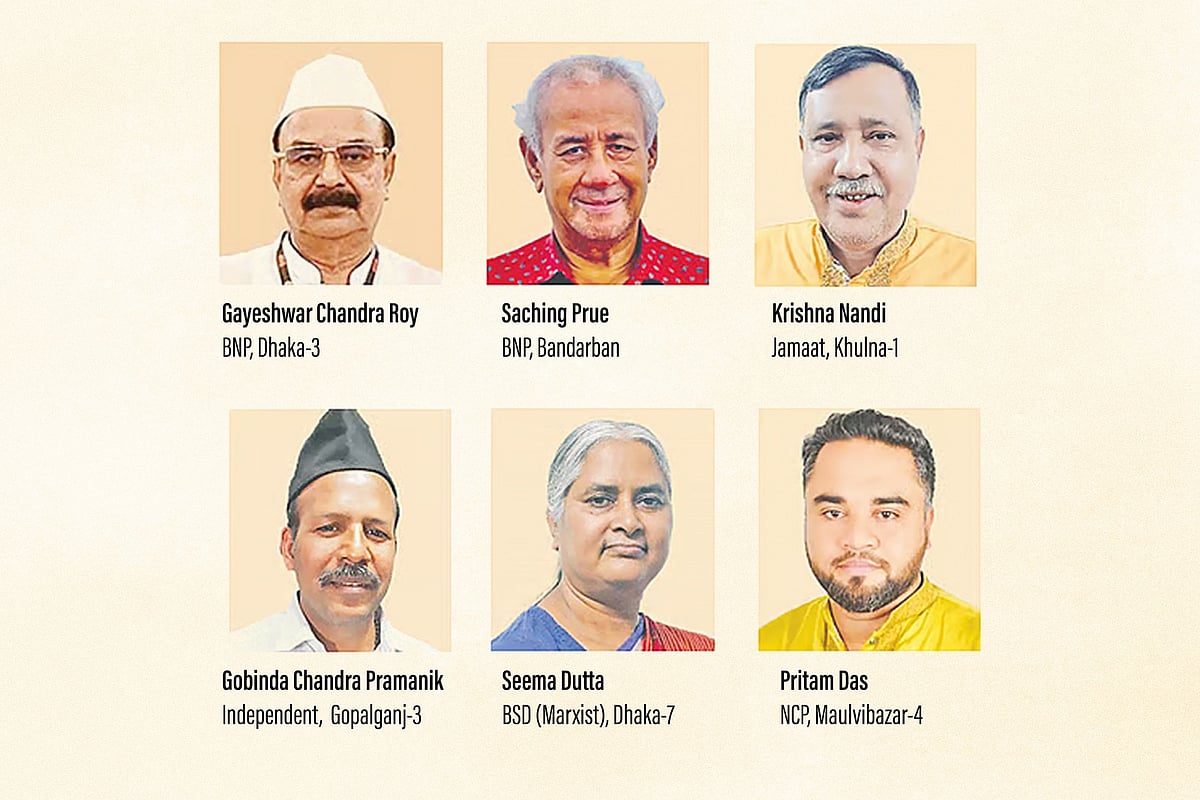
A total of 80 candidates from religious and ethnic minority communities are contesting in Bangladesh''s 13th national parliamentary election. Among them, 12 are independent candidates, and 10 of the minority candidates are women.
A total of 22 political parties, including the BNP and Jamaat-e-Islami, have nominated 68 candidates from minority communities for this election. Currently, 60 parties are registered with the Election Commission, of which the Awami League’s registration is suspended and its activities are also banned.
A total of 88 minority community candidates had submitted nomination papers to contest the election. The Election Commission rejected the nomination papers of 5 candidates, and 3 candidates withdrew their nominations. As a result, 80 candidates remain in the race.
Among political parties, the Bangladesh Communist Party (CPB) has fielded the highest number of minority candidates, 17 in total.
Nirmal Rosario, one of the presidents of the Bangladesh Hindu Buddhist Christian Unity Council, told Prothom Alo that if minority communities cannot participate in political decision-making processes and influence outcomes, then their rights, development and survival cannot be fully safeguarded. Minority communities need to be more actively involved in political processes and elections.
Six from BNP, one from Jamaat
BNP has nominated six candidates from minority communities this time. Among them are two senior leaders of the party: Standing Committee member Gayeshwar Chandra Roy (Dhaka-3) and Vice Chairman Nitai Roy Chowdhury (Magura-2).
The other four minority candidates nominated by the BNP are Kapil Krishna Mondal (Bagerhat-1), Somnath De (Bagerhat-4), Dipen Dewan (Rangamati), and Saching Prue (Bandarban).
For the first time in a national parliamentary election, Jamaat-e-Islami has nominated a candidate from a minority community. Krishna Nandi is contesting from Khulna-1, which comprises the Hindu-majority upazilas of Dakop and Batiaghata. He is from Chuknagar in Dumuria upazila, Khulna, and serves as the president of the Hindu Committee of Dumuria upazila Jamaat.
A total of eight minority candidates are contesting in Khulna-1. Among them, six political parties, including Jamaat, Jatiya Party, and CPB, have nominated candidates from minority communities. In addition, two independent candidates from minority communities are also contesting in Khulna-1.
The National Citizen Party (NCP) has nominated one minority candidate. Preetam Das is contesting from Moulvibazar-4 as the NCP’s "supervisor" for the Sylhet region.
Jatiya Party has nominated four minority candidates this election. They are Bahni Bapari (Dhaka-10), Sajan Kumar Mistri (Bagerhat-4), Mithila Roja (Khagrachhari), and Ashok Talukdar (Rangamati).
Three parties have nominated two minority candidates each. The Ganasanghati Andolon has nominated two minority candidates: Dipak Kumar Roy in Lalmonirhat-3 and Anjan Das in Narayanganj-3.
The Ganadhikar Parishad has also nominated two minority candidates: Ranjit Kumar Bardai in Barishal-2 and Dinmoy Roja in Khagrachhari.
From Gonoforum, Dulal Chandra Biswas is contesting in Gopalganj-3 and Ujjal Bhaumik in Chattogram-11.
Leftist parties field the most minority candidates. The Communist Party of Bangladesh (CPB) has nominated 17 minority candidates.
The CPB minority candidates are: Nimai Chandra Roy (Lalmonirhat-2), Madhusudan Roy (Lalmonirhat-3), Shipon Kumar Ravidas (Bogra-5), Kishore Kumar Roy (Khulna-1), Chitta Ranjan Goldar (Khulna-5), Prashanta Kumar Mondal (Khulna-6), Manbendra Dev (Gazipur-4), Montu Chandra Ghosh (Narayanganj-5), Nirad Baran Majumdar (Gopalganj-1), Niranjan Das (Sunamganj-2), Johar Lal Dutta (Moulvibazar-3), Amrit Kumar Roy (Dinajpur-3), Mihir Kumar Ghosh (Gaibandha-2), Sri Nirmal (Gaibandha-5), Tridip Kumar Saha (Dhaka-8), Kallol Banik (Dhaka-12), and Pramod Baran Barua (Chattogram-7).
Eighteen minority community candidates had submitted nomination papers as independents for this election. The Election Commission rejected five of these nominations, and one candidate withdrew. The remaining 12 are contesting in the race
The BSD (Bangladesh Samyabadi Dal) has nominated six minority candidates: Kalipada Sarkar (Naogaon-3), Shampa Basu (Magura-1), Janardan Dutta (Khulna-3), Monisha Chakraborty (Barishal-5), Pronob Jyoti Pal (Sylhet-1), and Milan Krishna Mondal (Lakshmipur-4).
BASAD (Marxist) has nominated seven minority candidates: Pragati Barman Toma (Rangpur-4), Parmananda Das (Gaibandha-1), Shekhar Kumar Roy (Mymensingh-4), Seema Dutta (Dhaka-7), Sanjay Kanta Das (Sylhet-1), Bitul Chandra Talukdar (Noakhali-4), and Deepa Majumdar (Chattogram-11).
JSD’s candidate for Khulna-1 is Prosenjit Dutta. Bangladesh Jasad’s candidates are Gautam Chandra Shil (Patuakhali-1) and Barua Manojit Dhiman (Cumilla-1).
The Biplobi Workers Party has nominated two minority candidates: Champa Rani Sarkar (Netrokona-4) and Jui Chakma (Rangamati).
BMJP candidates
The Bangladesh Minority Janata Party (BMJP) has eight candidates this time, seven of whom are from minority communities. The party president Sukriti Kumar Mondal is contesting from Jashore-4 (Abhaynagar-Bagharpara).
Other BMJP minority candidates include Kamala Kanta Roy (Thakurgaon-2), Tarun Kumar Ghosh (Kushtia-4), Probir Gopal Roy (Khulna-1), Mrinmoy Kanti Das (Faridpur-1), Rubel Gain (Satkhira-3), and Ushyepu Marma (Khagrachhari).
Sukriti Kumar Mondal told Prothom Alo that the party had nominated nine candidates, all of whose nominations were valid. Among these, eight are from minority communities, but one candidate withdrew after the death of his father.
Sukriti Kumar Mondal said that so far, they have not faced any obstacles on the electoral field.
Other parties that have nominated minority candidates
Raghunath Chandra Roy (Dinajpur-1) from Zaker Party, Sunil Shubho Roy (Khulna-1) from Bangladesh Islami Front, Nitai Chakraborty (Madaripur-3) from Bangladesh Supreme Party, Ujjal Chandra Roy (Rangpur-4) from Bangladesh Congress, Subrata Mondal (Khulna-1) from Bangladesh Samadhikar Party, Subal Chandra Majumdar (Madaripur-2) from Bangladesh Kalyan Party, Jagdish Barua (Cox’s Bazar-3) from Bangladesh Labour Party, and Sajal Kumar Kar (Cumilla-7) from Bangladesh Cultural Mukti Jote are contesting in the national parliamentary election.
12 independent candidates
Eighteen minority community candidates had submitted nomination papers as independents for this election. The Election Commission rejected five of these nominations, and one candidate withdrew. The remaining 12 are contesting in the race. Among them, Gobinda Chandra Pramanik, Secretary General of the Bangladesh National Hindu Mahajot, is contesting as an independent in Gopalganj-3, which comprises Kotalipara and Tungipara. His nomination was initially rejected by the returning officer, but he regained it after appealing to the Election Commission.
Other independent minority candidates include Sukesh Saha Anand (Narail-1), Achintya Kumar Mondal (Khulna-1), Govind Halder (Khulna-1), Jeet Barua (Gazipur-2), Utpal Biswas (Gopalganj-2), Milton Baidya (Madaripur-2), S N Tarun De (Brahmanbaria-2), Sameeran Dewan (Khagrachhari), Dharm Jyoti Chakma (Khagrachhari), Jirun Tripura (Khagrachhari), and Pahela Chakma (Rangamati).
Women candidates
Ten women from minority communities are contesting in the national parliamentary election this time. Among them, one is running as an independent candidate.
The remaining nine are candidates from various parties. Three are contesting from BASAD (Marxist): Seema Dutta (Dhaka-7), Pragati Barman Toma (Rangpur-4), and Deepa Majumdar (Chattogram-11).
Two are contesting from BSD: Monisha Chakraborty (Barishal-5) and Shampa Basu (Magura-1).
From the Biplobi Workers Party, Jui Chakma (Rangamati) and Champa Rani Sarkar (Netrokona-4) are contesting.
Two are contesting from the Jatiya Party: Bahni Bapari (Dhaka-10) and Mithila Roja (Khagrachhari). Additionally, Jiruna Tripura (Khagrachhari) is contesting as an independent candidate.
Monisha Chakraborty of BSD told Prothom Alo that she does not engage in politics as a woman or a minority. She participates in politics to uphold the rights of the people.