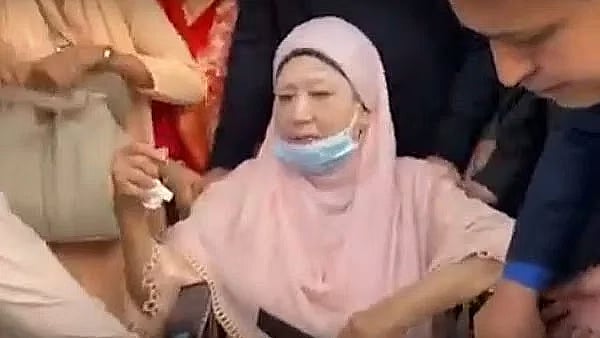
BNP Chairperson and former Prime Minister Khaleda Zia was admitted to the hospital with breathing difficulties caused by a lung infection. After that, pneumonia developed.
Along with this, she has longstanding issues with her kidneys, liver, arthritis, and diabetes. As a result, the situation is such that treating one condition is adversely affecting another.
In this situation, BNP Secretary General Mirza Fakhrul Islam Alamgir has described Khaleda Zia’s health condition as “extremely critical.” BNP leaders say that her condition has not improved over the past two days. Doctors are considering taking her to Singapore for better treatment as soon as possible, if feasible.
Meanwhile, the head adviser of the interim government, Professor Muhammad Yunus, has expressed deep concern over Khaleda Zia’s current physical condition. He has asked the people of the country to pray for her. BNP held prayers and doa mahfils across mosques nationwide yesterday, Friday, wishing for her recovery.
Khaleda Zia was admitted to the hospital last Sunday. That day she experienced severe breathing problems. She was quickly taken to Evercare Hospital. After immediate tests, her treatment began. When her condition worsened, she was moved from the hospital cabin to the Coronary Care Unit (CCU) two days ago. There, medical treatment for Khaleda Zia is being administered under the supervision of local and foreign specialist physicians on the medical board. News of her deteriorating condition has caused anxiety and concern among party leaders and activists.
Her eldest son, BNP’s acting chairman Tarique Rahman, who is in London, and daughter-in-law physician Zubaida Rahman are constantly monitoring Khaleda Zia’s physical condition. Zubaida Rahman is a member of the medical board formed for her treatment. The wife of her late younger son Arafat Rahman Coco, Shamila Rahman, is also at the hospital with her mother-in-law Khaleda Zia.
Yesterday, Friday afternoon, Mirza Fakhrul Islam and BNP Standing Committee member Amir Khasru Mahmud Chowdhury went to the hospital to see Khaleda Zia. They did not enter the CCU. They saw her from outside. Later, speaking to journalists waiting in front of Evercare Hospital, Amir Khasru said, “We saw from a distance. There is a risk of infection, so we cannot enter the CCU. We spoke to the physicians. Madam’s condition has not improved. The medical board is trying.”
Sources concerned said that the medical board composed of local and foreign specialist physicians meets daily to decide on treatment.
During the tenure of the Awami League government, which was ousted in the July mass uprising, Khaleda Zia was sentenced to prison in two cases. She was imprisoned for more than two years. On 25 March 2020, the then government suspended her sentence through an executive order and released her conditionally. After that, the government continued to extend her release every six months upon application. However, she was not allowed to go abroad for treatment.
After the fall of the Awami League government in the mass uprising, Khaleda Zia was freed. On 8 January she went to the United Kingdom for treatment. Four months later, on 6 May, she returned to the country.
Condition ‘extremely critical’
Since Khaleda Zia was hospitalised this time due to illness, the BNP has been organising doa mahfills across the country for her recovery. Yesterday was the scheduled day for offering doa at mosques. After Friday prayers at the Nayapaltan Central Jame Mosque, Mirza Fakhrul Islam joined a doa mahfil for Khaleda Zia. There he stated that her condition is extremely critical.
Mirza Fakhrul said, “Last night (Thursday) the physicians said her health condition is extremely critical. That is why, on behalf of our party, we requested people across the country – at every mosque – to pray for the recovery of the leader of democracy, the mother of democracy, our national leader Begum Khaleda Zia. As part of that program, after offering prayers today (Friday) at the mosque in Nayapaltan, we all prayed to the Almighty Allah for the national leader’s recovery.”
The secretary general said, “We prayed to Allah so that He may fully heal Madam, restore her health, and return her to the people so she can once again work for the nation.” He added, “We are again urging the people of the country to pray for her recovery. Everyone, please pray for Madam.”
Earlier in the morning, at the biennial–annual conference of the Bangladesh Federal Union of Journalists (BFUJ) at the National Press Club, Mirza Fakhrul also appealed for prayers from the people through journalists, describing the chairperson’s health condition.
The BNP secretary general said, “Madam is ill and in Evercare Hospital. Last night (Thursday), I returned home from the hospital at almost two o’clock. The physicians were still trying, still working.”
BNP Senior Joint Secretary General Ruhul Kabir Rizvi reported that prayers were held in mosques across the capital and nationwide after Friday prayers seeking Khaleda Zia’s recovery and well-being.
The chief adviser of the interim government, Professor Muhammad Yunus, has expressed deep concern over the current physical condition of BNP Chairperson and former Prime Minister Khaleda Zia. He has sought prayers from the people of the country for her recovery.
The press wing of the chief adviser’s office said this information in a message issued on Friday evening. The message stated that the head adviser is regularly monitoring updates on Khaleda Zia’s health condition and has instructed all concerned to ensure every necessary form of medical support.
According to the press statement, the head adviser has prayed for the quick recovery of the former three-time prime minister and has appealed to the nation to pray for her. The government is prepared to provide all necessary assistance to ensure that there is no shortfall in Begum Khaleda Zia’s treatment.
Describing Khaleda Zia as a profound source of inspiration for the nation during this period of democratic transition, the head adviser said, “Her good health is extremely important for the country.” He has also instructed all involved to remain constantly prepared with full support and coordination.
Khaleda Zia, 79, has long been suffering from various complications including arthritis, diabetes, kidney issues, liver disease, lung problems, and eye-related conditions. On the night of 23 November, Sunday, she was rushed to the hospital urgently. Tests detected an infection in her lungs, and she was admitted to the hospital.
The next day, Professor FM Siddiqi, a member of Khaleda Zia’s medical board, told journalists that for several months she had been falling ill very frequently. Multiple problems emerged simultaneously, which is why she was hospitalised.
Professor FM Siddiqi further said that Khaleda Zia had developed a chest infection. She already had a heart condition. Because her heart and lungs were both affected simultaneously, she was experiencing severe respiratory problems. That is why she was taken to the hospital very quickly, the doctor said.
BNP leaders-activists gather in front of the hospital
BNP leaders and activists have been arriving in front of Evercare Hospital in the capital to inquire about the health condition of BNP Chairperson Khaleda Zia.
Last night, upon visiting the hospital premises, several leaders and activists of the BNP and its affiliated organisations were seen standing there. Journalists were also present in front of the hospital.
At 11:38 p.m., interim government’s advisor for law, justice, and parliamentary affairs, Professor Asif Nazrul, arrived at the hospital to visit Khaleda Zia. He left the hospital at 12:06 a.m. Senior BNP leaders also came to the hospital that night to see the chairperson. Among them, BNP Secretary General Mirza Fakhrul Islam Alamgir and Standing Committee member Abdul Moyeen Khan were seen entering the hospital.
At around 12:06 a.m. at the hospital gate, Abdul Moyeen Khan told journalists, “The medical board met and reviewed her (Khaleda Zia’s) latest condition and are taking whatever steps are necessary.”
When asked what the physicals said about the chairperson’s health, Abdul Moyeen Khan replied, “She is under intensive observation, and the medical parameters relating to her treatment are being studied, and appropriate measures are being taken.”
Khaleda Zia went to London on 7 January for better treatment. After staying 117 days in London, she returned to the country on 6 May. Since then, due to various physical complications, she has had to go to the hospital several times.