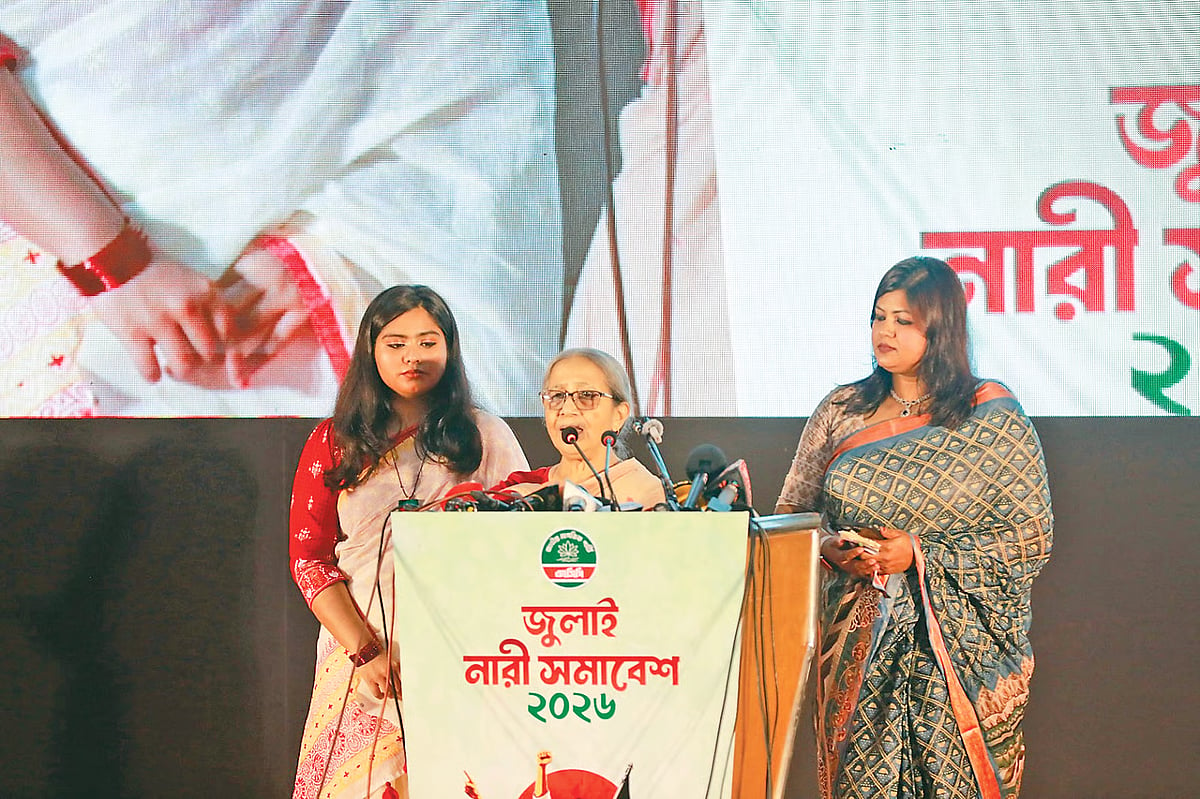
Jatiya Nari Shakti rally
Where have the women who led July mass uprising gone?
Women stood at the forefront of the July Mass Uprising. However, many of them found no place in the post-uprising landscape and have, in effect, faded from public view.
Their contributions and achievements have also largely gone unrecognised. In Bangladesh, the focus on the exercise of power by men alone has become an entrenched trend.
Participants said the country now needs to examine why this pattern has emerged and how it can be overcome.
Several women who took part in the July Mass Uprising made these remarks yesterday, Tuesday, evening, while attending the July Women's Assembly 2026 at the Institution of Diploma Engineers, Bangladesh (IDEB) in Kakrail, Dhaka.
Jatiya Nari Shakti, female wing of the National Citizen Party (NCP), organised the event as part of the NCP's month-long programme marking the second anniversary of the July Mass Uprising.
The July Mass Uprising culminated in the fall of the then Awami League government on 5 August 2024. During the early phase of the movement, on 14 July, then Prime Minister Sheikh Hasina (now sentenced to death by the International Crimes Tribunal) made derogatory remarks directed at students protesting for quota reform.
That night, female students broke the locks of five women's halls at Dhaka University, alongside students from the men's halls, and gathered at the feet of the Raju Memorial Sculpture.
The following day, members of the Bangladesh Chhatra League (now banned) attacked both male and female students at the university's VC Chattar. These two incidents marked a turning point in the movement.
To mark the second anniversary of 14 July, Jatiya Nari Shakti organised yesterday's assembly. Many of the prominent women associated with the July Uprising attended the event and spoke about their disappointment and sense of exclusion in the period that followed.
The NCP Convener and Chief Whip of the Opposition in Parliament, Nahid Islam, attended the gathering as the chief guest.
Referring to repeated attempts to portray the women of the July Uprising as no longer being part of the NCP, he said, "We have repeatedly faced the question: women stood at the forefront of the July uprising, so why are they absent today? I believe this is a legitimate question. We need to address it."
Nahid Islam also said that although women had played a significant role and made considerable sacrifices during the July uprising, their contributions had not been adequately reflected over the past two years within society, across political parties or in the country's overall political activities.
Farida Akhter, former adviser to the interim government, attended the event as a special guest. She said quotas remained necessary for disadvantaged women.
She also expressed regret that the country's state structure had not undergone meaningful reform even after the July uprising.
Monira Sharmin, convener of Jatiya Nari Shakti, chaired the assembly.
Other speakers included reserved-seat member of parliament Nusrat Tabassum and Dhaka University Central Students' Union (DUCSU) member Umma Uswatun Rafia.
Monjila Jhuma, NCP organiser for the southern region, and Rafia Rehnuma Hridy, senior vice-president of Jatiyo Chatroshokti, moderated the event.