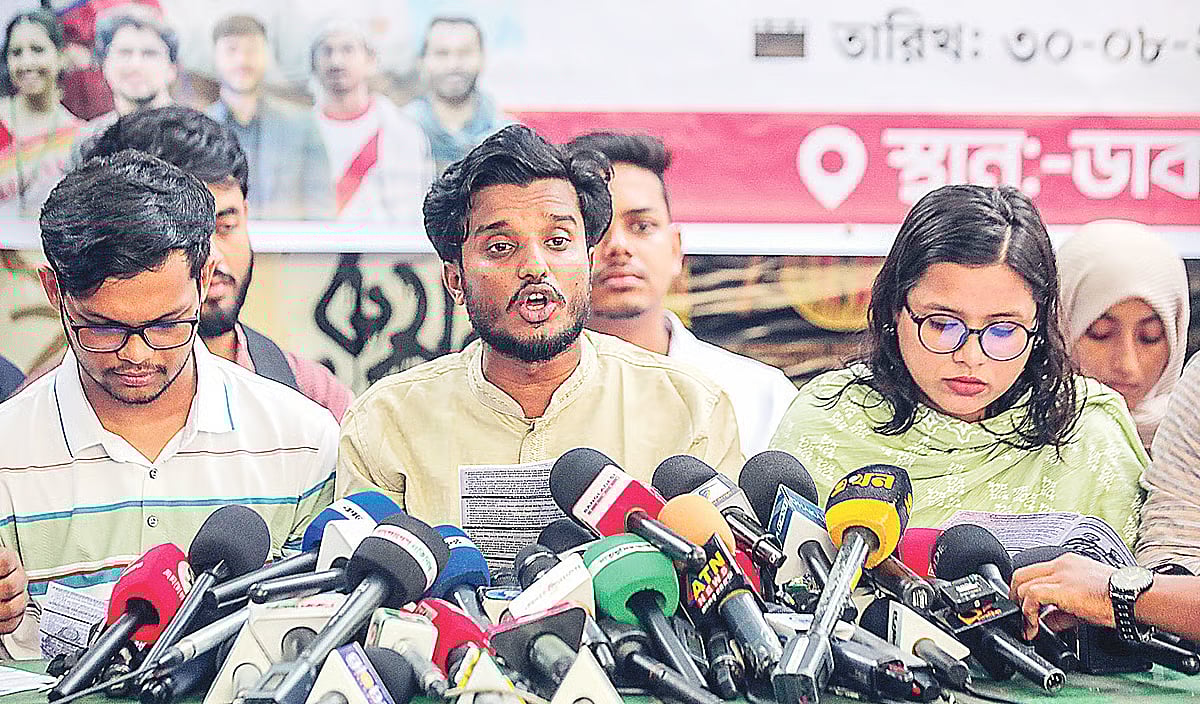
Anti-discrimination students’ council manifesto
DUCSU: Priority for research and political independence
The Anti-Discrimination Students’ Council has announced its manifesto with a commitment to transforming Dhaka University into a research-oriented institution while placing highest priority on political freedom on campus. The panel, supported by the Bangladesh Democratic Students’ Council, pledged to permanently abolish the culture of “guest rooms” (where students are tortured under the guise of etiquette training) and “mass rooms” in the halls of residence.
In anticipation of the Dhaka University Central Students’ Union (DUCSU) election, the council unveiled its manifesto on Saturday, at a press conference held at Madhur Canteen. The panel’s Vice-President (VP) candidate, Abdul Kader, delivered the opening remarks and read part of the manifesto, while the remaining sections were presented by General Secretary (GS) candidate Abu Baker Mojumdar and Assistant General Secretary (AGS) candidate Ashrefa Khatun. Elections for DUCSU and hall unions are scheduled for 9 September.
The manifesto begins with a pledge to ensure regular DUCSU elections in accordance with the academic calendar. It promises to end the practice of 'rehearsing' national politics, and the presence of weapons and cadre-based politics on campus. Instead, students will be prepared to become citizens equipped for life, work, knowledge, skills and service. Political party structures within the halls of residence and academic spaces will be abolished.
In his opening speech, Abdul Kader remarked that students of Dhaka University have been deprived of their rights. He said, “Some have turned the university into a cantonment, while others have turned it into a concentration camp of oppression. To secure the democratic rights of students, DUCSU requires leadership that will not hesitate to challenge the authorities, safeguard students’ independence, dignity and rights and refuse to tolerate discrimination and authoritarianism within the university and the state.”
The manifesto begins with a pledge to ensure regular DUCSU elections in accordance with the academic calendar. It promises to end the practice of rehearsing national politics, the presence of weapons and cadre-based politics on campus. Instead, students will be prepared to become citizens driven by life, work, knowledge, skills and service. Political party structures within the halls of residence and academic spaces will be abolished.
The council also pledged to develop a mobile application named “One-Stop Solution.” Through this app, students would be able to access comprehensive university services without bureaucratic hurdles, including admission procedures, examination results, admit card downloads and tuition payments.
The second section of the manifesto promises democratic reforms to give meaningful effect to the autonomy granted under the Ordinance of 1973. To end “administrative authoritarianism,” a transparent recruitment policy will be introduced for positions including Vice-Chancellor, Pro-Vice-Chancellor and Hall Provost. Efforts will also be made to reclaim 300 acres of encroached university land.
The council also pledged to develop a mobile application named “One-Stop Solution.” Through this app, students would be able to access comprehensive university services without bureaucratic hurdles, including admission procedures, examination results, admit card downloads and tuition payments.
The third section of the manifesto focuses on student welfare, promising the introduction of a “One Card All Services” system to facilitate access to libraries, healthcare, transport, canteen services and hall entry. The principle of “One Student One Seat” will be implemented by strengthening hall administration to ensure a fair and coordinated allocation of accommodation.
The eighth section commits to making public spaces within the university more women-friendly. A special cyber security cell will be created to protect female students from cyber bullying.
The fourth section pledges strict administrative action against “moral policing” related to attire, including beards, caps, burqas, hijabs or regional identity. It also promises to eliminate discrimination and marginalisation against students of different faiths, ethnicities and madrasa backgrounds.
The fifth section includes a pledge to provide high-speed internet across the entire university campus through Starlink.
The sixth section promises the creation of part-time job opportunities and the establishment of outsourcing and skill development training programmes in each hall. The seventh section outlines plans to establish a museum and cultural centre to preserve and showcase the century-long history of Dhaka University.
The eighth section commits to making public spaces within the university more women-friendly. A special cyber security cell will be created to protect female students from cyber bullying.