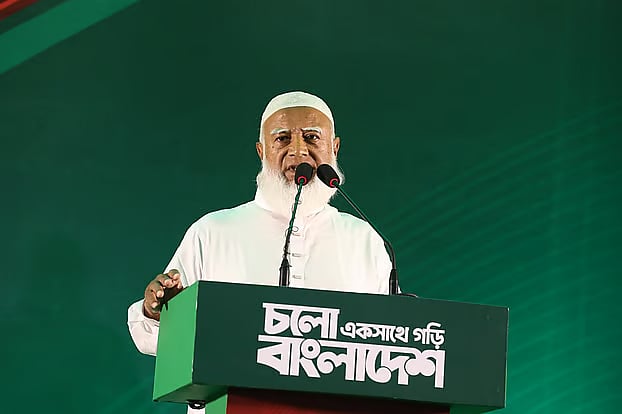
Manifesto unveiled
Women’s working hours to be reduced: Jamaat ameer
A statement by Jamaat-e-Islami ameer Shafiqur Rahman regarding the reduction of working hours for women at offices sparked widespread debate and criticism several weeks ago.
Although the party’s election manifesto does not explicitly mention anything on this issue, Shafiqur Rahman raised the matter again during the manifesto launching event.
On Wednesday evening, Jamaat-e-Islami formally unveiled its manifesto at a hotel in Banani, Dhaka.
Speaking at the event, Shafiqur Rahman stated that the party has a plan to determine women’s working hours, which it intends to implement gradually.
According to him, under Jamaat’s proposal, employers will pay wages for the hours women work in factories or institutions, while the government will bear responsibility for compensating the remaining hours.
The manifesto states that Jamaat will introduce a project titled “Amar Aayer shongsar” (My income supported family) to promote self-reliance among rural women.
Rather than providing women with stipends alone, the project aims to ensure sustainable income and employment through training and the provision of necessary resources.
The party promises one-time government assistance to enable women to engage in productive activities such as tailoring, handicrafts, freelancing and agriculture.
The manifesto also pledges to ensure safe and standard working environments and fair wages for women.
In his speech at the manifesto launch, Shafiqur Rahman paid tribute to the martyrs of the mass movements and uprisings of 1947, 1971 and 2024.
He said that, following 5 August 2024, Jamaat has moved forward with a firm commitment to building a clean and ethical Bangladesh.
He emphasised the need to abandon past political practices and govern the country through merit, innovation and value-based leadership.
Referring to the last 15 and a half years, the Jamaat ameer said that opposition parties, civil society members, journalists and Islamic scholars had all suffered repression.
“We were oppressed,” he said, “after 5 August many people appeared to have forgotten the memories of that period.”
He further remarked that some individuals have since focused on securing personal gains and have caused hardship to the people in various ways.
Against this backdrop, he described Jamaat’s manifesto as pro-people, business-friendly, peace-friendly and discipline-friendly.
Jamaat stated that the manifesto is not merely a political declaration but a comprehensive blueprint for establishing a discrimination-free and justice-based state.
26 priority areas
The manifesto identifies 26 priority areas under the slogan “An uncompromising Bangladesh in the national interest.” These include:
Building a state uncompromising on independence, sovereignty and national interests; establishing a humane Bangladesh based on equality, justice and fairness; empowering youth and prioritising their role in state governance; creating a safe, dignified and participatory state for women; improving law and order to establish a drug-free, extortion-free and terrorism-free society; developing a technology-driven modern and smart society; creating large-scale employment across sectors including technology, manufacturing, agriculture and industry; ensuring free application for government jobs, merit-based recruitment and elimination of all forms of discrimination; reforming the banking and financial sectors to restore confidence and build a transparent, investment- and business-friendly sustainable economy; ensuring a fair electoral environment, introducing proportional representation (PR), and strengthening the caretaker government system to consolidate effective democracy; launching an agricultural revolution through increased use of technology and enhanced support for farmers; achieving complete food safety free from adulteration by 2030 and implementing the “Three zero vision” (zero environmental degradation, zero waste and zero flood risk) to build a green and clean Bangladesh; expanding industrialisation and employment through the growth of small and medium enterprises and a favourable environment for domestic and foreign investment; improving workers’ wages and living standards and ensuring quality working conditions, particularly safe workplaces for women; ensuring voting rights and full civic rights for expatriates and enabling their proportional and realistic participation in national development; establishing equal citizenship rights for all, regardless of majority or minority identity and providing special facilities for disadvantaged groups; providing modern and universal healthcare and gradually ensuring free advanced treatment for the poor and underprivileged; undertaking fundamental reforms in education aligned with global demands and gradually ensuring free education; keeping commodity prices within purchasing power and ensuring full provision of essential needs; overhauling transportation systems and reducing travel time between the capital and divisional cities to two or three hours; introducing fundamental changes to regional connectivity and Dhaka’s internal transport system; ensuring affordable housing for lower- and middle-income families; continuing judicial and reform processes to completely dismantle fascist systems and prevent their resurgence; establishing a universal social security system to ensure secure working lives and gradually provide international-standard social protection for all citizens; establishing good governance through transparency and accountability and building a happy, prosperous welfare state, with honest leadership and institutional reform to eliminate corruption.
“Missiles are being fired from all sides”
In recent days, public debate and criticism have intensified over a post published on Shafiqur Rahman’s X (formerly Twitter) account. Jamaat claimed that hackers had accessed the ameer’s account and published the post.
Referring to the controversy, Shafiqur Rahman said, “Today, I am a wounded soldier. Over the past few days, you have seen missiles being fired at me from all directions. I will not use any anti-missile system. Instead, with you as witnesses, I forgive all those who have unjustly attacked my character.”
The event was attended by senior Jamaat leaders as well as representatives of allied parties under the 11-party electoral alliance, including Asif Mahmud Shojib Bhuyain, spokesperson of the National Citizen Party (NCP), Ahmad Abdul Kader, secretary general of Khelafat Majlish, Tofazzal Hossain Miazi, joint secretary general of Bangladesh Khelafat Majlish, Musa Bin Izhar, secretary general of Bangladesh Nizam-e-Islam Party and Mostafizur Rahman, chairman of the Bangladesh Labour Party.
According to a Jamaat press release, ambassadors, high commissioners and diplomats from the United States, the United Kingdom, China, India, Pakistan, as well as representatives from the United Nations, UNDP and other international organisations, were also present at the event.