Only 4pc women candidates in election: Rights activists raise questions of accountability
A total of 2,568 candidates have submitted nomination papers to contest the upcoming 13th Jatiya Sangsad elections. Of them, only 109 are women accounting for slightly over 4 per cent. Women’s rights activists have demanded that political parties give explanation before the public and be held accountable for nominating so few female candidates.
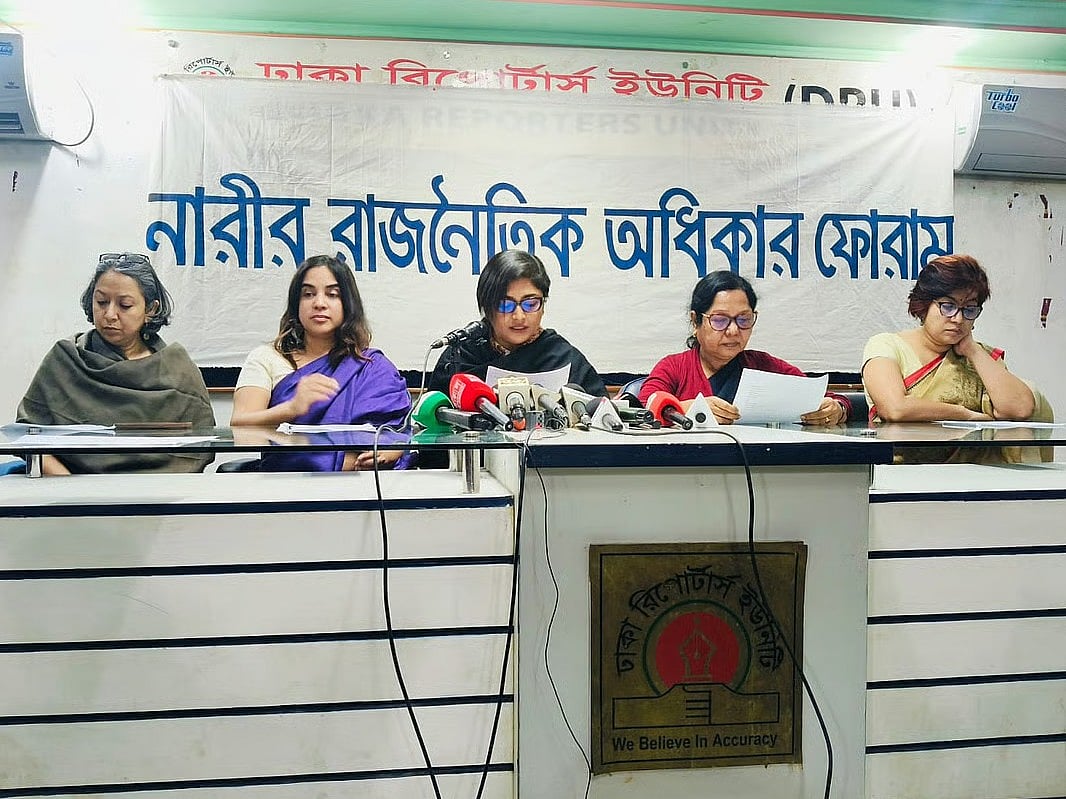
The demand was raised yesterday, Monday at a press conference organised by the Forum for Women’s Political Rights. The speakers also called for accountability from both the Election Commission and the political parties.
A written statement titled ‘The crisis of women’s nominations: The gap between political parties’ commitments and implementation, and the accountability of the Election Commission’ was read out at the press conference, held at the Sagar-Runi Auditorium of the Dhaka Reporters Unity (DRU) in Segunbagicha of Dhaka.
The statement noted that under Clauses 22(b)-(d) of the July National Charter 2025, formulated by the National Consensus Commission, every political party was required to ensure that at least five per cent of its candidates in this parliamentary election were women. The charter also sets a target of gradually increasing this to 33 per cent in future elections. However, among the 51 political parties contesting the upcoming election, 30 don’t have even a single female candidate.
The statement also said these figures highlight a severe imbalance. It argued that even a minimum of five per cent female nominations is not an acceptable benchmark and reiterated the forum’s longstanding demand that at least 33 per cent of candidates in general seats be women to ensure fair representation.
It further said that parties which had committed to the July Charter’s minimum five per cent requirement but failed to meet it need to explain this failure publicly and be held accountable. When even minimum conditions are not met, public trust is questioned.
Twelve organisations are affiliated with the Forum for Women’s Political Rights. Those present at the press conference included publisher Mahrukh Mohiuddin, Narigrantha Prabartana director Seema Das, Ritu Sattar, Khubdha Nari Samaj convener Reetu Sattar, Naripokkho member Sadaf Saaz Siddiqi, and Bohnishikha director Samina Yasmin.
Responding to different questions, Mahrukh Mohiuddin said women’s rights activists had always objected to the five per cent nomination threshold. To push parties to increase nominations beyond five per cent, women’s organisations held a large rally on 9 October last year. Therefore, she said, there was no scope to shift the blame by claiming that the women’s movement had failed to apply sufficient pressure.
The publisher mentioned a common question raised is whether women can win the elections. She countered by asking whether parties provide the necessary support to help women candidates win, pointing out that such support is extended to male candidates nonetheless. She added that the question also remains whether a level playing field has been created for women in elections.
Mentioning that the political parties must aim to bring women into decision-making positions Sadaf Saaz Siddiqi said, many women are interested in contesting elections but are not given the opportunity. If the process were opened up, many more women would come forward. She questioned why the public should trust parties’ election manifestos when they have failed to uphold even their minimum commitment of nominating five per cent women candidates.
Four key demands were outlined at the event. Firstly, hold respective political parties accountable before the Election Commission for failing to meet the minimum consensus on women’s nominations they had reached under the July Charter. Secondly, ensure that the Election Commission plays a stronger and more assertive role in addressing violations of electoral rules related to women’s political rights.
Thirdly, require political parties to take responsibility for breaching their minimum commitments under the July Charter rather than treating women’s nominations as charity or symbolic gestures. And finally, introduce real, structural changes within parties, treating women’s political rights as a democratic duty and constitutional obligation, to reform party activities, nomination processes and leadership development.