Did the minister legitimise ‘extortion’ in transport by calling it ‘mutual understanding’?
Newly appointed Minister for Road Transport, Railways and Shipping Sheikh Rabiul Alam has effectively granted legitimacy to extortion collected in the name of owner and worker associations in the transport sector, according to critics.
The minister believes the money is collected on the basis of mutual understanding and is not forcibly taken. Therefore, he does not consider it “extortion.”
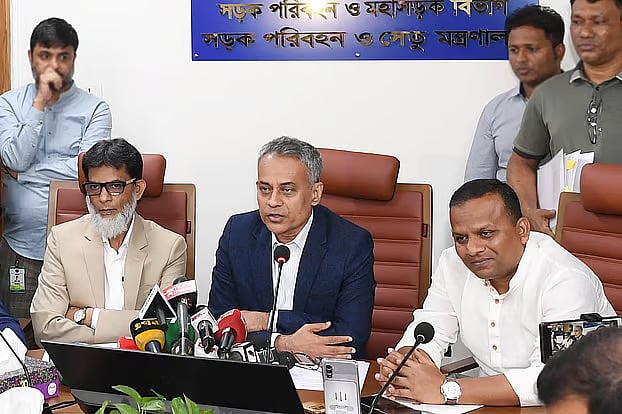
Speaking at a press conference at the Road Transport Ministry yesterday (Thursday), Rabiul Alam expressed this view in response to questions from journalists.
It was his first formal media briefing since assuming office in the new government. State Ministers Habibur Rashid and Md Rajib Ahsan were also present.
The press conference focused on railway expansion, restoring order on roads, canal re-excavation, and developing an integrated transport system. The government plans to implement an 80-day priority action plan in these sectors.
Transport sector experts have strongly disagreed with the minister’s remarks. They say that billions are extorted annually in various ways in the transport sector, and that such extortion is the primary cause of disorder. Without stopping it, they argue, discipline cannot be restored.
A research report published on 5 March 2024 by Transparency International Bangladesh (TIB) found that Tk 10.59 billion is extorted annually from privately owned buses and minibuses.
The beneficiaries include politically affiliated individuals or groups, traffic and highway police, officials of the Bangladesh Road Transport Authority (BRTA), owner and worker associations, and representatives of municipalities and city corporations.
The study also revealed that about 92 per cent of large bus companies are linked to politicians, with 80 per cent connected to the ruling party.
Sources say that during the previous Awami League government, ruling party leaders controlled transport-sector extortion. After the fall of the Awami League, control reportedly shifted to transport leaders aligned with the BNP.
Responding to a question about extortion in the transport sector, Rabiul Alam said, “What is called transport extortion on the roads—I don’t see it that way. There are owners’ associations and workers’ associations; they spend this money for their welfare. It functions like an unwritten rule. I would call something extortion if someone is forced to pay. The owners’ association collects money at a fixed rate for the welfare of owners. There may be debate about how much is actually used, but they do this on the basis of understanding.”
He further said, “There are many organisations, including the Workers’ Welfare Federation. They collect money based on mutual understanding. Influence shifts depending on which group or party is in power. The workers’ organisation of the ruling party usually dominates. But we do not have the opportunity to view this as extortion, because it is done through compromise.”
However, the minister added that the government would examine whether such collections impose additional burdens or cause deprivation.
Welfare Claimed, But No Real Welfare
Sector insiders say there are more than 900,000 commercial vehicles in the country. Over Tk 20 billion is collected annually in various forms of extortion. There is no estimate of unreported collections.
Although funds are collected in the name of welfare, transport owner and worker associations were largely absent during the hardship caused by the Covid-19 pandemic.
Transport expert Professor Shamsul Haque of Bangladesh University of Engineering and Technology (BUET) told Prothom Alo that any “shadow cost” beyond operational expenses is illegal.
“Whether called extortion or welfare expense, it ultimately burdens the public. Collection in the name of police, owners, workers, and political groups is an open secret,” he said.
“The current government has come to power with a strong public mandate. It must show goodwill by stopping extortion at the outset. Otherwise, it will not be able to do so later. Without stopping extortion, discipline cannot return to the transport sector.”
Regarding worker welfare, he said labourers’ rights include appointment letters and monthly salaries under the law. Ensuring these would suffice—there is no need to collect funds in the name of welfare. He also noted that such funds are not audited, and no one knows how they are spent.
History of Attempts to Legalise ‘Tolls’
According to ministry sources, around 2002, under BNP’s then Communications Minister Nazmul Huda, an advisory council meeting initiated efforts to formulate a policy on transport-sector extortion. A subcommittee prepared recommendations, but the plan was not implemented amid criticism over legitimacy.
In 2009, during the Awami League government, Communications Minister Syed Abul Hossain and Workers Federation leader Shajahan Khan revised those recommendations and moved to draft a new policy.
The draft policy proposed that owners’ associations could collect up to Tk 40, workers’ unions Tk 20, and the national federation Tk 10 per vehicle. Terminal committees could collect up to Tk 70 collectively.
However, amid criticism, the Awami League government did not approve the policy. Over time, the Tk 70 collection in the name of owner-worker organisations became normalised, along with additional informal charges.
Government’s Priorities
At the press conference, Rabiul Alam said the new government has begun work to make state management people-friendly, transparent, and accountable. A 180-day priority action plan will focus on railway expansion, restoring road discipline, canal re-excavation, and integrated transport management.
Regarding battery-powered auto-rickshaws operating freely on Dhaka’s main roads and contributing to congestion, the minister said authorities will quickly develop a coordinated plan with city corporations, traffic police, and the home ministry to decide whether to ban or regulate them.
On railways, he said Prime Minister Tarique Rahman has given special importance to the sector and directed officials to examine whether locomotives and coaches can be manufactured domestically.
He also said a decision on resuming India–Bangladesh rail connectivity could come within 15 days, based on national interest considerations.
To ease Eid travel congestion, the government will follow previously successful models, possibly with additional measures to be finalised within three to four days.
Regarding the Bus Rapid Transit (BRT) project from the airport to Gazipur, the minister said initial impressions suggest the project has not been “state-friendly,” but given the significant financial investment and loan complexities, no immediate decision can be made; the matter is under review.
Responding to questions about corruption and political influence, Rabiul Alam said public interest outweighs party interest, and no organisation or group will be allowed to dominate. Transparency and accountability will be ensured.
Among others present at the briefing were Road Transport and Highway Division Secretary Mohammad Ziaul Haque, Shipping Secretary Nurun Nahar Chowdhury, Dhaka Mass Transit Company Managing Director Faruque Ahmed, BRTA Chairman Abu Momtaz Saad Uddin Ahmed, and Roads and Highways Department Chief Engineer Syed Moinul Hasan.