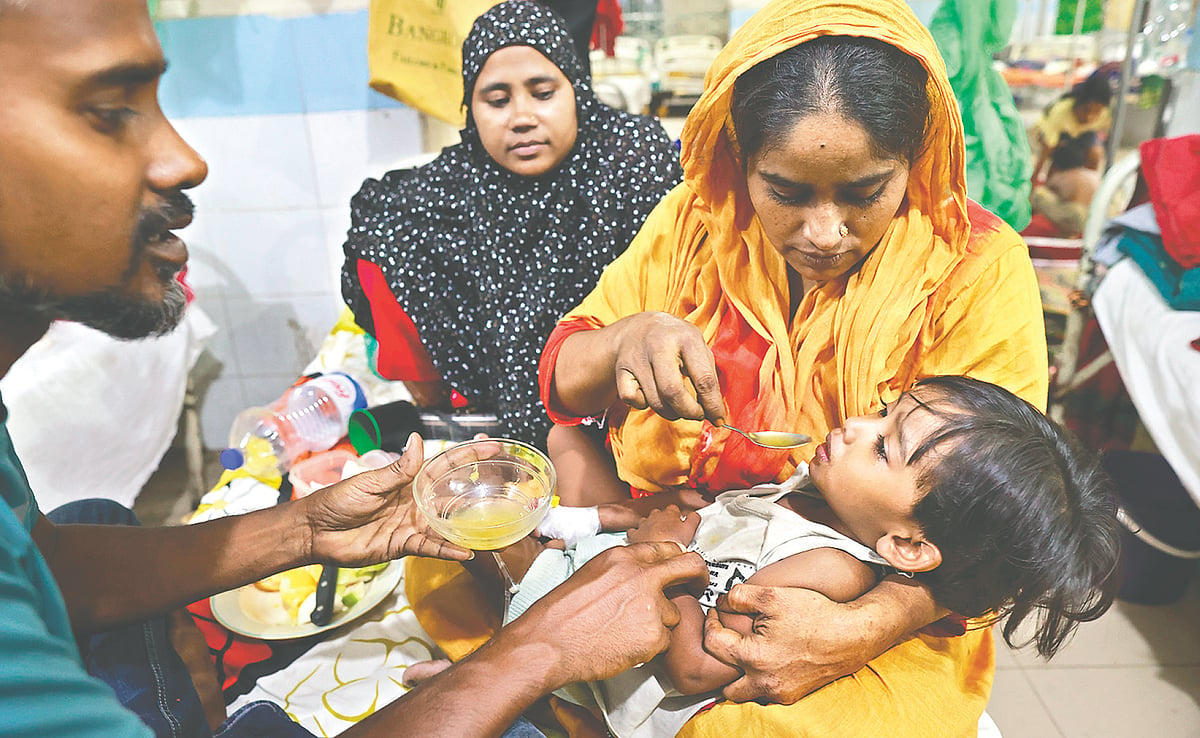
Parents lose both sons to dengue within 21 days as deaths continue to mount
The couple had two sons: Md Nazmul Hasan Ifti, 24, and Md Intisar Hasan Yas, 16.
Nazmul was a pharmacy student at North South University, while Intisar studied in Class IX at Adamjee Cantonment Public School. Their parents have lost both sons to dengue within 21 days.
Their father is Md Babul Haque and their mother, Nazmin Akter. Speaking to Prothom Alo on Thursday, Nazmin said, “A tiny mosquito has taken away all the happiness from my family. We have nothing left in this world to live for.”
According to the Directorate General of Health Services (DGHS), 331 people died of dengue between 1 January and 15 October this year. Like Babul and Nazmin, many parents have lost their children. Many children have lost their parents, and countless people have lost other loved ones. Many families have also faced financial hardship while trying to save relatives from the disease.
Dengue was first detected in Bangladesh in the 1960s, when it was known as “Dhaka fever”. A fresh outbreak of the disease began in 2000.
The spread of mosquitoes and unplanned urbanisation have turned dengue into an endemic disease in Bangladesh. Successive governments have failed to take effective measures to control it. The current government is making efforts, but deaths continue. In the first 15 days of October alone, 86 people died of the disease. There are also allegations that not all infections and deaths are reflected in official dengue statistics.
Babul and Nazmin lived with their two sons in their own home in Bhashantek, Mirpur, in the capital. Babul retired from the Bangladesh Army as a warrant officer and now works in a civilian position in the army. Nazmin is a homemaker.
Their younger son, Intisar, died on 21 September. Their elder son, Nazmul, died on 12 October.
According to family members, Babul and Intisar contracted dengue at around the same time. After Intisar's physical condition improved, physicians allowed him to return home. However, when his condition deteriorated again, he had to be admitted to Popular Medical College Hospital.
When Intisar died on 21 September, his father was admitted to the intensive care unit (ICU) of Dhaka Combined Military Hospital (CMH). Intisar was buried in the family's ancestral home in Panchagarh.
Nazmul was diagnosed with dengue in October. After spending three days at Popular Medical College Hospital, he died on 12 October.
Speaking to Prothom Alo over the phone, Nazmin said, “I was worried about the boys' father. I thought something might happen to him. In the meantime, we lost both our sons. Our younger boy was the tallest among his father and brother. He used to say he was the senior member of the family. And what a senior he was—he was the first to leave us.”
When Babul was admitted to CMH, Nazmul stayed by his father's side. After his younger brother died, Nazmul continued to look after both his parents. Then he, too, died of dengue.
Babul and Nazmin have been married for 26 years. Both are from Panchagarh, where they are now staying at their ancestral home.
When Prothom Alo first contacted Nazmin, she was reluctant to speak. She eventually agreed and spent an hour on the phone talking about her sons and sharing memories of them.
She said the boys were rarely away from her, except when they slept. They would lie beside her, embrace her and talk. When walking, they would hold their mother's hand. Even after they had grown up, Nazmin would still feed them by hand.
Her younger son was an excellent cook, she said. Food he had prepared was still in the refrigerator.
Nazmin said, “We were supposed to go to Panchagarh on 18 October during the Puja holidays. My elder son had booked the tickets himself. Those tickets are still there. Yet, before that date, I had to rush to Panchagarh with the bodies of both my sons. They were supposed to travel to Kolkata with their maternal uncle. Both had obtained passports. But they got the kind of passports and visas that took them out of this world altogether.”
Nazmin had much more to say. Her voice repeatedly grew heavy with grief.
“At the hospital, my elder son would say, ‘How will you live without me?’ Yas is gone too. Just before he was taken into the ICU, my elder son said, ‘Abbu, Ammu, take care of yourselves’,” she said.
Saying that there would be no way for them to be all right again, Nazmin added, “Our whole life is over.”
Babul did not want to speak over the phone. Nazmin said her husband was in a very poor physical and mental state after contracting dengue himself and losing both sons. She might have to return to Dhaka to arrange treatment for him.
Families face financial hardship as well
Alongside the grief of losing loved ones to dengue, many families have been pushed into financial distress.
The treatment of Babul and Nazmin's two sons cost around Tk 900,000.
“I told the doctors not to worry about the cost. Just make my sons well. I would take them home. But I could not take them home,” Nazmin said.
10 deaths in 24 hours
According to the DGHS's dengue report, 10 people died of the disease in the 24 hours from Wednesday to Thursday morning. During the same period, 1,943 dengue patients were admitted to hospitals. Dhaka and Chattogram divisions reported the highest numbers of patients.
The report said 107,259 people had been hospitalised with dengue between 1 January and 15 October this year. Of them, 331 had died.
Bangladesh recorded its highest number of dengue infections and deaths in 2023. That year, according to official figures, 321,179 patients were hospitalised with dengue—more than the total number of cases recorded over the preceding 23 years.
A total of 1,705 people died of dengue in 2023 alone, exceeding the combined death toll of 849 recorded in all previous years.
In 2025, dengue claimed 323 lives. In just over 10 months this year, the death toll has already surpassed last year's total, reaching 331 as of 15 October.
In September, the government launched a three-month special campaign to prevent dengue. The programme aims to raise public awareness, destroy Aedes mosquito breeding sites, intensify cleaning activities and coordinate government, private-sector and community initiatives. Prime Minister Tarique Rahman inaugurated the campaign on 12 September.
Although the government has emphasised dengue control at the highest levels, questions remain over whether measures are being implemented effectively on the ground.
Public health expert Professor Be-Nazir Ahmed, a former director of the government's Communicable Disease Control (CDC) unit, told Prothom Alo, “I do not see much to be hopeful about in dengue control. The picture is largely one of disappointment. Dengue is no longer confined to Dhaka; it has spread to villages across the country. We do not even understand how Aedes mosquitoes are breeding in rural areas.”
Professor Be-Nazir Ahmed said the current approach to controlling Aedes mosquitoes was fundamentally flawed. Despite efforts using this approach since 2000, dengue had not been brought under control, he said.
“Effective, scientific mosquito control measures are needed across the country,” he added.
Deaths are more than just numbers
Prothom Alo was able to speak to Nazmul and Intisar's parents through their maternal uncle, Roknuzzaman, who was with the family when both boys died.
Speaking to Prothom Alo, Roknuzzaman said people who die of dengue seem to be treated as nothing more than numbers by the government.
“But only those families who lose their loved ones can truly understand this pain,” he said.