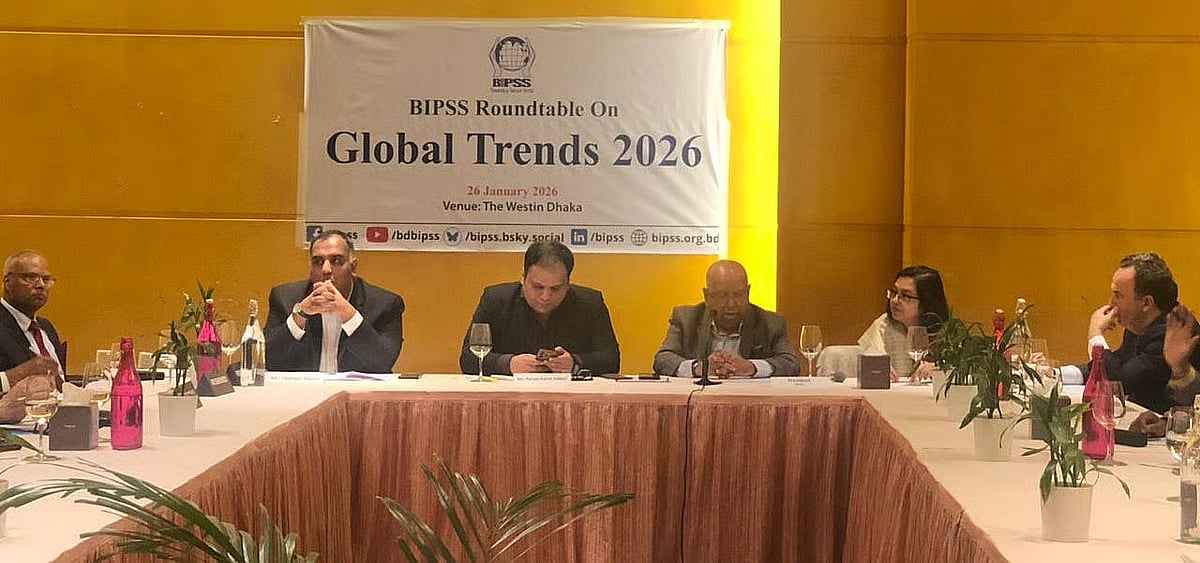
Experts at BIPSS seminar
Clear understanding of changing world challenges is essential
The world has now entered an era of rapid and multidimensional change. Economic systems, technology and the global security environment are evolving at an unprecedented pace.
Bangladesh must develop a clear understanding of the challenges arising from these complex transformations in a changing world.
Experts made these observations yesterday, Monday, at a roundtable discussion titled “Global Trends 2026”, held at a hotel in the capital.
The event was organised by the research institution Bangladesh Institute of Peace and Security Studies (BIPSS).
In his opening remarks, the moderator of the discussion and president of BIPSS, major general (retd) ANM Muniruzzaman, stated that no country—large or small—remains immune from global instability.
In this context, he emphasised the need for in-depth analysis to understand the causes of geopolitical realignments from Gaza to Ukraine, the rise of protectionism and the expansion of inter-state conflicts, in order to avoid further escalation.
He noted that the world has entered an era of rapid and multidimensional change, in which economic systems, trade relations, technology, environmental stability and the global security situation are all transforming simultaneously and at an unprecedented speed.
In his view, as an emerging middle power, Bangladesh must develop a clear understanding of these complex changes.
Parvez Karim Abbasi, assistant professor in the Department of Economics at East West University and executive director of the Centre for Governance Studies, observed that international competition is increasingly revolving around electrification, digitalisation, and decarbonisation.
Access to lithium, copper and rare minerals—essential for power transmission lines, data centres, electric vehicles and clean energy technologies—is now becoming a key determinant of economic and geopolitical influence.
He stressed that for Bangladesh, strengthening internal economic resilience while maintaining balanced relationships is imperative.
Shafqat Munir, head of the Bangladesh Centre for Terrorism Research (BCTR) and senior research fellow at BIPSS, stated that the world has entered a new technological order in which international relations are being reshaped around technology blocs, digital infrastructure, supply chains and data governance.
He pointed out that the security outlook of many countries, including Bangladesh, remains excessively traditional and is misaligned with the realities of 2026.
He further noted that inter-state conflicts have intensified anew, alongside the rise of grey-zone and hybrid warfare, which are becoming the primary forms of competition beyond conventional warfare.
Artificial intelligence, he said, is no longer merely generating information; it is now implementing decisions and actions that affect governance and security.
As a result, deepfakes, disinformation, and AI-generated biometrics are eroding trust and rendering traditional identity verification systems ineffective.
Shafqat Munir also highlighted the risks of AI-enabled terrorism, including drone warfare, automated radicalisation, cryptocurrency-based financing, and three-dimensional printed weapons. He identified climate change as a major threat to productivity and security.
Saima Ahmed, assistant professor in the Department of International Relations at the University of Dhaka, observed that the tendency to pursue narrow and rigid national interests in international relations has increased markedly.
Major powers are becoming more inclined to adopt unilateral and coercive measures and, in many cases, are bypassing multilateral institutions and international legal frameworks.
This, she noted, signals a return to realist power politics, in which global governance structures are fragmenting and confidence in the rules-based international order is declining.