Eid-ul-Fitr
Prayers for an end to war during Eid munajat
The world is in turmoil over a conflict in the Middle East, and its effects have already reached Bangladesh. Consequently, the call for peace resonated even during the Eid-ul-Fitr prayers and subsequent supplications.
Following a month of fasting, Eid-ul-Fitr marks a joyous occasion for Muslims. This year, however, the celebrations in the Middle East were subdued due to the ongoing war, which began on 28 February when the United States and Israel jointly launched attacks on Iran. The conflict has since spread across nearly every country in the region.
In Bangladesh, Eid-ul-Fitr was observed on Saturday, based on the sighting of the Shawwal moon. The principal eid congregational prayer was held at the National Eidgah near the Supreme Court in Dhaka at 8:30 am. President Md. Sahabuddin and Prime Minister Tarique Rahman attended the prayer.
Muslims offered a two-rakat prayer in unison, led by Mufti Abdul Malek, Khatib of Baitul Mukarram National Mosque. Following the khutbah, devotees raised their hands in supplication.
Mufti Abdul Malek prayed for peace and prosperity in Bangladesh and for the world at large, calling for an end to discord and strife. Thousands of devotees responded with a heartfelt “Ameen.”
He urged Allah to protect the oppressed and deliver justice against tyrants, highlighting the plight of Muslims and other people suffering in conflict zones.
The war in the oil- and gas-rich region has destabilised global fuel markets. In response, the Bangladeshi government implemented temporary rationing of petroleum sales, affecting vehicle movement in the lead-up to eid.
Although restrictions were lifted for the holiday, prolonged conflict threatens further energy shortages and potential load-shedding.
Prior to eid, over 150 Bangladeshis stranded in Iran were repatriated by special flights. Meanwhile, more than 500,000 Bangladeshis remain in conflict-affected countries, many in fear of missile and drone attacks; at least five have already lost their lives. The uncertainty weighs on their families in Bangladesh and may impact remittance flows, a key driver of the national economy, particularly from Middle Eastern nations.
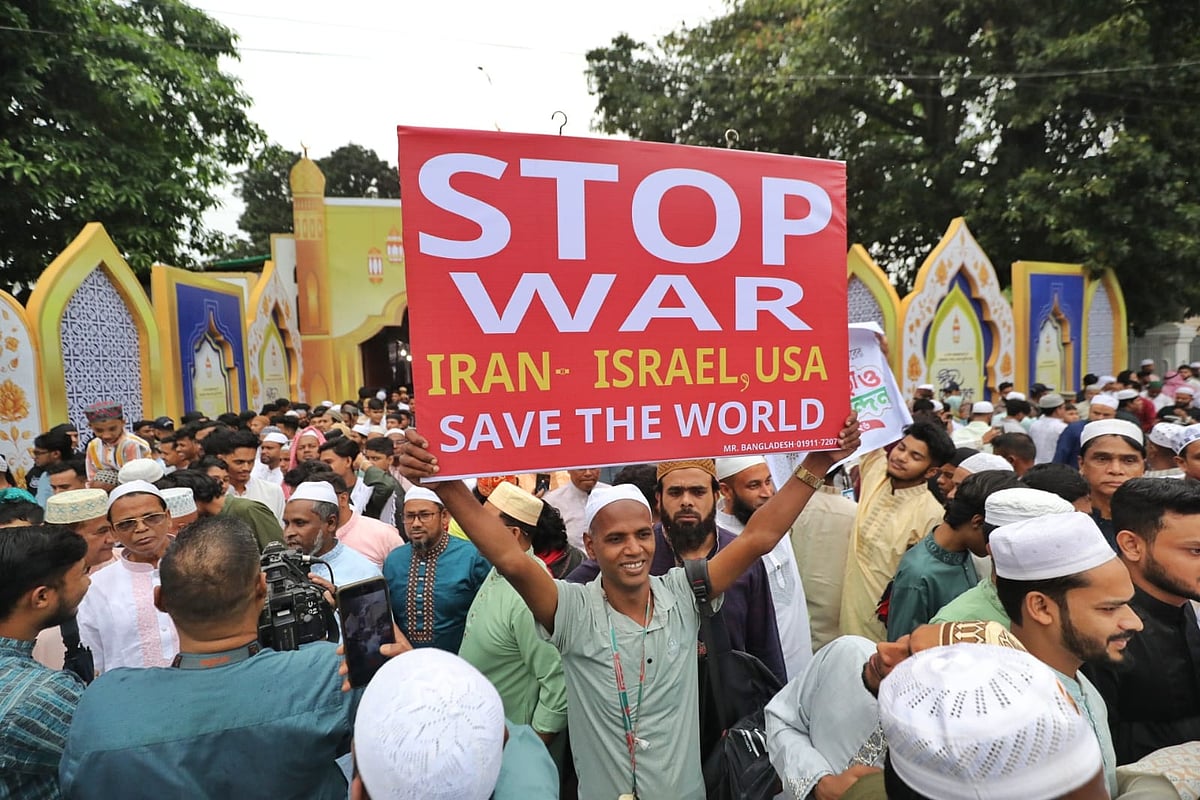
The eid sermon and prayers also reflected these concerns. One worshipper displayed a placard at the National Eidgah calling for an end to the war.
In his eid message, the President noted the adverse effects of the global energy and economic crisis on Bangladesh and reaffirmed that the government is addressing the situation with utmost priority.
In his message, Prime Minister Tarique Rahman expressed hope that national unity, mutual harmony, and solidarity would be further strengthened.
For the first time in nearly three and a half decades, the President and Prime Minister were seen together at the Eid congregation. Tarique Rahman, dressed in a sky-blue panjabi, arrived at 8:20 am, followed five minutes later by President Md. Sahabuddin in a maroon panjabi. They sat side by side for the prayers and later exchanged greetings with worshippers.
The congregation also included Chief Justice Zubayer Rahman Chowdhury, judges of the Supreme Court and High Court, several ministers, political leaders, diplomats, and senior government officials.
Despite forecasts of rain and thunderstorms, the main Eid congregation proceeded smoothly. Devout worshippers queued from early morning, passing through archways and metal detectors. The National Eidgah reached full capacity before the scheduled prayer time, prompting some to perform the eid prayer in nearby streets.
The main pandal accommodated around 35,000 worshippers, with a separate area arranged for women. According to Dhaka South City Corporation, including surrounding roads and open spaces, between 90,000 and 100,000 Muslims participated in the Eid prayers this year.