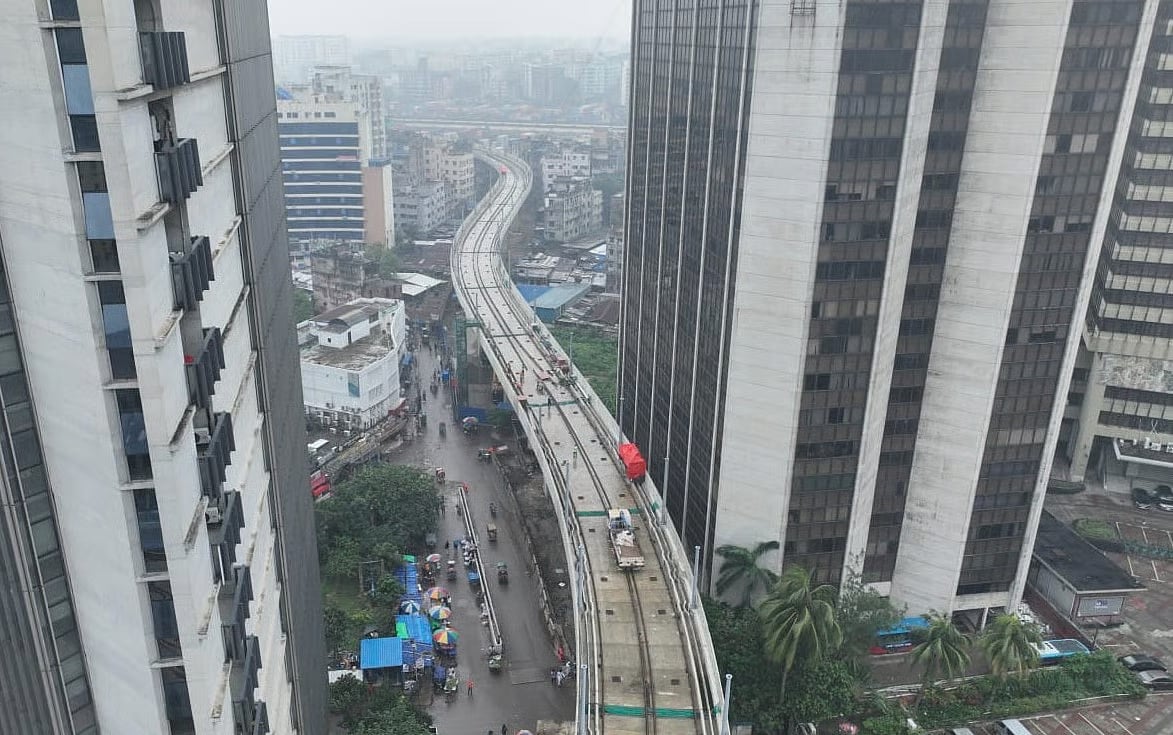
Dhaka Metro Rail
Cost of two new metro rail projects surges past Tk 2 trillion
The cost of constructing metro rail on two routes in Dhaka is set to more than double. The initial estimated cost of the two projects was Tk 938 billion. A new proposal has now been prepared with a cost of Tk 2.13985 trillion. The proposal for the additional expenditure is awaiting approval from the Planning Commission.
One of the projects is the construction of an underground metro rail line from Kamalapur to the airport. Work on the project, MRT Line-1, is already underway. A section of the line, from Nadda to Purbachal, will run on an elevated track, meaning the project will combine underground and elevated sections. The other project, MRT Line-5 (Northern Route), will run from Savar through Gabtoli, Mirpur and Gulshan to Bhatara. It too will combine underground and elevated sections.
Dhaka Mass Transit Company Limited (DMTCL) is responsible for constructing and operating metro rail in Dhaka. Sources at the agency under the Road Transport Ministry said the costs of the two projects are increasing because of changes to the detailed designs, rising construction-material prices, depreciation of the taka against foreign currencies, delays in implementation and various technical changes.
The MRT Line-1 and Line-5 (Northern Route) projects were undertaken in 2019. Depot development work is nearing completion, while the process of appointing contractors is underway.
Meanwhile, DMTCL has revised the project proposals and sent them to the Planning Commission seeking approval for the higher costs. Evaluation meetings on the two projects are scheduled to be held at the Planning Commission today. The revised development project proposals (RDPPs) will be approved after discussions on the justification for the additional expenditure.
The two metro rail projects are being financed by Japan International Cooperation Agency (JICA). The issue of increased costs first emerged during the tenure of the interim government. The interim government did not proceed further, urging that the costs be reduced.
Several rounds of discussions were subsequently held with JICA during both the interim government and the current BNP government. On 24 May, the BNP government formed a seven-member technical committee, headed by former professor of civil engineering at Bangladesh University of Engineering and Technology (BUET) Shamim Z Bosunia, to advise on reducing project costs. The committee submitted its report in July.
According to sources at the Road Transport Ministry, the technical committee concluded in its report that the more-than-doubling of the original project costs was justified. DMTCL subsequently sent the revised proposals for the higher expenditure to the Planning Commission.
Shamim Z Bosunia defended the increase in costs. He told Prothom Alo that inflation was running at around 5 per cent a year, the value of the dollar had increased by 38 per cent, and the scope of work had expanded because of changes to the designs.
In addition, government VAT and taxes had increased. “Dhaka needs metro rail. If the government considers the cost too high, it can look for another lender. But the longer it takes, the higher the cost will be,” he said.
An Expensive Metro Rail
Metro rail is currently operating on the Uttara–Motijheel route. Its extension to Kamalapur is under construction. The entire route will cost Tk 334.72 billion, or Tk 15.84 billion per kilometre. The project was undertaken in 2012.
During the interim government’s tenure, DMTCL analysed the costs of metro rail projects being implemented in various Asian countries. The analysis found that, excluding land acquisition and salaries and allowances, the cost of constructing one kilometre of metro rail in India ranged from Tk 1.5 billion to Tk 4.5 billion. India also implements projects through foreign loans, but does not accept conditions on such loans that undermine competition in contractor selection.
The proposals to more than double the costs of MRT Line-1 and Line-5 (Northern Route) state that the initial cost estimates were prepared in 2019, when detailed designs had not yet been completed.
Many changes were subsequently made during preparation of the detailed designs. In addition to inflation, the prices of construction materials also increased. Cement, steel, fuel, bitumen, machinery and transportation costs were all affected.
The depreciation of the taka has added to the costs. In 2019, the exchange rate was estimated at around Tk 84.50 to the US dollar. By 2025, it was around Tk 122 per dollar, significantly increasing the taka cost of machinery and other materials purchased from abroad. The revised estimates also include taxes, VAT, land acquisition, relocation of utility lines, consultancy costs, interest during construction and various contingency expenses.
Road, Rail and Shipping Minister Sheikh Robiul Alam told Prothom Alo that metro rail is essential. “Otherwise, Dhaka cannot be saved,” he said. Regarding the higher costs, he said the original estimate had been prepared before the full design was completed. The full design was completed before the BNP government came to power. Had the full design been prepared earlier, some costs could have been reduced. “If we do not build the metro rail now at the higher cost, the cost will rise even further in the future,” he said.
Lack of Competition Driving Up Costs
In 2019, the cost of MRT Line-1 was estimated at Tk 525.61 billion. The revised project proposal sent to the Planning Commission puts the cost at Tk 1.20 trillion—an increase of nearly Tk 680 billion over the original approved cost. In terms of total expenditure, it is set to become the country’s second-most expensive project after the Rooppur Nuclear Power Plant.
Under Line-1, more than 31 kilometres of elevated and underground metro rail track and 21 stations will be constructed. If the additional cost is approved, the project will cost Tk 38.66 billion per kilometre.
The original cost of the MRT Line-5 (Northern Route) project was Tk 412.39 billion. The route will cover 20 kilometres, combining elevated and underground sections, with 14 stations. The revised proposal submitted to the Planning Commission puts the cost at around Tk 931.91 billion. This is an increase of approximately Tk 350 billion over the original estimate. If approved, the cost will come to around Tk 46.6 billion per kilometre.
Sources at the Road Transport Ministry said the high cost of metro rail is partly due to various conditions imposed by lender JICA and a lack of competition. Japanese companies participate as contractors in the tenders and quote high prices, leaving little room for negotiation.
In addition, tender documents specify methods and technologies that are almost impossible for companies other than Japanese firms to meet. As a result, there is little competition in the tenders, causing costs to rise sharply.
Asked about the matter, BUET civil engineering professor Shamsul Hoque told Prothom Alo that costs would not come down unless open competition was ensured in the tender process. If the government can persuade the lending agency to relax the conditions, costs would automatically fall.
It is as clear as water, he said. He added that costs could reasonably rise because of depreciation of the taka, changes in design and increases in product prices, among other factors. There is no scope for them to become astronomical, he said.