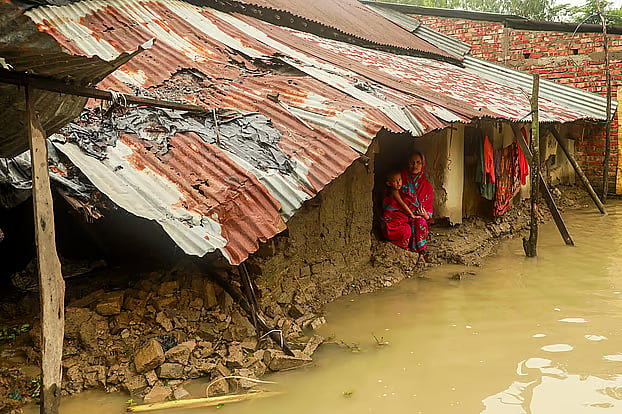
44 dead as heavy rain triggers floods, landslides across seven districts
The two children were playing in their courtyard when the mountain runoff suddenly struck. They were washed away by the surge and their bodies were recovered later.
The victims, identified as Mohammad Ashik (7) and Mohammad Miraj (3), died last Friday in Chattogram’s Banshkhali upazila. Local residents noted that several areas of the upazila have been submerged for days due to persistent rain and mountain runoff.
According to the 11 July daily report from the Ministry of Disaster Management and Relief, seven districts—Khagrachhari, Rangamati, Bandarban, Cox’s Bazar, Chattogram, Moulvibazar and Habiganj have been affected by floods as of 6:00 pm Saturday. Fifty-eight upazilas across these districts have been inundated.
The death toll from floods, mountain runoff and landslides has reached 44, with 39 others injured. A total of 267,918 families remain stranded, while the number of affected individuals has reached 1,022,963.
Heavy rainfall began in the Chattogram region on 4 July due to the influence of the monsoon. Over the past week, the region recorded 1,169 mm of rainfall, with the highest daily total of 412 mm recorded last Tuesday.
Following the crisis in Chattogram, floods also spread to Moulvibazar and Habiganj in the Sylhet division.
The ministry's report confirmed that 1,131 shelters have been opened, providing refuge to 44,457 people.
Meanwhile, rainfall declined over the past 24 hours compared with the previous two days, reducing the immediate risk of further deterioration.
The death toll from floods, mountain runoff and landslides has reached 44, with 39 others injured. A total of 267,918 families remain stranded, while the number of affected individuals has reached 1,022,963.
However, authorities warned that rising water levels in Feni, Sylhet and parts of northern Bangladesh, particularly along the Teesta River, could trigger temporary flooding.
In its bulletin issued on Saturday, the Flood Forecasting and Warning Centre said water levels remained above danger level at seven monitoring stations on five rivers in six districts.
The affected stations include the Bandarban and Lama points on the Sangu and Matamuhuri rivers in Bandarban; the Dohazari point on the Sangu River in Chattogram; the Markuli point in Sunamganj and the Fenchuganj point in Sylhet on the Kushiyara River; the Manu River in Moulvibazar and the Kolmakanda point on the Someshwari River in Netrokona.
River levels and regional outlook
Sardar Udoy Raihan, Executive Engineer of the Flood Forecasting and Warning Centre, told Prothom Alo that water from five rivers—the Manu, Kushiyara, Sangu, Matamuhuri and Someshwari was flowing above the danger level on Saturday. While four rivers were above the mark on Friday, the Someshwari crossed the threshold yesterday.
Upazila Nirbahi Officers are facing a major challenge in managing the situation. The problem is not a shortage of relief or funds, but coordination. Reaching those who need assistance most is difficult.Gowhar Naeem Wara, disaster management expert
Raihan added that the flood situation in the Chattogram region is expected to improve within the next 24 to 48 hours. However, water levels in the Teesta and other rivers in Feni, Sylhet and the north are rising, which may lead to fresh flooding. He said that water levels are expected to begin receding in these areas within the next three days.
The Meteorological Department reported that Faridpur recorded the country’s highest rainfall yesterday at 144 mm. This was followed by the Ambagan area of Chattogram with 106 mm. Other notable figures included 90 mm in Rangamati, 88 mm in Bandarban and 55 mm in Cox's Bazar.
Loss of loved ones and livelihoods
While some families are mourning the loss of relatives to the floods and landslides, others have watched their entire livelihoods vanish.
In Bocharpara village of Chattogram’s Banshkhali upazila, Abdul Kader was seen yesterday afternoon using a shovel to clear the collapsed mud walls of his home. His wife, Rina Akter, stood by his side, wiping away tears as she spoke.
"Our mud house was all we had," Rina said. "On Wednesday night, the flood surge came suddenly. The house was submerged in an instant and the walls began to crumble. We grabbed the children and ran for our lives. Now, I have no idea where we will stay or how we will eat."
The five-room mud house was home to Abdul Kader and his elder brother Nur Kader’s families—15 members in total. Both brothers are day laborers.
"If we work, we eat. If we don't, we go hungry," Abdul Kader said. "Everything was destroyed in a single night."
The aid gap
The Ministry of Disaster Management and Relief said it had allocated 6,900 tonnes of rice and Tk 345 million to deputy commissioners across all 64 districts from July 7 for humanitarian assistance.
Of that, the seven flood-hit districts received Tk 145 million and 2,650 tonnes of rice.
However, many affected residents said they had yet to receive any assistance.
Among them is Sukumar Acharya, 42, of Bonikpara in Paschim Amirabad, Lohagara upazila, Chattogram.
His wife, Arpana Acharya, said no relief had reached their home.
"We've heard that elected representatives and others are distributing relief, but no one has come to us. Our cooking stove has been damaged. We're surviving on a small amount of dry food bought from a grocery shop," she said.
Floods often create shortages of food and safe drinking water, while pregnant women, children and older people face heightened risks. Many sick people also require medicine and medical care.
Disaster management expert Gawher Nayeem Wahra said the absence of elected local government representatives had made relief coordination more difficult.
Upazila Nirbahi Officers are facing a major challenge in managing the situation. The problem is not a shortage of relief or funds, but coordination. Reaching those who need assistance most is difficult, he said.
He stressed that vulnerable groups, including pregnant women and elderly people, should be prioritised for rescue and assistance, and called for organisations such as the Red Cross, Red Crescent, Scouts and Girl Guides to be involved in relief efforts.