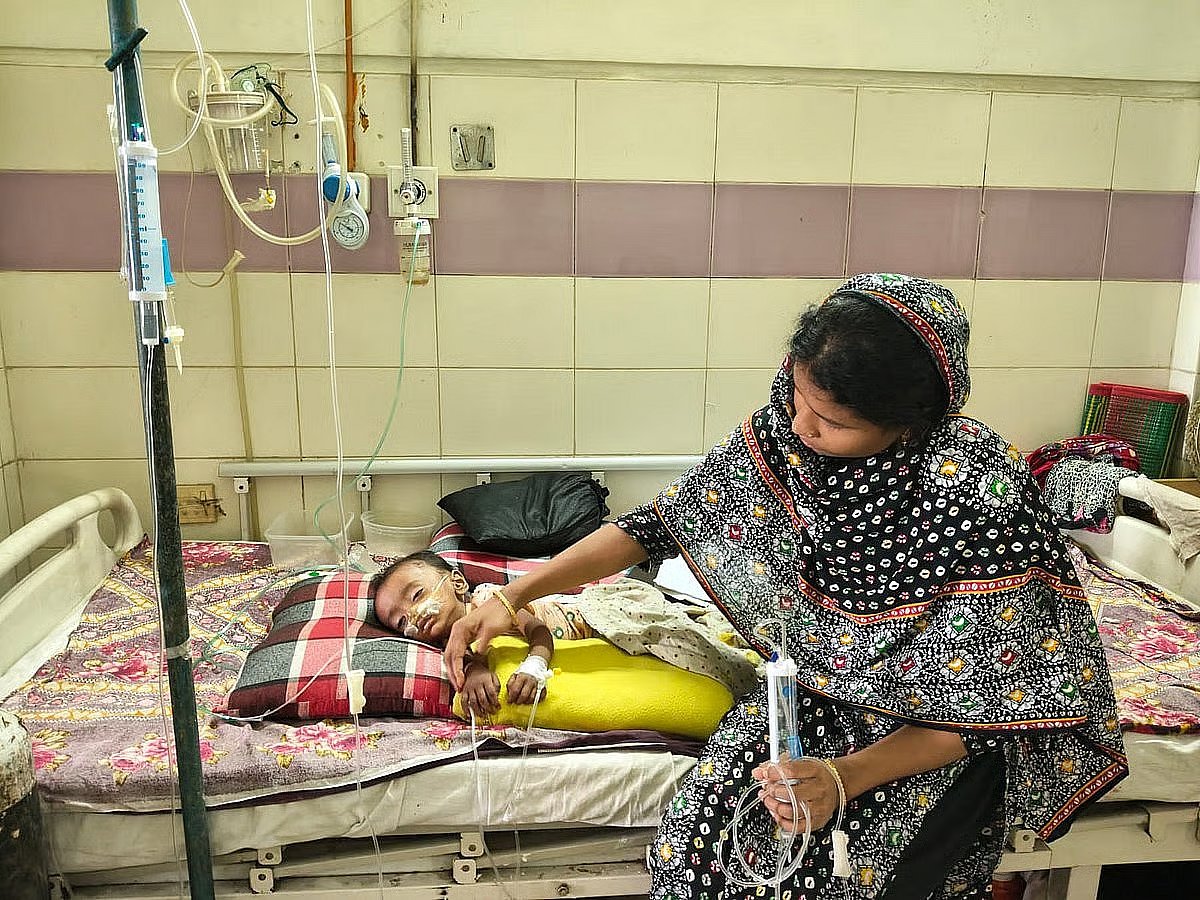
Measles elimination progress reversed amid vaccine gaps, Bangladesh now at high risk: WHO
The World Health Organization has expressed concern over the measles situation in Bangladesh and assessed the situation as ‘high risk’ at the national level.
WHO published this assessment report yesterday, Thursday (23 April) based on the spread of infection in 58 out of 64 districts in Bangladesh, the large number of affected children, gaps in disease prevention capacity due to lack of vaccination, and incidents of deaths with measles symptoms.
On 4 April 2026, the the National International Health Regulations (IHR) Focal Point for Bangladesh notified WHO of a significant increase in measles cases, driven by sustained domestic transmission. Since January 2026, Bangladesh has experienced a marked increase in measles cases.
Following the new assessment by the World Health Organization, the organization’s former adviser and public health expert Mushtuq Hossain told Prothom Alo today, Friday, “As the infection situation was worsening, we had said that measles should be declared a public health emergency. Now the government should declare an emergency and move forward with vaccination.”
According to the WHO report, a total of 19,161 suspected measles cases and 2897 laboratory-confirmed measles cases have been reported between 15 March and 14 April 2026, including 166 measles related deaths (case fatality rate 0.9 per cent).
Moreover, 166 suspected measles-related deaths (case fatality rate 0.9 per cent) and 30 confirmed measles-related deaths (CFR 1.1 per cent) have been recorded. A total of 12,318 hospital admissions and 9,772 hospital discharges have also been reported.
Highest in Dhaka division, more cases in slum areas
WHO said the highest cumulative burden of suspected measles cases since 15 March 2026 has been reported in Dhaka (8263 cases), Rajshahi (3747 cases), Chattogram (2514 cases), and Khulna (1568 cases).
In Dhaka, cases are concentrated in densely populated informal settlements, including Demra, Jatrabari, Kamrangirchar, Korail, Mirpur, and Tejgaon industrial and slum clusters.
WHO said that geographically, measles cases have been reported across all eight divisions, in 58 out of 64 districts (91 per cent of districts), indicating widespread transmission nationally.
According to data from the country’s Expanded Programme on Immunization (EPI), measles has spread across 61 districts. About 83 per cent of the affected children are under five years of age.
Most infected are children
The WHO report said children aged under 5 years account for the majority of reported cases (79 per cent ), including children aged under 2 years (66 per cent) and infants aged under 9 months (33 per cent).
A total of 166 suspected deaths have been reported (CFR 1 per cent), mainly among unvaccinated children aged under 2 years.
The current outbreak in Bangladesh is occurring in the context of suboptimal population immunity, according to the report. A substantial proportion of cases occurred among children who were either unvaccinated or had received only one dose of measles-containing vaccine. In addition, some children were infected before reaching the age of eligibility for vaccination at 9 months. Most cases (91 per cent) occurred among children aged 1 to 14 years, indicating substantial immunity gaps in this age group.
How measles spreads
Who said measles is a highly contagious acute viral disease which affects individuals of all ages and remains one of the leading causes of death among young children globally. The mode of transmission is airborne or via droplets from the nose, mouth, or throat of infected persons.
Initial symptoms, which usually appear 10-14 days (range 7-23 days) after infection, include high fever, usually accompanied by a runny nose, bloodshot eyes, cough and tiny white spots inside the mouth. The rash usually appears 10-14 days after exposure and spreads from the head to the trunk to the lower extremities.
A person is infectious from four days before up to four days after the appearance of the rash. There is no specific antiviral treatment for measles, and most people recover within 2-3 weeks.
Complications and risk of death
Measles is usually a mild or moderately severe disease. However, measles can lead to complications such as pneumonia, diarrhoea, secondary ear infection, inflammation of the brain (encephalitis), blindness, and death.
The WHO said postinfectious encephalitis can occur in about one in every 1000 reported cases. About two or three deaths may occur for every 1000 reported cases.
Measles can cause serious illness in at-risk groups, including children under 5 years of age, those who are malnourished especially those with vitamin A deficiency and people with weakened immune systems.
Gaps in vaccination set back earlier progress
WHO said that before this outbreak, Bangladesh had made substantial progress towards measles elimination. Reported coverage with the first dose of measles-containing vaccine increased considerably between 2000 (89 per cent) and 2016 (118 per cent), while coverage with the second dose also improved between its nationwide introduction in 2012 (22 per cent) and 2024 (121 per cent).
During the same period, confirmed measles incidence declined sharply. However, recent declines in MR1 and MR2 coverage due to nationwide stockout of MR vaccine between 2024-2025, combined with routine immunisation gaps and the absence of regular nationwide supplementary measles-rubella campaigns since 2020, have increased the number of susceptible children and contributed to the current outbreak, the WHO assessed.
According to the WHO report, the risk at the national level is assessed as high due to ongoing transmission across multiple divisions, the large number of susceptible children, documented immunity gaps, and the occurrence of suspected measles-related deaths.
The concentration of cases among unvaccinated and under-vaccinated children including infants too young to be vaccinated, raises concern for continued uninterrupted transmission and severe disease outcomes.
Overall, the outbreak suggests a reversal from Bangladesh’s previous progress towards measles elimination and highlights increasing vulnerability to sustained transmission. Continued spread is likely unless urgent measures are implemented to strengthen surveillance, rapidly detect and respond to cases, and close immunity gaps through high-quality vaccination activities.
Vaccination campaign begins
A nationwide measles-rubella (MR) vaccination campaign was approved by the National Immunization Technical Advisory Group (NITAG) on 30 March 2026, targeting children aged 6–59 months (with expanded coverage for 6–8 months), and started on 5 April in 30 upazilas (sub-districts) of 18 priority districts. A nationwide campaign commenced on 20 April.
Vitamin A campaign was held throughout the country on 15 March 2025. During this outbreak response, Vitamin A supplementation is provided to all suspected and confirmed measles cases as an essential component of standard treatment and case management.
District Rapid Response Teams (RRTs) have been activated, and vaccine procurement fast-tracked by the Ministry of Health.
Other outbreak response actions include strengthening routine immunization to prevent further spread of the outbreak, enhancing hospital preparedness, ensuring availability of vitamin A, strengthening isolation capacity, and reinforcing infection prevention and control measures.
Strengthening nationwide surveillance and epidemiological analysis, is also ongoing including measures to improve case detection and reporting. Trainings are being conducted at health facilities to improve case detection and reporting, and weekly situation reports produced to support evidence-based decision-making.
Risk of cross-border spread
According to WHO report, there are considerable risks of cross-border spread, facilitated by cross-border population movement, with major urban centres such as Dhaka, Chattogram, Sylhet, and Cox’s Bazar being important international travel and transit hubs increasing the likelihood of national and international spread, particularly among unvaccinated or inadequately vaccinated travelers.
Measles is endemic across the South-East Asia region. The risk is assessed as high at regional level.
Bangladesh shares extensive land borders with India and Myanmar, and population mobility across these borders may facilitate continued transmission. In Myanmar there is a considerable number of unvaccinated/zero dose children. With ongoing conflict and humanitarian crisis, surveillance and response capacities are limited.
India, despite achieving high vaccination coverage, has reported a rise in case count over the past six months. Cities with high incidence such as Jashore and Chapainawabganj (an identified hotspot) share busy land crossings with India, thereby increasing the risk of introduction across the border.
Despite Bangladesh’s progress towards measles elimination the current outbreak highlights the vulnerability of the population and underscores the fragility of immunization gains.
The risk at the global level is assessed as moderate due to high levels of population mobility, combined with ongoing widespread measles transmission and immunity gaps.
Recommendations of WHO
WHO recommended maintaining sustained homogeneous coverage of at least 95 per cent with the first and second doses of the MCV vaccine in all municipalities and strengthening integrated epidemiological surveillance of measles and rubella to achieve timely detection of all suspected cases in public, private, and social security healthcare facilities.
WHO also recommended strengthening epidemiological surveillance in high-traffic border areas to rapidly detect and respond to highly suspected measles cases.
Providing a rapid response to imported measles cases to avoid the re-establishment of endemic transmission through the activation of rapid response teams trained for this purpose and by implementing national rapid response protocols when there are imported cases.
Once a rapid response team has been activated, continued coordination between the national, sub-national, and local levels must be ensured, with permanent and fluid communication channels between all levels.
During outbreaks, it is recommended to establish adequate hospital case management to avoid nosocomial transmission, with appropriate referral of patients to isolation rooms (for any level of care) and avoiding contact with other patients in waiting rooms and/or other hospital rooms.
WHO recommends vaccination of at-risk populations (without proof of vaccination or immunity against measles and rubella), such as healthcare workers, persons working in tourism and transportation (hotels, airports, border crossings, mass transportation, and others), and international travelers.
Implementing a plan to immunize migrant populations in high-traffic border areas, prioritising those considered at-risk, including both migrants and residents, in these municipalities increases vaccination coverage to increase population immunity.
In all settings, consideration should be given to providing susceptible contacts with post-exposure prophylaxis (PEP), including a dose of MCV or normal human immunoglobulin (NHIG) (if available) for those at risk and in whom the vaccine is contraindicated.
In well-resourced settings, MCV should be provided to susceptible contacts within 3 days. For contacts for whom vaccination is contraindicated or is not possible within 3 days post-exposure, consideration can be given to providing NHIG up to 6 days post-exposure. Infants, pregnant women, and the immunocompromised should be prioritised.
WHO also recommended maintaining a stock of the MR and/or measles, mumps, rubella (MMR) vaccine, and syringes/supplies for control actions of imported cases. Facilitating access to vaccination services according to the national scheme to those from other countries or people from the same country who perform temporary activities in countries with ongoing outbreaks; displaced populations; indigenous populations, or other vulnerable populations.
WHO, however, does not recommend any restriction on travel and trade based on the information available on the current outbreak.