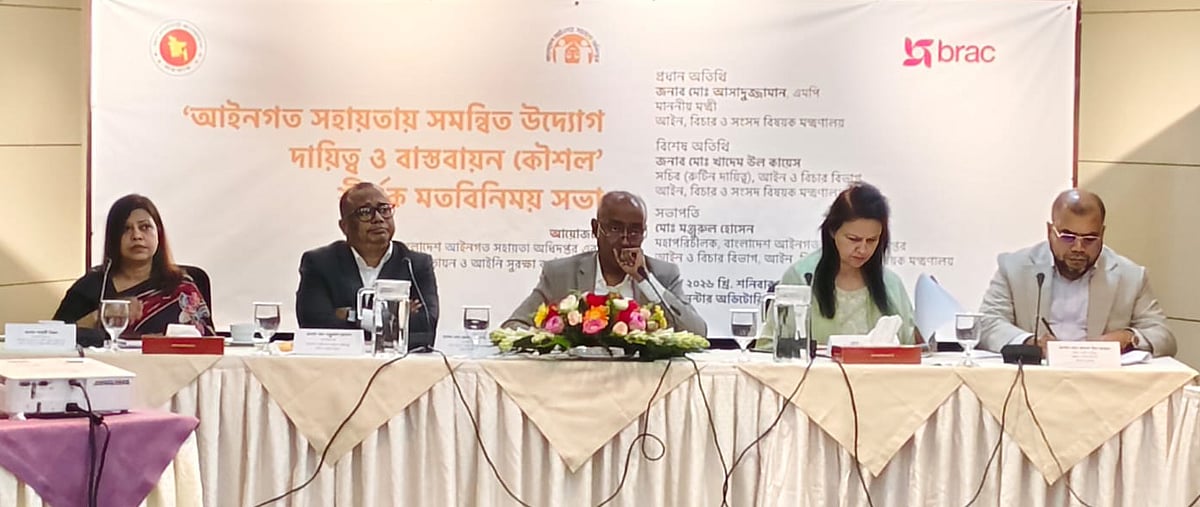
BRAC and Legal Aid Department host national consultation meeting
Effective coordination between government and non-government initiatives is essential to ensure accessible, humane, and inclusive legal aid for marginalised and disadvantaged communities across the country. Gaps in information sharing, monitoring, service referrals, coordinated planning, and joint implementation among relevant stakeholders must be addressed. Government and non-government institutions must also work together to raise public awareness regarding legal aid services.
Speakers highlighted these issues at a consultation meeting titled ‘Coordinated Initiatives in Legal Aid: Responsibilities and Implementation Strategies’ held on Saturday, 23 May, at BRAC Centre in Mohakhali, Dhaka. The meeting was jointly organised by the National Legal Aid Services Organisation (NLASO) and BRAC’s Social Empowerment and Legal Protection (SELP) programme, reports a press release.
As the chief guest at the event, Md Asaduzzaman, MP, minister for Law, Justice and Parliamentary Affairs, said the government is working to ensure access to justice for every citizen. Both government and non-government partners share the common objective of delivering legal aid services to the doorsteps of poor and vulnerable people. At present, around 4.5 million cases remain pending before the courts. Of the cases eligible for settlement through mediation, 80 per cent can be resolved in a single day, while the remaining 20 per cent can be resolved in two to three days.
Emphasising the need to determine the number of cases eligible for settlement, the minister said that resolving 50,000 cases through mediation within three months could significantly improve the situation. He added that meaningful change could be achieved within two years under such an initiative. The government is placing importance on mediation both before and after cases are filed. Government and non-government institutions must jointly undertake awareness campaigns on this issue.
Highlighting the need to strengthen and sustain coordination among institutions working on legal aid, the minister urged stakeholders to submit recommendations from the grassroots level regarding existing challenges and possible solutions. He added that the government would review proposals requiring amendments to the law. He also stressed the importance of incorporating legal aid issues into educational curricula to raise awareness among students.
Responding to journalists’ questions regarding the rape and murder of a child in Pallabi, Dhaka, the law minister said the government would take all necessary measures to ensure the case is concluded as swiftly as possible.
Zeba Amina Khan, MP, Reserved Women’s Seat, Bangladesh National Parliament, underscored the importance of united action against violence against women, child marriage, and social discrimination. She stressed the need for awareness campaigns and broader social initiatives.
Special guest Md Khadem Ul Qayes, Secretary (Routine Charge) of the Law and Justice Division, said that establishing a strong referral mechanism and an integrated common database is essential to ensure effective oversight, coordination, and service delivery. He emphasised the importance of increased information exchange and coordinated initiatives among relevant institutions, as well as integrated implementation structures at district and sub-district levels.
In his remarks as chair, Md Monjurul Hossain, Director General of the National Legal Aid Services Organisation (NLASO), Bangladesh, said joint partnerships between government and non-government organisations are critical to delivering legal aid services at the grassroots level. He highlighted the need for coordination with the Department of Social Services to ensure safe homes, protection, and rehabilitation support for survivors. He also called on all stakeholders to work together towards an inclusive and sustainable legal aid system.
The welcome address was delivered by Shashwatee Biplob, Associate Director of BRAC’s Social Empowerment and Legal Protection and Gender Justice and Diversity Programme. She said that empowering marginalised and vulnerable communities, ensuring legal aid, and promoting social justice are the core objectives of the Legal Aid Services Act. Highlighting the positive impact of the Legal Aid Services Act 2000 (amended), she called for strengthening alternative dispute resolution (ADR) mechanisms. She also stressed the importance of raising awareness, learning from field-level experiences, and building a safe and inclusive society.
ATM Morshed Alam, Lead of Legal Aid and Policy Advocacy at BRAC, moderated the session. Representatives from government institutions, development partners, national and international non-government organisations, civil society groups, and other relevant stakeholders participated in the meeting.
The discussion particularly focused on expanding inclusive legal aid services for women, children, persons with disabilities, working-class communities, the Hijra community, prisoners, migrant families, climate-vulnerable populations, and people living in remote areas. Participants also discussed digital legal aid services, online dispute resolution, pre-case mediation, and integrated implementation structures at district and sub-district levels.
The organisers expressed hope that the consultation meeting would further strengthen effective partnerships between government and non-government initiatives and help develop a sustainable and coordinated framework to ensure justice-based services reach people across the country.