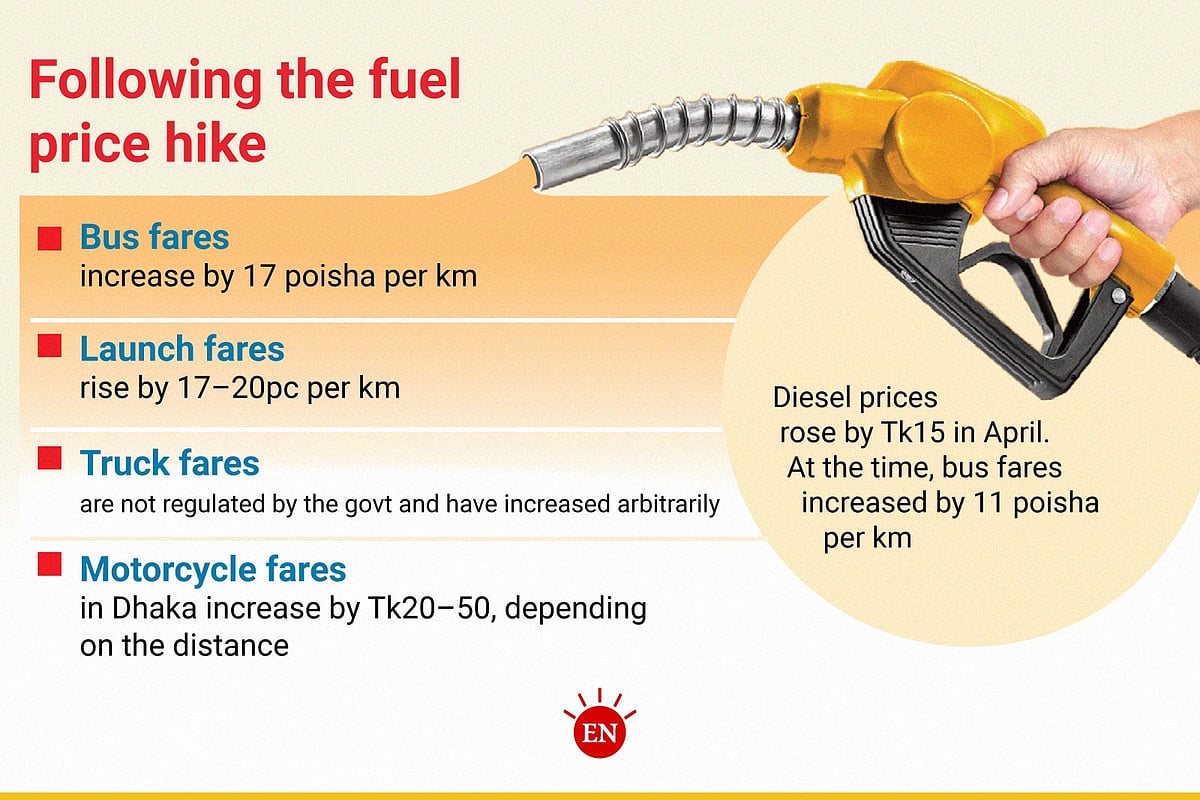
Following the increase in fuel prices, the government raised bus fares by 17 poisha per kilometre yesterday, Tuesday. Launch operators have announced fare increases of 17–20 per cent per kilometre. Truck operators are also charging higher fares.
Taken together, people are once again facing the pressure of higher fares and rising prices of essential goods, just five months after the previous increase.
The higher fares for passenger transport are coming directly out of people’s pockets. Meanwhile, the increased cost of transporting goods is initially being borne by traders and wholesalers. Ultimately, however, the pressure is passed on to the market for essential commodities, forcing consumers to buy goods at higher prices.
The government raised fuel prices by Tk 20 per litre on Sunday night. Five months earlier, in April, prices had been raised by Tk 15–20. Bus fares were increased by 11 poisha per kilometre at the time. Truck fares also went up.
Diesel prices have now risen by Tk 35 per litre in two rounds over five months. An increase in diesel prices affects people across all sections of society, because almost all modes of transport—including passenger buses, trains, launches, goods trucks, covered vans and ships—run on diesel. A large proportion of agricultural machinery also runs on diesel.
Speaking to journalists after a meeting on fare increases at the Secretariat on Tuesday, Road Transport, Railways and Shipping Minister Shaikh Rabiul Alam said, “Any increase in fares is a burden on the people. But considering the circumstances, we have been able to keep the fare increase, resulting from the fuel price hike, below what would be considered reasonable.”
Higher fares for long-distance and city buses
The gazette notification on the bus fare increase was issued on Tuesday night. Under the government’s new decision, bus fares in Dhaka and Chattogram metropolitan areas have risen from Tk 2.53 to Tk2.70 per kilometre. The fare for minibuses has increased from Tk 2.43 to Tk2.60. For 52-seat long-distance buses, the fare has risen from Tk 2.23 to Tk 2.40 per kilometre.
Diesel prices have now risen by Tk 35 per litre in two rounds over five months. An increase in diesel prices affects people across all sections of society, because almost all modes of transport—including passenger buses, trains, launches, goods trucks, covered vans and ships—run on diesel.
The government does not set fares for air-conditioned buses. Nor does it determine fares for goods-carrying vehicles such as trucks and covered vans.
Even before the new government-set fares came into effect, passengers were already being charged more on various routes. Yesterday, passengers travelling on long-distance buses from Dhaka’s Sayedabad and Fulbaria bus terminals were being charged an additional Tk 50–200.
At Fulbaria Bus Terminal yesterday morning, a passenger named Hosne Ara Begum bought tickets on a Tungipara Express bus. She was travelling to Gopalganj with her daughter. She paid Tk 1,100 for two tickets on a non-AC bus.
“There is no bus charging less. Everyone is taking an extra Tk50 per ticket,” she said.
Within the capital, fares of Tk 10 were being raised to Tk15 on some routes, while fares of Tk15 were being raised to Tk 20 on others. Some buses were still charging the old fares until yesterday afternoon.
At around 11:00 am, a bus operated by Moumita Paribahan arrived at Shonir Akhra. It runs between Chashara in Narayanganj and Chandra in Gazipur. As passengers boarded, the driver’s assistant, Saddam Hossain, was telling them, “The fare is higher today.”
Once on board, passengers were seen arguing over the higher fares. They also questioned why they were being charged more when the new fare list had not yet been published. Saddam Hossain told Prothom Alo that they were charging an additional Tk5 at each stop. However, he said, they were unable to collect the extra amount from every passenger.
Following the diesel price increase, the cost of transporting goods from various districts to Khatunganj in Chattogram has begun to rise. Traders said truck owners were already demanding an additional Tk 4,000–6,000 on some routes.
Following the fuel price increase, ride-sharing motorcycle drivers have been charging an additional Tk 20–50, depending on the distance.
Sabbir Hossain supports his family by running a ride-sharing motorcycle. He told Prothom Alo at Shahbagh intersection on Tuesday that passengers did not want to pay more even though fuel prices had increased. But with fuel prices rising, he said, drivers had no alternative but to charge higher fares.
Truck and covered-van fares rise arbitrarily
Truck driver Mohammad Masud travelled from Pabna to Khatunganj in Chattogram, one of the country’s largest wholesale markets for consumer goods, carrying onions yesterday.
According to his calculations, his truck consumes around 220 litres of diesel for the round trip. With the price of diesel rising by Tk 20 per litre, his cost for the same trip will increase by Tk 4,400 on fuel alone.
It is not only Mohammad Masud’s truck. Following the diesel price increase, the cost of transporting goods from various districts to Khatunganj in Chattogram has begun to rise. Traders said truck owners were already demanding an additional Tk 4,000–6,000 on some routes.
Chowdhury Zafar Ahmed, secretary general of the Bangladesh Covered Van-Truck-Prime Mover Goods Transport Owners’ Association, said truck operators were now charging up to Tk 5,000 more for transporting goods from Chattogram to Dhaka and Savar. The cost of transporting goods had increased, he said.
Passengers did not want to pay more even though fuel prices had increased. But with fuel prices rising drivers had no alternative but to charge higher fares.Sabbir Hossain, A ride-sharing motorcycle driver in Dhaka
The fare for transporting garments products from Benapole to Kanchpur in Dhaka in a 10.5-tonne covered van used to be Tk 18,000–19,000. It is now Tk22,000. The fare for transporting a truckload of rice from Kushtia to Dhaka has also risen from Tk 20,000 to Tk 22,000.
Mohammad Hossain, general secretary of the Bangladesh Covered Van-Truck-Prime Mover Goods Transport Owners’ Association, told Prothom Alo that letters had been sent to clients regarding the increase in transport fares.
He said the Tk50,000 charge for transporting a container from Dhaka to Chattogram would rise by up to Tk 10,000.
The fuel price increase has also affected the handling of import-export containers. A 9.85 per cent “fuel surcharge” has been imposed on various services provided by 21 private container depots in Chattogram. The new charge took effect on Monday.
The Bangladesh Inland Container Depots Association (BICDA) said diesel-powered machinery and vehicles were used to operate the depots. The surcharge had been imposed because operating costs had increased following the rise in diesel prices.
Launch fares also rise
The government has not officially increased launch fares. However, fares on passenger launches operating directly on the Dhaka–Barishal route have risen by around 17 per cent for deck seats and up to 20 per cent for cabins. The new fares set by the launch owners’ association came into effect yesterday, Tuesday.
The government says it raised prices because it had no other option. If there really was no alternative, then where does the money come from to raise salaries and make large purchases?Salauddin Sardar, A private-sector employee
Under the decision of the launch owners’ association, the deck fare on the Dhaka–Barishal route has increased from Tk300 to Tk350. The fare for a single cabin has risen from Tk 1,000 to Tk 1,200, while the fare for a double cabin has increased from Tk 2,000 to Tk 2,400.
Inflation set to rise
Inflation in the country stood at 8.26 per cent in August. Inflation has remained high since 2022, while wages have risen at a slower pace during this period. In other words, real incomes have declined. BBS data show that August 2026 inflation was 8.26 per cent, with non-food inflation at 9.32 per cent.
Citing a study by the private research organisation, Power and Participation Research Centre (PPRC), the report said in August 2025 that the poverty rate had reached 27.93 per cent, or around 28 per cent. According to government figures, the rate was 18.7 per cent in 2022.
Analysts fear that the increase in fuel prices could push inflation even higher. Poverty could rise further as a result.
For private-sector employee Salauddin Sardar, the main concern is how he will support his family. He told Prothom Alo, “The government says it raised prices because it had no other option. If there really was no alternative, then where does the money come from to raise salaries and make large purchases?”
He added, “Ordinary people have had their backs against the wall for a long time. How are they supposed to run their households?”
[The Prothom Alo Chattogram office and its Staff Correspondent in Barishal contributed to this report.]