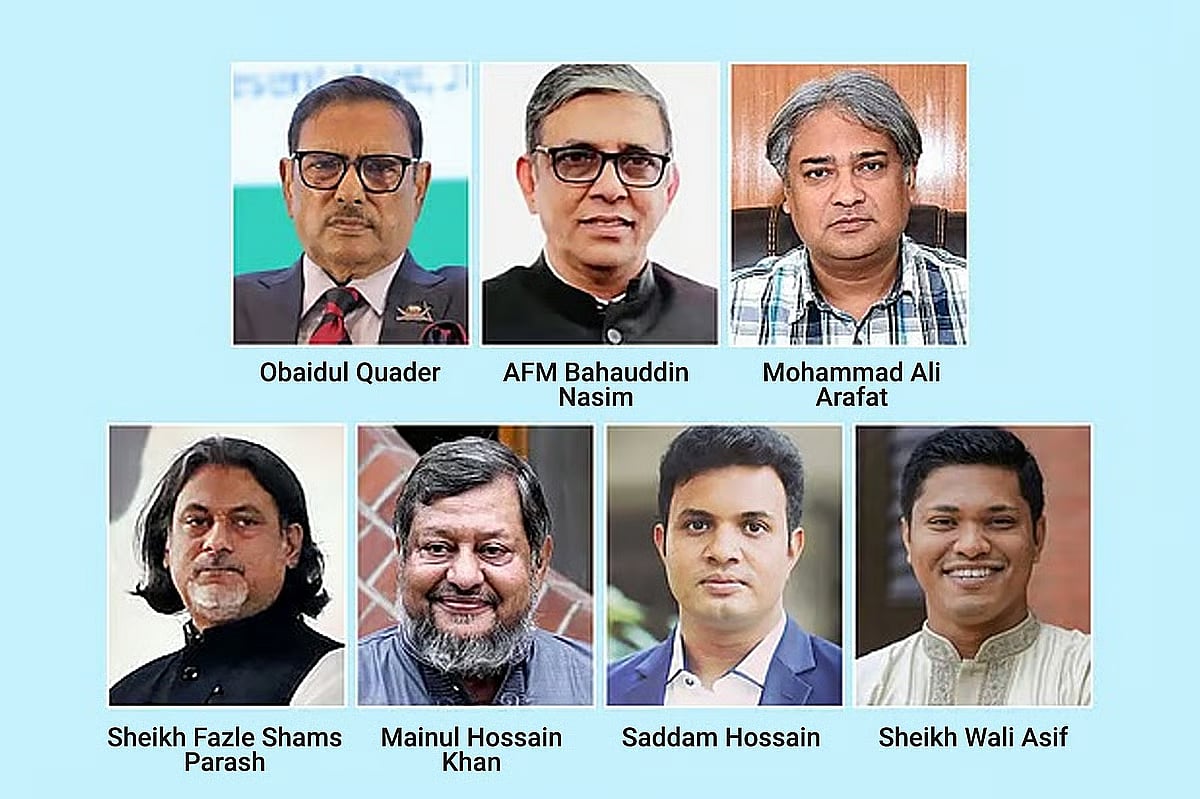
Crimes against humanity: Obaidul Quader, 6 other sentenced to death
Seven accused, including Awami League (whose activities have been banned in the country) General Secretary Obaidul Quader, have been sentenced to death for crimes against humanity committed during the July mass uprising.
A three-member bench of International Crimes Tribunal-2, headed by Justice Nazrul Islam Chowdhury, delivered the verdict today, Tuesday. The other two members of the tribunal are Justice Md Manzurul Basid and Justice Nur Mohammad Shahriar Kabir.
The other accused sentenced in the case are Awami League (activities banned) Joint General Secretary AFM Bahauddin Nasim; former state minister for information and broadcasting Mohammad Ali Arafat; banned Jubo League Chairman Sheikh Fazle Shams Parash; General Secretary Mainul Hossain Khan; banned Chhatra League Central President Saddam Hossain; and General Secretary Sheikh Wali Asif. All the accused are absconding.
Sheikh Hasina, president of the Awami League (activities banned) and ousted prime minister, was sentenced to death on 17 November last year for crimes against humanity committed during the July mass uprising. Nearly 10 months later, the verdict has been delivered in the case against seven accused, including the party’s general secretary, Obaidul Quader.
The Awami League government fell on 5 August 2024 in the face of the student-public uprising. Subsequently, trials began before the reconstituted International Crimes Tribunal for charges of crimes against humanity committed during the July mass uprising. Today’s verdict is the seventh in cases involving crimes against humanity committed during the uprising.
Across seven verdicts delivered by the two tribunals, 68 accused have been sentenced. Of them, 22—including Sheikh Hasina, Obaidul Quader and former home minister Asaduzzaman Khan—have been sentenced to death. Eighteen of those 22 are fugitives, while four are in custody.
Charges against Obaidul Quader
The formal charges presented before the tribunal provide details of the allegations against each of the seven accused. Three ‘counts’ (charges) were brought against Obaidul Quader.
The first count states that at 5:50 pm on 11 July 2024, Awami League General Secretary Obaidul Quader spoke by phone with Bangladesh Chhatra League President Saddam Hossain. At the time, while giving direct instructions to suppress the movement, Quader told Saddam, “Why don’t you beat them? Why are you encouraging them?”
At a press conference at Gonobhaban on 14 July 2024, Sheikh Hasina made provocative remarks referring to the protesters as the “children and grandchildren of Razakars.” Obaidul Quader was present at the press conference and, according to the charges, supported and incited the commission of crimes.
The following day, 15 July, at a press conference at the Awami League president’s party office in Dhanmondi, Obaidul Quader said, “Chhatra League will respond to the self-proclaimed Razakars,” calling for action against the quota reform protesters and to suppress the movement. Through this statement, he incited Chhatra League against the students and members of the public participating in the movement. He also ordered their killing, according to the charges.
Motivated by these and other statements and directives from Obaidul Quader, armed Chhatra League members, along with law enforcement personnel, attacked innocent and unarmed students at Dhaka University and in various other locations and educational institutions across the country. As a result, around 300 students, including women, were seriously injured at Dhaka University that day, while countless others were injured across the country.
On 16 July, Obaidul Quader called then state minister for information and communication technology Zunaid Ahmed Palak and instructed him to slow down internet speeds in an effort to suppress the movement.
On the same day, Quader called former Chattogram City Corporation mayor AZM Nasir Uddin and instructed him to maintain control over Chattogram University and all areas of Chattogram city.
Following these directives from Obaidul Quader, Awami League activists shot dead Mohammad Wasim, Faisal Ahmed Shanto and Md Faruk in the Muradpur area under Chandgaon police station in Chattogram. On the same day, six unarmed protesters, including Begum Rokeya University student Abu Sayed in Rangpur, were killed across the country.
The second count against Obaidul Quader states that on 17 July 2024, at the party office in Tejgaon, he instructed leaders of the Dhaka District Awami League, Dhaka North and South city units, and other senior party leaders to prepare and organise resistance in their respective areas to suppress the movement.
The following day, 18 July, at a press conference at the Awami League office in Dhanmondi, Obaidul Quader described the movement as anti-government and conspiratorial. He instructed leaders, activists and supporters of the Awami League and its affiliated organisations to take to the streets and build resistance to deal with the situation.
On 19 July, after a meeting of the Awami League and 14-party alliance leaders at Gonobhaban, Obaidul Quader spoke about the imposition of a curfew and deployment of the army, saying, “It must be a curfew, and it will be shoot-at-sight.” In other words, he ordered that protesters be shot on sight.
In phone conversations with Sheikh Hasina, Obaidul Quader engaged in various conspiracies to suppress the movement, according to the charges. They also conspired to set fire to important government installations and blame the protesters for the arson.
As part of the conspiracy to suppress the movement, Obaidul Quader gave instructions for abduction, enforced disappearance, killing and torture through conversations with Awami League leaders Asaduzzaman Khan, Anisul Huq, Mohammad Ali Arafat, Sheikh Fazle Shams Parash, Mirza Azam, Shamim Osman, AHM Khairuzzaman Liton, DB chief Mohammad Harun-or-Rashid and others.
Following these directives from Obaidul Quader, law enforcement personnel and Awami League activists shot dead three people, including Sheikh Shahriar Bin Matin, in Mirpur on 18 July; 30 people, including Asif Iqbal, on 19 July; and Sifat Hossain and six others in the Mohakhali area on 20 July. Numerous other protesters were also killed across the country.
The third count against Obaidul Quader states that at a press conference at the Awami League office in Dhanmondi on 3 August 2024, he instructed party leaders and activists to take positions in neighbourhoods and localities to resist the movement.
Following this directive, law enforcement personnel and Awami League activists shot dead 12 people, including Shahriar Hasan Alvi, Miraj Farazi and Mohiuddin, in Mirpur on 4 August 2024; seven people, including Ishtiaq Ahmed, in Feni’s Mahipal; and four people, including Sad-Al Afnan, in Lakshmipur Sadar.
Similarly, on 5 August, 20 people, including Mahfuzul Alam, were killed in Mirpur, while numerous protesters, including Raihan Ali and Sakib Anjum, were killed across the country, including in Rajshahi city.
In the same way, in an effort to suppress the movement across the country, more than 1,400 innocent and unarmed protesters were killed using lethal weapons, while more than 25,000 protesters sustained serious injuries.
Charges against Nasim
According to the formal charges, on 15 July 2024, Obaidul Quader held a press conference at the Awami League office in Dhanmondi to suppress the movement and the protesters, saying, “Chhatra League will respond to the self-proclaimed Razakars.”
Bahauddin Nasim was present at the press conference and, according to the charges, supported and incited the commission of crimes. Motivated by his incitement, armed cadres of the Awami League, Jubo League and Chhatra League, together with law enforcement personnel, carried out a brutal attack on protesting students at Dhaka University, which was in Nasim’s electoral constituency, on 15 July.
Following Nasim’s incitement, Awami League activists shot dead Mohammad Wasim, Faisal Ahmed and Md Faruk in Chattogram. On the same day, six people, including Abu Sayed, were killed across the country.
Sheikh Hasina ordered the use of lethal weapons and helicopters to kill students and members of the public. Obaidul Quader ordered a “shoot-at-sight” policy. According to the charges, as Awami League joint general secretary, Bahauddin Nasim played a key role in implementing these decisions through Awami League leaders and activists and law enforcement agencies across the country.
In his home district of Madaripur, Nasim supervised the suppression of the quota reform movement on an ongoing basis through former mayor Khalid Hossain. Under the protection of law enforcement agencies, cadres of the Awami League, Jubo League, Chhatra League and Swechchhasebak League killed Dipto Dey on 18 July and Touhid on 19 July and seriously injured numerous protesters.
On 3 August, Nasim was present at the Awami League office in Dhanmondi when Obaidul Quader held a press conference and instructed party leaders and activists to take positions in neighbourhoods and localities to resist the movement. According to the charges, Nasim’s presence there constituted support for and incitement to the commission of crimes.
On 4 August 2024, at the Institute of Engineers, Bangladesh in Farmgate, Dhaka, Nasim delivered an inflammatory speech portraying participants in the movement as Jamaat-Shibir members, war criminals, religious profiteers, identified criminals, an evil force, opponents of independence and opponents of the spirit of the Liberation War.
Following such incitement, on 4 August, alongside law enforcement personnel, Awami League activists killed Abdul Gani, Belal Hossain and Nayan Mia in Banglamotor, within Nasim’s electoral constituency, and Obaidul Haque at the Nightingale intersection in Paltan.
The following day, 5 August, they killed 13 people, including Rakib Hossain in front of Dhaka Medical College Hospital, Ramzan Mia in front of the Awami League office in Gulistan, Ismail Hossain in the Banglamotor area and Ismam ul Haque in the Chankharpul area.
Similarly, more than 1,400 protesters were killed and more than 25,000 people were seriously injured across the country through the use of lethal weapons in an effort to suppress the movement.
Charges against Arafat
Mohammad Ali Arafat served as the state minister for information and broadcasting in the Awami League government during the July mass uprising. According to the formal charges, on 13 July 2024, at the Awami League office in Tejgaon, he made various provocative and conspiratorial statements, including saying that there was no justification for the quota reform movement.
The following day, 14 July, Sheikh Hasina made provocative remarks at a press conference at Ganabhaban, referring to the protesters as the “children and grandchildren of Razakars.” Arafat was present and, according to the charges, supported and incited the commission of crimes.
Later that night, Arafat entered the Dhaka University area and made various provocative statements. He also ordered a planned attack. The following day, Jubo League and Chhatra League activists launched armed attacks on protesters in the Dhaka University area.
On 19 July, Arafat labelled participants in the quota reform movement as terrorists during a press briefing. He also threatened them by saying that law enforcement agencies had sufficient stockpiles of weapons and ammunition to continue using them for five years.
On 19 July, Awami League, Jubo League, Chhatra League and other party cadres launched attacks around the Mohakhali railway crossing and the Chourasta area, within Arafat’s electoral constituency, shooting dead six protesters, including Md Shahjahan and Gani Mia. According to the charges, Arafat was responsible for overall supervision of the killings.
Arafat spoke to Obaidul Quader by phone on 20 July. In an effort to suppress the movement and divert it from its course, Arafat said, “We switched off two or three [television channels] yesterday. I have also said today that those who do not listen, I will have them switched off immediately.”
Arafat shut down the broadcasts of Bangla Vision, Desh TV, Channel 24 and NTV for 30 minutes at 6:00pm on 18 July, while their evening news bulletins were being aired, and those of Bangla Vision and Channel 24 for 30 minutes at 2:00pm on 22 July, after they broadcast reports on the government’s unlawful use of force and various acts of violence during the movement.
As the movement turned into a mass uprising on 4 August, Arafat held a press briefing in the Parliament complex as the spokesperson of the ousted government, where he described the participants in the movement as terrorists.
He claimed that the movement involved violent activities and instructed law enforcement agencies, as well as leaders, activists and supporters of the Awami League and its affiliated organisations, to suppress it.
Following that directive, more than 1,400 protesters were killed and more than 25,000 protesters were seriously injured through the use of lethal weapons.
Charges against Sheikh Fazle Shams Parash
According to the charges against Sheikh Fazle Shams Parash, during the July Mass Uprising, he issued various directives to the Awami Jubo League under his control to suppress the movement nationwide, acting on instructions from Sheikh Hasina and Obaidul Quader.
Following Parash’s orders, Jubo League leaders and activists, armed with firearms and domestic weapons, launched attacks on protesters across various parts of the country, killing and severely injuring innocent and unarmed students and members of the public.
During the crackdown, attacks by law enforcement agencies, the Awami League, Jubo League, Chhatra League, and the 14-Party armed cadres resulted in the deaths of over 1,400 students and people, whilst more than 25,000 were gravely injured. Parash was one of the central leaders and order-givers behind these killings and acts of violence.
On 18 July, Jubo League cadres opened fire indiscriminately in Chattogram city, killing Tanveer Siddiqui, Saimon Mahin, and Hridoy Chandra Tarua.
On 19 July, Jubo League cadres shot and killed Shahajahan, Goni Mia, Al Amin Roni, Jahid Hossain, Imam Mehdi Hasan, and Mamun Hossain in the Mohakhali area.
At Bangabandhu Avenue in the capital on 1 August, Parash characterised the Anti-Discrimination Student Movement as aggression and devastation.
He stated, “Today, an executive declaration banning Jamaat may finally be issued. Following this announcement, they may launch a desperate final strike. You must exercise maximum vigilance in this regard.”
The formal complaint notes that declaring a disciplined party like Jamaat-e-Islami—a major partner in the Anti-Discrimination Student-People Movement—banned prior to the 14-Party meeting constituted a conspiracy. It further states that on 4 August, Jubo League cadres under Parash opened fire indiscriminately in Lakshmipur town, killing Saad-al Afnan, Osman Patwari, Sabbir Hossain, and Kawsar. On 5 August, Jubo League members killed two individuals, Ali Raihan and Sakib Anjum, in Rajshahi city.
Charges against Mainul Hossain Khan
The formal charges against Mainul Hossain Khan states that on 12 July 2024, during an event at the Sylhet City Corporation, he taunted the protesters. He instructed Jubo League leaders, activists, and followers to remain prepared to resist the movement.
Instigated by the instructions and incitement of Obaidul Quader, Mainul personally took up arms on 19 July and conducted a show of force in the Mirpur area. He launched attacks on the protesters, including opening fire. That afternoon, under his leadership and direction, indiscriminate firing in Mirpur resulted in the deaths of 26 people, including Rustom and Asif Iqbal.
In Mainul’s presence and under his supervision, law enforcement agencies, and armed goons of the Jubo League, and other affiliate organisations killed 12 people, including Shahriar Hasan, on 4 August in Mirpur, and 20 people, including Mahfuzul Alam, on 5 August. He also faces charges regarding the deaths of 1,400 individuals and injuries to more than 25,000 protesters.
Charges against Saddam Hossain
The case documents state that on 11 July 2024, during a Chhatra League gathering at the feet of Raju Memorial Sculpture of Dhaka University, Saddam Hossain threatened and provoked protesters, stating that "no one will be spared".
To carry out Obaidul Quader’s instruction—"Why aren't you hitting them? Why are you indulging them?"—Saddam incited and instructed armed goons operating under the banner of the Chhatra League across the country. Additionally, he accepted funds, formulated plans, and issued organisational directives to suppress the movement.
On 15 July, under Saddam's leadership, external Jubo League and Chhatra League cadres launched an armed assault on unarmed protesters in the Dhaka University area. Members of the Chhatra League Central Committee, Dhaka University Committee, Dhaka City North and South Committees, and the Dhaka College Committee were directly involved in this attack.
Acting on Obaidul Quader's provocation and directive that "Chhatra League will answer the self-proclaimed Razakars", Saddam ordered and supervised Chhatra League attacks on protesters at educational institutions, cities, districts, and upazilas across the country, including Dhaka University.
On 15 July, Saddam delivered a provocative statement, asserting that "the Bangladesh Chhatra League will confront the Quota Reform Movement politically". On 16 July, he threatened to "teach the protesters a lesson". Following his remarks, armed Chhatra League goons carried out brutal attacks on unarmed general students at all educational institutions across the country, including the capital. On 16 July, six people were killed nationwide. The following day, over 400 students were injured across the country.
Alongside law enforcement agencies, armed goons from the Chhatra League, Awami League, and its associate organisations opened fire indiscriminately on 18 July, resulting in 23 deaths nationwide.
Throughout the student-led mass movement, armed Chhatra League goons carried out attacks across the country under Saddam’s incitement, instruction, and supervision. He is similarly charged with the deaths of 1,400 people and injuries to more than 25,000 protesters.
Charges against Sheikh Wali Asif Inan
The formal charges state that Sheikh Wali Asif Inan formulated plans, issued directives, and accepted funding to suppress the movement. On 13 July, he delivered aggressive, hateful, and provocative speeches at Madhur Canteen on Dhaka University campus, attempting to intimidate protesters into withdrawing from the movement.
On 15 July, Inan issued orders to resist the students' movement. Under his leadership that day, members of the Chhatra League Central Committee, Dhaka University unit, Dhaka City North and South units, and the Dhaka College unit launched attacks in the Dhaka University area.
On 16 July, Inan was present at the Raju Sculpture and endorsed the threats made by Saddam to "teach the protesters a lesson". Six people were killed nationwide that day.
On 18 July, attacks by the Chhatra League and others resulted in 23 deaths across the country. Throughout the student-led movement, armed Chhatra League terrorists carried out attacks nationwide under Inan’s incitement, instruction, and supervision. He also faces charges regarding the deaths of 1,400 individuals and injuries to more than 25,000 protesters.