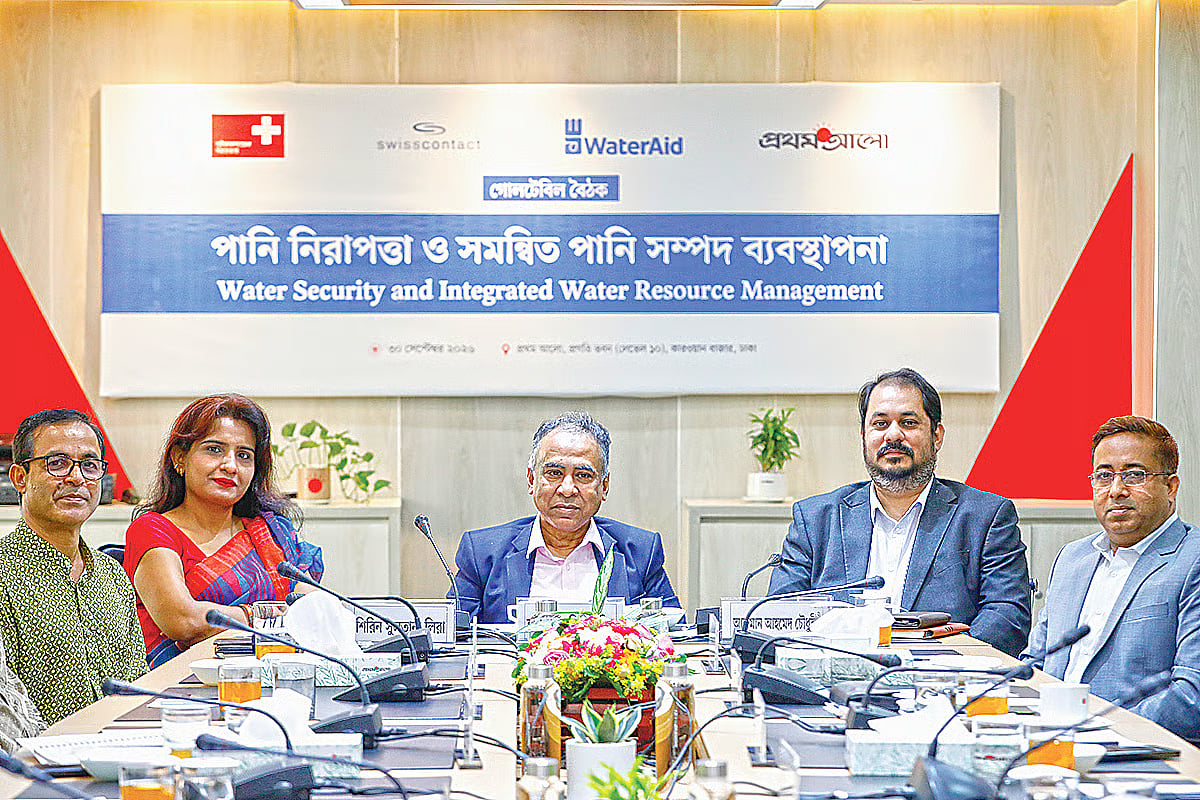
Roundtable
Call for sustainable water management
Bangladesh has no shortage of laws, plans or regulations concerning water. The country also has numerous water-related projects and infrastructure, while several government ministries work in the sector. Yet coordination among them remains inadequate.
This lack of coordination is not limited to government ministries and agencies; it is also evident among international organisations working in the water sector. Sustainable, climate-resilient water management requires both an integrated plan and effective coordination in its implementation.
Speakers at the roundtable stressed the need for long-term planning in the water sector, public engagement and women’s participation in the planning process, and mechanisms for government agencies to share data and information with one another. They also called for greater information exchange between government and non-government organisations.
Short-term planning, lack of coordination
Water-related problems exist across Bangladesh, but their nature varies from one region to another. The drought-prone northwest, haor areas, coastal belt, hill regions, the capital and other urban areas each face different types of water challenges.
Mohammad Hasan Zafir Tuhin, chairman of the Barind Multipurpose Development Authority (BMDA), highlighted these regional differences. He said that despite the varying nature of the problems, there was no integrated plan to address them. Most plans in the country are short-term, he added, and the problem also lies with those involved in policymaking.
The BMDA has played an important role in expanding irrigation facilities in the Barind region. Hasan Zafir Tuhin said water scarcity had been one of the main causes of poverty in northern Bangladesh. Poverty declined considerably after access to water improved.
Recently, however, the Water Resources Planning Organisation (WARPO) declared a vast part of the Barind region a water-stressed area. Criticising the move, he said laws were enacted in Bangladesh without first assessing how feasible their implementation would be.
Measures needed to ensure water security
The roundtable was not limited to the issue of safe drinking water. Participants also discussed environmental concerns, water sources, transboundary water flows and other related issues.
SM Zobaidul Kabir, joint chief of the Delta Wing at the General Economics Division of the Planning Commission, said around 91 per cent of Bangladesh’s total water flow originates outside the country. In other words, transboundary rivers are a major source of the country’s water. This makes the management of the Ganges, Brahmaputra and Meghna river basins critically important for Bangladesh.
Zobaidul Kabir said the issue for Bangladesh was not merely how much water entered the country. It was also necessary to consider when the water arrived, whether its volume was adequate, whether it was safe and suitable for agriculture, how the flow was changing, and how those changes affected the lives and livelihoods of people downstream.
All these factors must be addressed in an integrated manner to ensure water security in Bangladesh, he added.
Emphasising the need for coordination, WaterAid Bangladesh country director Azman Ahmed Chowdhury described water as a key driver of the economy. He said access to water—particularly safe water—was not merely a development issue. It was directly linked to people’s lives, health and dignity. This, he said, underscored the importance of integrated water resources management.
Preventing water waste is essential
Bangladesh’s water sector remains heavily dependent on groundwater. Agriculture accounts for 90 per cent of total water use, while drinking water accounts for 8 per cent and industry for 2 per cent.
Participants discussed the excessive use of water in agriculture. They also pointed out that the readymade garment sector uses groundwater.
Mohammad Saiful Islam Majumder, joint secretary of the Policy Support Branch under the Local Government Division, said a considerable amount of water was also wasted at the individual level. Behavioural change was essential in every sector, he said, adding that there was no alternative to it in tackling water scarcity.
Recommendations to overcome water scarcity
Anwar Zahid, a former director of the Bangladesh Water Development Board, said water should be allocated after assessing the amount of usable water available at the union level and the level of demand.
The Water Act provides for committees to be formed from the union level. These committees are supposed to analyse data and allocate water by considering demand and availability across different sectors. In practice, however, the committees are not functioning effectively.
Shirin Lira, senior programme manager for Governance, Climate Change and Environment at the Agency of Switzerland in Bangladesh, stressed the need to ensure marginalised people’s access to water. She said ponds and other water bodies existed in many indigenous communities, but people living beside them often had no rights over those resources.
Women use the most water at the household level. Yet despite carrying out the physically demanding task of collecting water, their water rights remain largely unprotected, said Tania Haque, professor at the Department of Women and Gender Studies at the University of Dhaka.
Others who spoke at the roundtable included Mohammad Motaleb Hossain Sarker, executive director of the Center for Environmental and Geographic Information Services (CEGIS); Mohammad Alamgir, chief scientific officer at WARPO; Mohammad Monirul Alam, WASH specialist at UNICEF Bangladesh; Shankar Kumar Biswas, director at the Department of Bangladesh Haor and Wetlands Development; Mohammad Zobayer Hasan, deputy executive director of DORP; Joseph Halder, convener of FANSA-Bangladesh; Mohammad Masud Hasan, deputy executive director of VERK; Nishat Sultana, director–ICC at Plan International Bangladesh; Alok Kumar Majumder, director for programmes and operations at RedOrange Limited; and Saif Manzur-Al-Islam, team leader of Go for Impact at WaterAid Bangladesh.
The roundtable was moderated by Prothom Alo assistant editor Firoz Choudhury.