Roundtable
Balanced foreign policy essential in changing world
Although geopolitical competition has intensified, the world's major powers remain mutually dependent in terms of the economy and trade. Against this changing global backdrop, Bangladesh must pursue a pragmatic, strategic and balanced foreign policy that places the national interest first in order to rebuild the economy and achieve long-term prosperity.
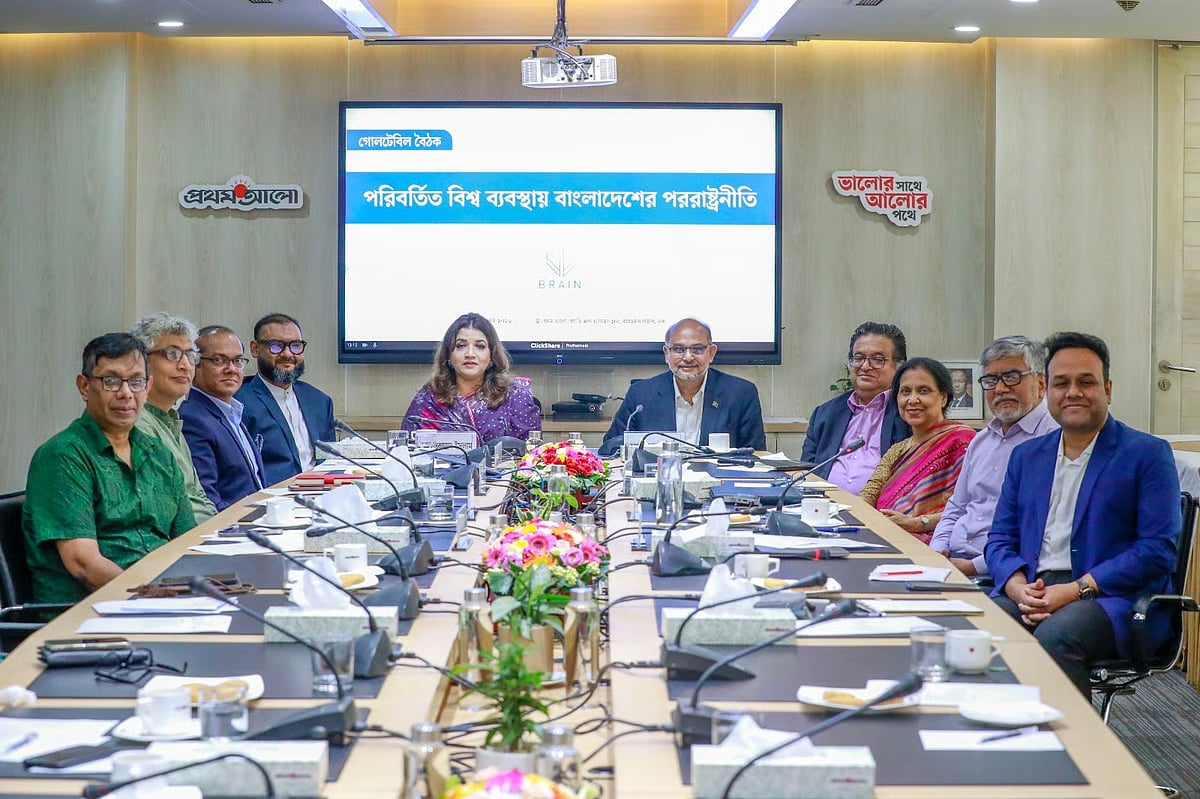
Government representatives, opposition figures and policy experts expressed this view at a roundtable discussion held today, Saturday. They said Bangladesh's foreign policy must evolve strategically in step with changes in the global landscape.
The research organisation Bangladesh Research Analysis and Information Network (BRAIN) organised the roundtable, titled 'Bangladesh's Foreign Policy in the changing world'. The event took place at the Prothom Alo office in Karwan Bazar, Dhaka, with Prothom Alo serving as the event's promotional partner.
The Prime Minister's Adviser on Economic Affairs and Planning, Rashed Al Mahmud Titumir said, “Bangladesh believes in multilateralism in the changing global order. It embraces multilateralism, which is why it is keen to join global and regional groupings such as BRICS, ASEAN, the Shanghai Cooperation Organisation (SCO) and the Regional Comprehensive Economic Partnership (RCEP). The present government has therefore expressed its interest in joining these alliances in order to strengthen Bangladesh's position as a ‘middle power’."
Bangladesh believes in multilateralism in the changing global order. It embraces multilateralism, which is why it is keen to join global and regional groupings such as BRICS, ASEAN, the Shanghai Cooperation Organisation (SCO) and the Regional Comprehensive Economic Partnership (RCEP).Rashed Al Mahmud Titumir, Prime Minister's Adviser on Economic Affairs and Planning
Rashed Al Mahmud Titumir said the government is pursuing a 'Bangladesh First' policy that prioritises domestic needs with the aim of rebuilding the fragile economy and achieving prosperity.
Highlighting the government's approach to tackling global uncertainty, he said,
"Rather than relying on loans or aid, the government is giving priority to industrialisation, production-oriented foreign direct investment and free trade agreements. Bangladesh is also strengthening strategic global partnerships through mechanisms such as the 'two plus two' framework."
Minister of State for Foreign Affairs Shama Obaed Islam said Bangladesh's strategic relationships with major powers such as China, India and Russia would rest on mutual benefit and the welfare of the Bangladeshi people.
"We will determine our bilateral relations with these countries entirely on the basis of Bangladesh's national interest."
Referring to the foreign policies pursued by the late President Ziaur Rahman and former Prime Minister Khaleda Zia, Shama Obaed said, "Under the leadership of Prime Minister Tarique Rahman, the government is implementing the 'Bangladesh First' policy. Rather than aligning blindly with or against any country, we are conducting foreign policy through strategic balance. To address the impact of the Middle East conflict and global uncertainty, the government is diversifying both energy sources and overseas labour markets instead of depending on a single source."
Bangladesh's strategic relationships with major powers such as China, India and Russia would rest on mutual benefit and the welfare of the Bangladeshi people.Minister of State for Foreign Affairs Shama Obaed Islam
Shama Obaed also said “Bangladesh believes any problems or differences with neighbouring India should be resolved through conversation". She added, "It is essential to maintain effective diplomatic engagement with India to stop border killings and to resolve trade imbalances and water-sharing issues."
Mir Ahmad Bin Quasem, member of parliament for Dhaka-14 and a leader of Bangladesh Jamaat-e-Islami, said the changing global environment had created an opportunity for Bangladesh to pursue a more ambitious foreign policy.
"However, to take full advantage of this opportunity, we must build a national consensus on strategic issues such as foreign policy, national security and energy security. The government should take the lead in this effort. At the same time, Parliament should become more effective, and its standing committees should be given a meaningful role in the policy-making process."
Mir Ahmad Bin Quasem said Bangladesh should pursue a foreign policy that is rooted in the national interest, independent and more proactive. He argued that the country should build strategic partnerships without relying on any single power, strengthen regional cooperation and project its position more confidently on the international stage.
Professor Amena Mohsin of the Department of International Relations at the University of Dhaka said that although the current world order is unstable and evolving, it has created new opportunities for Bangladesh.
"The rules-based international order may be under pressure, but it remains important for countries such as Bangladesh. We must therefore remain vigilant and seize the new opportunities emerging from the changing global environment."
Former Bangladeshi Ambassador to China Mahbub Uz Zaman said Bangladesh should base its foreign policy on multilateralism and regional cooperation in order to address current global challenges.
"To achieve this, Bangladesh should work to revitalise SAARC, expand infrastructure and economic cooperation with China, and strengthen constructive engagement with India on unresolved issues, particularly non-tariff barriers and the management of shared rivers."
Professor Mohammad Tanzimuddin Khan of the Department of International Relations at the University of Dhaka said, “The global order was still evolving and had not yet reached its final form. Although the United States, China and India compete strategically, they remain economically interdependent through trade and commercial relations. Bangladesh therefore has a significant opportunity to deepen its economic engagement and secure diplomatic advantages by making effective use of global and regional trade dynamics while safeguarding its national interest."
Drawing on his experience from a recent visit to China, Mohammad Hasan Arif, vice chairman of the Export Promotion Bureau (EPB), said Chinese businesses had shown growing interest in expanding trade, investment and connectivity with Bangladesh. "If potential economic corridors and transport connectivity projects serve Bangladesh's national interest, the country should make full use of those opportunities," he added.
Associate Professor Obaidul Haque of the Department of International Relations at the University of Dhaka said the changing global environment had opened new opportunities for Bangladesh.
"In today's global context, Bangladesh cannot remain confined to a policy of 'friendship to all'. The country must conduct its foreign policy on the basis of pragmatic, strategic and diversified engagement, with the national interest as its highest priority."
He also stressed the importance of building interest-based partnerships with all key partners, including the United States, China and India.
At the opening of the discussion, Shafiqur Rahman, executive director of the Bangladesh Research Analysis and Information Network (BRAIN), outlined the rationale behind the event.
He said, "Through rapid advances in technology and manufacturing, China has evolved beyond being a follower economy and has emerged as a frontier economy. Its rise in artificial intelligence, electric vehicles (EVs) and other high-technology sectors is creating a new global economic reality, the effects of which will be felt not only by advanced economies but also by countries such as Bangladesh."
Teacher and researcher Asif Bin Ali moderated the roundtable discussion. At the conclusion of the event, AKM Zakaria, deputy editor of Prothom Alo, delivered the vote of thanks.