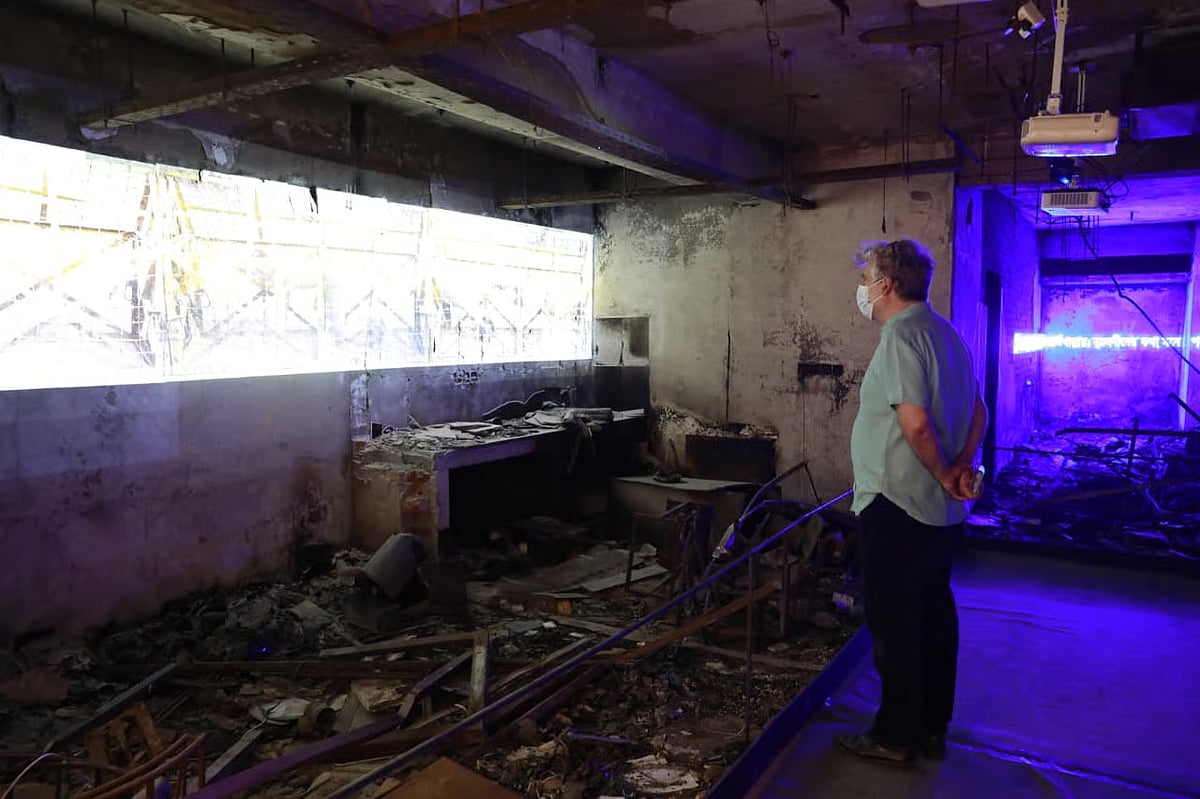
Exhibition at burned Prothom Alo building
‘I could feel some of the horror of that night’
An attack on an institution in this way cannot be a language of protest. Destruction never falls within humanity. It is truly very unfortunate. Such acts should not happen again in the future.
Today, Friday, marked the 10th day of the exhibition titled ‘Alo,’ created from the debris of the Prothom Alo building that was burned by organised extremists.
On the holiday, people from various walks of life and students came to see the exhibition. After witnessing the devastation, they expressed these views.
British journalist David Bergman, who has long written about Bangladesh, visited the exhibition today.
After touring it, Bergman wrote on Facebook, “The decision to stage an exhibition inside the very building that was set ablaze — targeted by anti-India and anti–free media extremists just a few months ago — is both courageous and inspired. Whoever conceived the idea deserves the highest praise, and the artist who brought it to life merits the strongest possible recognition.”
Bergman further wrote, “I visited today, and I cannot overstate how intelligent, inventive, and deeply thoughtful the exhibition is. It transforms destruction into reflection, and damage into meaning. You are unlikely to see anything quite like it.”
Whoever conceived the idea deserves the highest praise, and the artist who brought it to life merits the strongest possible recognition.David Bergman, Journalist
Sheikh Imrul Hasan came from Kallyanpur in the capital with his two daughters, Labiba Hasan Tia and Ariba Hasan Keya, to see the damaged building.
He said, “We have long read Prothom Alo; my children also read it. They enjoy Prothom Alo. It is unfortunate that the Prothom Alo office was burned down like this; it is a victim of negative politics.”
Labiba said she is now in sixth grade and has been reading Prothom Alo since she was in third grade. She especially likes the humour on page five and Gollachut. After touring the exhibition, Labiba said, “What happened last December was truly very sad. Seeing it here today made me feel very bad.”
Sabikun Nahar Swarnali, a student of the English Literature Department at the University of Liberal Arts Bangladesh (ULAB), said, “After seeing the exhibition, I could feel some of the horror of that night. Through the visuals, I also heard about the experiences of those who were inside during the fire. It gave me goose bumps. Those who did this were absolutely wrong. But we cannot always speak freely; there is a risk to life. If we speak in our own words, many will not accept it, and various labels will be attached.”
Perhaps there was anger over some news that was published. But no one can show such anger toward a building. This cannot be a language of protest. This system of expressing anger needs to change. And the artistic form that Prothom Alo has given to the destruction is unique. It is a protest against breaking art.Afrin Mahmud, Student of a private university in Dhaka
Another student, Jannatul Tasmia, praised this exceptional initiative. Seeing the destruction, she said, “This should never have happened. Anyone who has patriotism, whether from a religious perspective or any other, must understand that carrying out destruction does not fall within humanity.”
Another visitor, Juliet Mondol, said, “Many times we see incidents but cannot truly feel them from the heart. But after an incident, to present a pile of ruins in a new artistic form to people has deeply moved me. Those who carried out these acts of destruction never have good intentions. I hope such acts will not happen again in the future.”
Two classmates, Afrin Mahmud and Sumaiya Fatema, also came to see the exhibition. They are students of the Business Administration Department at a private university in the capital.
After touring the exhibition, Afrin Mahmud said, “Perhaps there was anger over some news that was published. But no one can show such anger toward a building. This cannot be a language of protest. This system of expressing anger needs to change. And the artistic form that Prothom Alo has given to the destruction is unique. It is a protest against breaking art.”
The exhibition titled ‘Alo,’ created by artist Mahbubur Rahman, began on 18 February. At the burned building in Karwan Bazar in the capital, the exhibition is open to all every day from 11:00 am to 1:00 pm and from 3:00 pm to 5:00 pm.
Initially, it was scheduled to continue until 28 February. Later, the duration was extended by two days. The exhibition will remain open to all until 2 March.