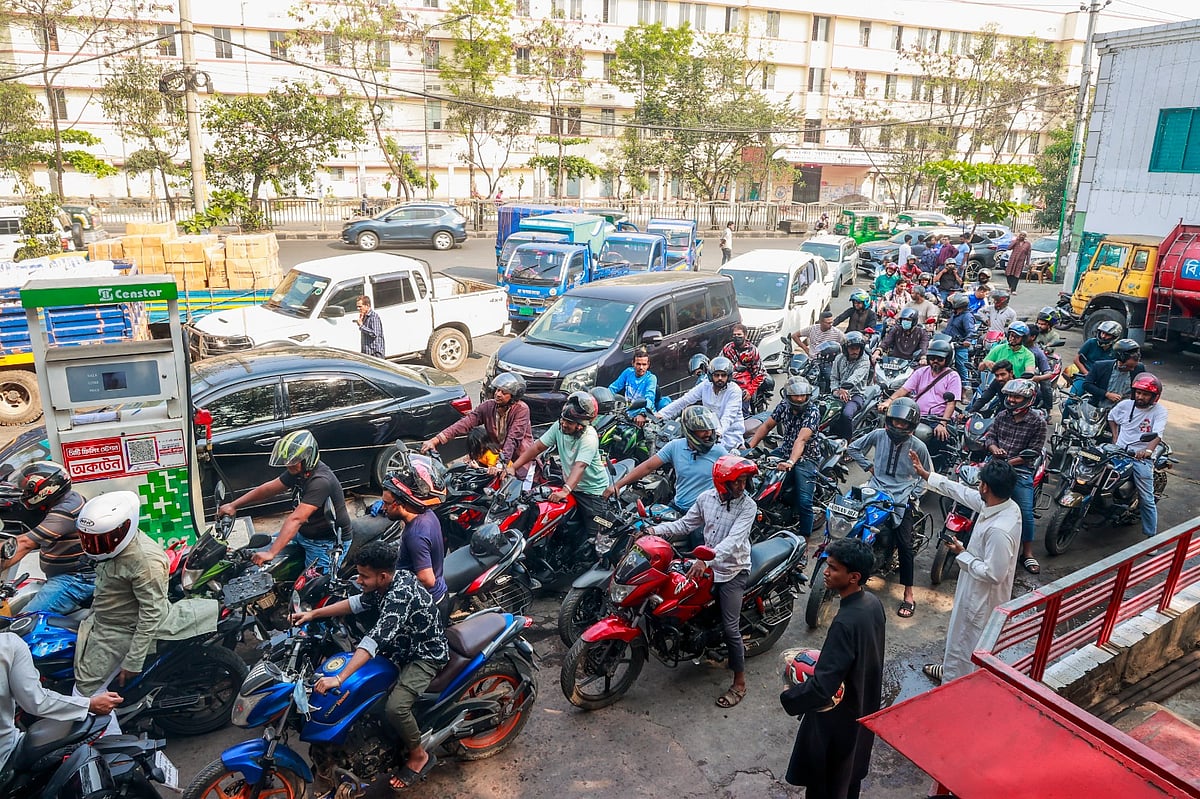
BPC has increased supply after fuel price hike
After increasing the prices of diesel, octane, petrol, and kerosene by Tk 15 to 20 per liter, people's suffering has not lessened.
Even yesterday, Sunday, people had to stand in line for hours to buy fuel.
The common people's question is, will the supply increase after the price hike?
Sources at the Ministry of Energy and the Bangladesh Petroleum Corporation (BPC) has said that the fuel oil reserve is relatively good.
There is a discussion about increasing supply, but no decision has been finalised.
People’s main question is whether supply will increase after the price hike. Sources from the Ministry of Energy and the Bangladesh Petroleum Corporation (BPC) say that fuel oil reserves are fairly adequate. A decision has been made to increase supply. Companies under BPC have been instructed to raise the supply of octane by 20 per cent and petrol and diesel by 10 per cent. A letter conveying this decision was sent on Sunday night to the fuel distribution companies Padma, Meghna, and Jamuna.
The global market's fuel oil supply was disrupted due to an attack by the United States and Israel on Iran on 28 February. Prices also started to rise. The government did not increase fuel prices in March. The government had stated they would not raise prices.
On 16 April, at the Independence Award-2026 ceremony at the Osmani Memorial Auditorium in the capital, Prime Minister Tarique Rahman said, "Even though oil-diesel prices have increased in all countries of the world, we have not made this decision considering public suffering. The government is trying sincerely to keep the situation normal by providing subsidies of hundreds of crore taka daily in this sector."
Typically, fuel oil prices are adjusted at the beginning of each month, either reduced or increased in line with the global market. However, before the end of the month, on the night of last Saturday, the government increased the price of diesel by Tk 15 per liter to Tk 115. The price of octane was increased by Tk 20 to 140 taka per liter, petrol by 19 taka to 135 taka, and kerosene by 18 taka to Tk 130 per liter.
Minister of Power, Energy, and Mineral Resources, Iqbal Hassan Mahmood, said that due to the increase in global prices, the government was compelled to raise prices domestically.
In response to journalists' questions at the Secretariat yesterday, he said, "We were forced to do this because it has to be purchased with foreign currency. So arrangements have been made to keep it at a sustainable level by slightly increasing the price.”
The Energy Minister further stated that reserves have been built by importing at higher prices. Some of the extra costs have been adjusted now.
The Awami League government, ousted in a public uprising in July, raised the price of fuel oil by Tk 34 to 46 per liter in a single jump in August 2022. At that time, commodity prices increased significantly.
The government imports and sells fuel oil, imposing various types of duties and taxes, ranging from 20 to 25 per cent. Taxes are also collected during sales. Overall, the government earns Tk 130 to 140 billion annually in revenue from fuel oil. The government takes dividends from the profits of fuel sales. Through its subsidiaries Padma, Meghna, and Jamuna, BPC sells oil through dealers. These companies also make regular profits.
In the 2023-24 fiscal year, BPC made a net profit of Tk 39.43 billion from selling fuel oil. Starting in March of that fiscal year, fuel oil prices began to align with global markets. Despite the commencement of the process of selling oil at market prices, profits did not decrease. In the last fiscal year (2024-25), profit exceeded Tk 400 billion. BPC has made a profit in nine out of the last ten years, with the only loss being in the 2021-22 fiscal year, amounting to Tk 27 billion.
According to BPC sources, in the first eight months of this year, BPC made over Tk 10 billion in profits. They incurred a loss of around Tk 22 billion in March after the start of the war. Losses may increase in April, leading to price adjustments to reduce the deficit. With the new prices, BPC’s additional monthly income could be around Tk 7.50 billion, with approximately Tk 6 billion from diesel.
Current reserves
The Division of Energy and Mineral Resources states that the demand for diesel in April is around 400,000 tonnes. Currently, there is a reserve of about 100,000 tonnes of diesel. In the next two weeks, it is expected that 4,78,000 tonnes of diesel will be added to the reserves. More than 100,000 tonnes of diesel have arrived in the country on four ships. If the directly ordered companies supply diesel, reserves will increase further.
Amid long lines at filling stations, diesel supply was reduced by 10 per cent last month compared to the previous year. In April, it decreased by 6 percent. BPC is now considering a 10 per cent increase in supply.
BPC officials state a 30 per cent increase in demand from petrol pumps. They have advised maintaining the same supply as the same day last year. Although supply decreased in April, allocations for daily oil supply to filling stations will be prepared based on last year’s list, with support from local district administration.
BPC's data shows there is currently no shortage of octane in the country. There is a storage capacity of 45,819 tonnes of octane. After sales on 17 April, 29,484 tonnes of octane remain in reserve. Last Friday, a ship carrying 25,000 tonnes of octane arrived at Chittagong port. Once unloaded, reserves will exceed capacity. Additionally, octane is being produced daily from domestic sources.
Compared to last year, this March saw an average daily increase of 26 tonnes in octane supply. However, compared to last year, supply decreased by 56 tonnes in April. BPC is considering a 20 per cent increase in octane supply.
Petrol pump owners say the crowd at filling stations is mainly due to octane and petrol. Therefore, increasing their supply might reduce public suffering to some extent. They welcomed the increase in fuel oil prices.
Motorcycles, private cars, and minibusses typically use octane as fuel. Of the total fuel oil supplied annually, 6 per cent is octane. Besides octane, petrol is also used in motorcycles. Some old private cars also use petrol.
Currently, there is an 18,830-tonnne reserve of petrol, which is wholly produced domestically. Compared to last year, 15 per cent less petrol was supplied last month. In April, it decreased by nearly 9 per cent. Supply may now be increased.
Khondaker Golam Moazzem, of the private research organisation Centre for Policy Dialogue (CPD), told Prothom Alo that the government's initiative to raise prices is inevitable. They did not increase prices for one and a half months, trying to cover additional costs. Although the increase in diesel prices will lead to inflation, he said it wouldn’t help in the availability of fuel oil. It may ease the government’s additional financial burden to some extent.