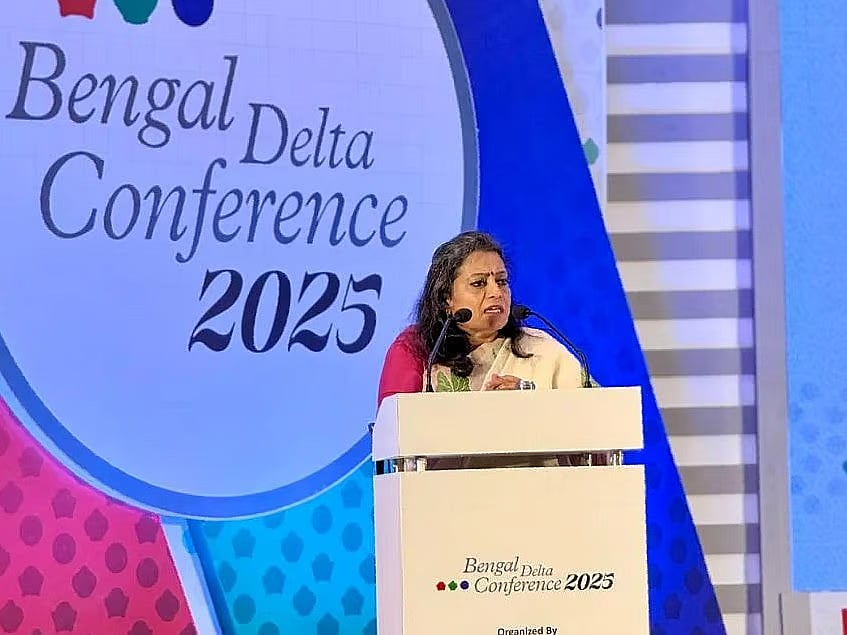
Bengal Delta Conference 2025
Sreeradha Datta in Dhaka: ‘Bangladesh and India need genuine candid dialogue’
India and Bangladesh must begin genuine and candid dialogue if their bilateral ties are to experience a revival, said Professor Sreeradha Datta of the Jindal School of International Affairs, O.P. Jindal Global University.
She argued that relations between Dhaka and New Delhi are now in “sleep mode” not because of Bangladesh, but because India has yet to fully understand how its national interests will be safeguarded in the post-Sheikh Hasina period.
In her view, in the past 50 years the two neighbours have never truly engaged in an open conversation.
Sreeradha Datta made the remarks yesterday, Friday, in a keynote address at the Bengal Delta Conference 2025, held at a hotel in Dhaka.
Her lecture was titled “Political Impacts of Bangladesh–India Relations: From the Liberation War to the July Uprising” and lasted about 15 minutes. The session did not include a Q&A with the audience.
The two-day international conference has been organised by the Dhaka Institute of Research and Analytics (DAIRA) under the theme: “Bangladesh at Crossroads: Rethinking Politics, Economics, Geopolitical Strategy.”
At the outset of her speech, Sreeradha Datta described the present Dhaka–Delhi relationship as being in “sleep mode”.
She noted that India is unlikely to take any major steps for now and is waiting for Bangladesh’s next election.
Reflecting on the past year, she observed that both in India and Bangladesh the media had spread significant amounts of misinformation.
“In these past months, I have sensed a deep-seated hostility towards India in Bangladesh,” she said, adding that within India too there is equal scepticism about Bangladesh’s interim government, its new political order, and emerging parties.
“There is a sense of mutual animosity on both sides,” she remarked, adding, “and I don’t think this requires much elaboration.”
According to her, if India and Bangladesh are serious about reviving their relationship, they must begin “a genuine candid dialogue – something that has never happened in the last 50 years.”
She stressed, “We always say, ‘What do you want?’ or ‘What do I want?’ But never, ‘What can we do together for our mutual benefit?’”
Calling Bangladesh “an extremely important neighbour” for India, she emphasised, “If there is one country we can place our highest trust in, it is Bangladesh. I firmly believe that in this region, much can be achieved if India and Bangladesh work together. But that will only be possible if both countries speak openly and sincerely with each other – which has happened very rarely between the two neighbours.”
Professor Sreeradha Datta added, “I know our problems, just as I know yours. But I believe there is no problem that the two countries cannot solve by sitting together. India has worked very closely with Sheikh Hasina, and I understand the resentment and hostility that has grown around her and the Awami League.”
“But Delhi’s closeness with the Awami League was a reality, and it is only natural that such intimacy would produce side effects,” she pointed out.