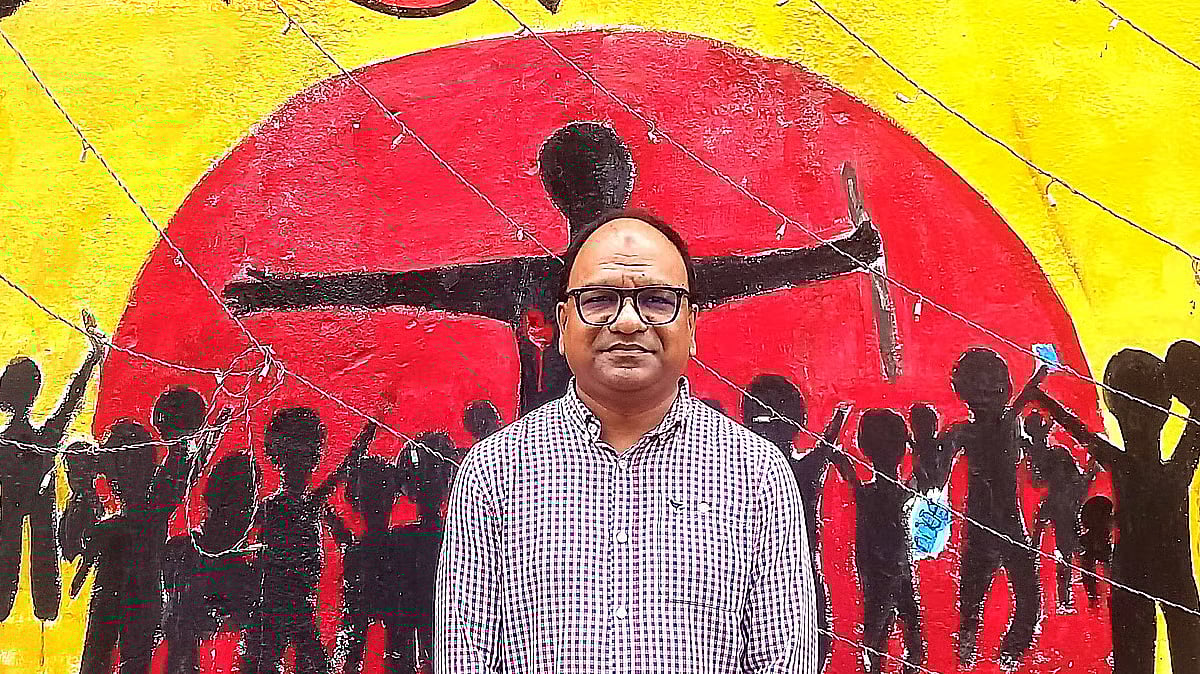
Mahmuduzzaman captured photos of 10,000 graffiti travelling across districts
From the very beginning of the student movement against discrimination, Mohammad Mahmuduzzaman began photographing graffiti painted on the walls across Dhaka. Since the end of the mass uprising on 5 August, he has travelled from district to district, capturing thousands of images—some of which have already been featured in exhibitions. Mahmuduzzaman shared his experience of photographing graffiti speaking to Prothom Alo's Kazi Alim-uz-Zaman.
In Rangpur, Mahmuduzzaman paused for a while in front of a graffito on a school wall- a guillotine cutting through a pencil, with the words “If you cut off the head, I can write again.”
In Dhaka’s Mirpur, near the Bangla College, another graffito caught his eye for its powerful language. He captured the message in his camera: “When soaked in water, one changes clothes; when soaked in sweat, one changes fate; and when soaked in blood, one changes history.”
Through photographing graffiti and wall writings, Mahmuduzzaman has often found himself moved and deeply contemplative over the words and imagery. “For so long, we used to say the walls have ears,” he reflects “But the Gen-Z has shown that walls have mouths too.”
Mahmuduzzaman studied history at Jahangirnagar University and is an associate fellow of the UK-based Royal Historical Society. As a journalist and researcher, he has spent more than two decades working to present Bangladesh’s proud history to children, teenagers, and the public.
Since the start of the anti-discrimination movement, he observed the growing presence of graffiti artworks and wall writings in cities and towns. Realising that these images would not last forever, washed away by rain, erased, or lost to demolition, he felt compelled to preserve this “voice of the walls.”
Initially, Mahmuduzzaman photographed graffiti around Dhaka. After the mass uprising ended on 5 August, he began travelling to different districts across the country. So far, he has visited 42 districts and captured over 10,000 photographs. His work is still ongoing.
Loads of experiences scattered across districts
In Dhaka’s Banasree area, a wall bore the message: “Today is 32 July.” When Mahmuduzzaman tried to photograph it in early August last year, a group of young men suddenly surrounded him. He quickly slipped his phone into his pocket and defused the situation.
Another time, he was startled by a graffito painted on a metro pillar in Mirpur 10 that read: “[Bangladesh] Religion is personal, the country belongs to all.” Here, the word “Bangladesh” was illustrated using a map of the country.
Once, while crossing a road, he noticed a graffito on a road divider that made him stop in his tracks. There, a little girl was asking her father, “Baba (Dad), will they shoot me too?” The father replies, “No, sweetheart, we are free.” The entire message was painted in black ink, except the word “free,” which was written in red and green, the colours of the national flag.
He visited Rajshahi University on 24 August. All day, he took photographs of graffiti on campus walls, streets, and even tree trunks. At the time, the university’s largest graffiti mural was still in progress.
Three students were painting a massive boat taking on water. Inside the boat, former minister Anisul Huq and former adviser to the ousted prime minister Sheikh Hasina, Salman F Rahman were busy bailing it out, while ex-prime minister was shown escaping atop an aeroplane. Interestingly, none of the students were from the Fine Arts faculty.
In Rangpur, college teacher Moniruzzaman found himself unable to keep his two children indoors as they were determined to paint graffiti anyhow. Eventually, he gave in and joined them.
Mahmuduzzaman also noticed some variations in the graffiti based on the regions. In Dhaka, one slogan read: “If you ask for a bribe, you’ll get a punch.” In Chattogram, this became “Maijjom if you want a bribe.”
A phrase like “Eyes on the robbers” in Dhaka took the local form “Dakait honde?” in Chattogram dialect. In some places, slogans read “Natore, the city of dreams.” In Rajshahi, a map showed the district as disproportionately large, perhaps an expression of local pride.
In contrast, Mahmuduzzaman couldn’t capture many graffiti images in Gopalganj despite travelling through the district all day. The art form appeared to be far less common there. Even when he found one or two, strangers would approach him with suspicion. “Why are you taking pictures?” “What’s the point of this?” he was bombarded with questions.
Among the messages that caught his eye were: “Anyone littering here is a Haun uncle,” “The whole country can’t come to a standstill for one VIP,” “Reform not only the country, but the mind,” and “Grow by effort, not by flattery.”
Many graffiti pieces also addressed issues like urban cleanliness, communal harmony, and even metaphorical statements using marital relationships, like warnings against the interference of a “third person.” In some, the graffiti compared publics to superheroes like Spider-Man, Superman, or the Avengers.
“Nothing seems to have been left out of graffiti,” Mahmuduzzaman reflected. “What sets this generation apart is its ability to express even the most serious matters with humour or lightness.”
Exhibitions across the country
Mahmuduzzaman does not use social media platforms like Facebook or Instagram. Instead, he has taken a more traditional route to share his thoughts on graffiti to the public, through direct PowerPoint presentations in various locations including Rajshahi and Chattogram.
His collection of graffiti photographs has been showcased in several events such as a gathering of former members of Bishwo Shahitto Kendro’s ‘Shovyo Shongho’ in Dhaka, a discussion circle by Bhab Boithoki-organised exhibition at the Social Sciences building of Dhaka University, at the Department of Mass Communication and Journalism at the Dhaka University, at North South University’s South Asian Institute of Policy and Governance (SIPG), and at a programme organised by the Centre for Policy Dialogue (CPD) at the National Press Club.
One year on from the July movement, many of the graffiti artworks in Dhaka have been damaged or painted over. The same has happened outside the capital as well. Against this backdrop, Mahmuduzzaman’s work has taken on even greater significance.
He draws a parallel with Egypt, where many graffiti pieces created during the Arab Spring were lost, but efforts have been made to preserve those on Mohamed Mahmoud Street. If any of those fade, they are repainted. Mahmuduzzaman believes similar steps should be taken in Bangladesh. At the very least, the graffiti in and around Dhaka University should be preserved, he believes.
Alongside taking photographs himself, Mahmuduzzaman has also been collecting graffiti images from other sources. He plans to build an archive so that future researchers can access a valuable primary source. “A generation has inscribed its thoughts, its hopes for the future, and its emotions on these walls,” he says. “All we need to do is understand them and that’s the message I want to convey.”