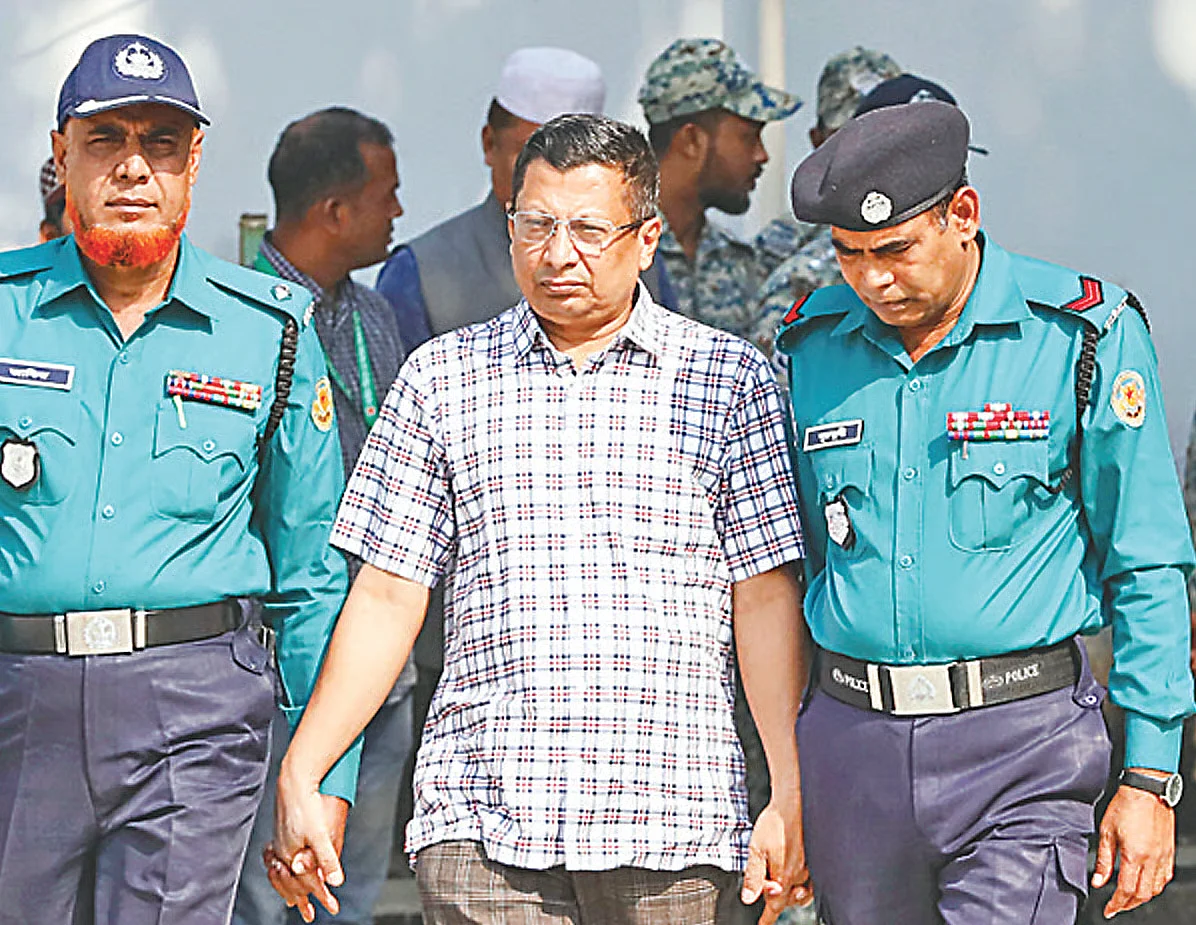
Former IGP confesses
Firing from helicopter, ‘block raid’ were political decisions
Quader, Nanak ‘unleashed’ Chhatra League on Dhaka University students
Sheikh Hasina held 2 meetings at Gonobhaban on 4 August
AL govt. directed to stuff ballots at night in 2018 parliamentary elections
Bullets were fired on the students and civilians from helicopters during the July uprising as part of a political decision, former Inspector General of Police (IGP) Chowdhury Abdullah Al-Mamun said in a confessional statement.
The testimony also revealed that meetings were held at the home of the then home minister to plan the suppression of the movement every night. “Block raids” were conducted dividing the protest-prone areas. Besides, lethal weapons were used at the direct orders of former Prime Minister Sheikh Hasina.
Chowdhury Abdullah Al-Mamun, who served as IGP from 2022 until the fall of the Awami League government, gave this confessional statement before the Chief Metropolitan Magistrate’s Court in Dhaka on 24 March.
The confession, submitted in connection with a case at the International Crimes Tribunal, was recently made public.
He had previously served as the director general of the Rapid Action Battalion (RAB) and is currently in prison. In his testimony, he spoke about the 2018 parliamentary election when ballots were stuffed at night, enforced disappearances, strategies to suppress July movement, and roles of the Awami League and Sheikh Hasina.
In this case concerning crimes against humanity during the July uprising, he has been designated as an approver (state witness).
In his confessional statement, Chowdhury Abdullah Al-Mamun stated, “At one stage of suppressing the movement, a secret plan was made to use helicopters to monitor the protests, to open fire and create an atmosphere of fear among protesters. Later I learned that this operation, using helicopters, was planned and carried out under the direction of RAB Director General Harunur Rashid, with support from the army. However, as the police chief, I was not involved in this activity. The helicopters were deployed through a political decision.”
The decision to use lethal weapons and to carry out block raids in protest-prone areas was made entirely on political grounds. Home Minister Asaduzzaman Khan Kamal informed me that the decision to use deadly weapons to suppress the movement has been made at the directive of prime minister Sheikh Hasina. At that time, additional DIG (headquarters) Proloy Joarder was present.Chowdhury Abdullah Al-Mamun, former IGP
Regarding the use of deadly weapons, his confessional statement reads, “The decision to use lethal weapons and to carry out block raids in protest-prone areas was made entirely on political grounds. Home Minister Asaduzzaman Khan Kamal informed me that the decision to use deadly weapons to suppress the movement has been made at the directive of prime minister Sheikh Hasina. At that time, additional DIG (headquarters) Proloy Joarder was present. Senior police officers, including the DMP commissioner, came to know about the directive through him.”
The statement also said, “DMP Commissioner Habibur Rahman had direct contact with the Home Minister. The DMP Commissioner and Detective Branch (DB) chief Harun-or-Rashid were particularly enthusiastic about using lethal weapons. The Home Minister wanted the movement to be suppressed at any cost. On 18 July 2024, DMP Commissioner Habibur Rahman openly ordered the use of Chinese rifles to fire upon protesters.”
On the issue of police inaction during attacks of the Chhatra League men on Dhaka University students, the former IGP said that the police did not perform their duty properly there. The police acted there basically under the directives of DMP Commissioner Habibur Rahman.
He further said in the statement that Obaidul Quader and Nanak used to give directives to the Chhatra League and Jubo League. Some other leaders alongside them unleashed the Chhatra League. Pro-Awami League intellectuals, journalists and police officers, all were interested in suppressing the movement with a hard hand and taking the government an illegal path.
He further said in the statement that Obaidul Quader and Nanak used to give directives to the Chhatra League and Jubo League. Some other leaders alongside them unleashed the Chhatra League. Pro-Awami League intellectuals, journalists and police officers, all were interested in suppressing the movement with a hard hand and taking the government an illegal path. Obaidul Quader’s aggressive rhetoric further energised the Chhatra League and Jubo League.
Meetings at home minister’s residence every night
According to the former IGP, there would be meetings nearly every night from 19 July 2024 of the law enforcement’s core committee at the then Home Minister Asaduzzaman Khan Kamal’s residence, to plan on how to suppress the July mass uprising.
The meetings usually began around 8:00 or 9:00 pm. He regularly attended those as a member.
In his confessional statement, former IGP Mamun said, “The meetings were attended by Home Secretary Jahangir, Additional Secretary (Political) Tipu Sultan, Additional Secretary Reza Mostafa, SB (special branch) chief Monirul Islam, DB chief Harun-or-Rashid, RAB DG Harunur Rashid, DMP Commissioner Habibur Rahman, Ansar DG Major General AKM Aminul Haque, NTMC DG Major General Ziaul Ahsan, BGB DG, and DGFI chief. There were detailed discussions on various tactics to suppress the protests. The Home Minister conveyed the government’s directives and sought our input.”
The meetings were attended by Home Secretary Jahangir, Additional Secretary (Political) Tipu Sultan, Additional Secretary Reza Mostafa, SB (special branch) chief Monirul Islam, DB chief Harun-or-Rashid, RAB DG Harunur Rashid, DMP Commissioner Habibur Rahman, Ansar DG Major General AKM Aminul Haque, NTMC DG Major General Ziaul Ahsan, BGB DG, and DGFI chief. There were detailed discussions on various tactics to suppress the protests. The Home Minister conveyed the government’s directives and sought our input.Chowdhury Abdullah Al-Mamun, former IGP
The decision to arrest the coordinators of the Anti-Discrimination Student Movement was made from one such meeting.
Stating this, the former IGP said, “Following this decision, DB chief Harun-or-Rashid and the DGFI were given the responsibilities of arresting. Later they (the coordinators) were arrested and taken to DB custody and put pressure, including metal torture, to compromise with the government. Their family members were also brought in. The coordinators were forced to issue a statement on television to withdraw the movement.”
In his testimony, the former IGP said, I opposed the arrests in the core committee meeting. But they were arrested following a decision of the home minister. The home minister had a close relationship with Harun-or-Rashid. Asaduzzaman Khan Kamal often referred to him as ‘Jinn’ and considered him active and politically effective in implementing the government decisions.”
The testimony also noted that many police officers, including officers-in-charge (OCs), the NTMC DG, and senior officials from DGFI and NSI, frequently visited the minister’s residence for unofficial meetings.
Sheikh Hasina’s two meetings on 4 August
The former IGP stated that on 4 August 2024, the day before the fall of the Awami League government, Sheikh Hasina held two high-level meetings at Gonnbhaban.
He said, “At 11:00 am, we had a meeting with the then Prime Minister (Sheikh Hasina) at the Gonobhaban. A security committee meeting was held where the then Law Minister, the Home Minister, the chiefs of the three services, and myself attended. There was a discussion on the movement and its suppression. Intelligence reports mentioned that the movement had reached a critical level and needed to be suppressed. There was no discussion about a change of government or its fall. We tried to convey the actual information, but the government wasn’t willing to hear of its own weaknesses. The meeting was adjourned as the situation continued to deteriorate at that time.”
Speaking about the second meeting, the confessional statement said, “The then prime minister suddenly convened a meeting at Gonobhaban at night on 4 August. The meeting took place at 10:00 pm. The then prime minister (Sheikh Hasina), her sister Sheikh Rehana, the then home minister Asaduzzaman Khan Kamal, Law Minister Anisul Huq, chiefs of the three services, RAB DG, and myself as IGP. Lt. Gen. Mujibur Rahman was also present. There were open discussions. SB Chief Monirul and DGFI DG were waiting outside.”
Operations involving abductions and disappearances were directly executed through intelligence officers under the instructions of Maj. Gen. (retd) Tarique Siddique (Sheikh Hasina’s Security Adviser).Chowdhury Abdullah Al-Mamun, former IGP
According to him, the meeting lasted 30–45 minutes and focused on how to deploy forces to stop the 5 August mass mobilisation. “Following the meeting, we moved to the Army’s operations control room. Chiefs of three services, Major General Mujib, RAB DG, intelligence personnel, DMP commissioner Habibur Rahman and myself were present there. There were discussions on mobilising forces there. The meeting ended around 12:30 am. It was decided to tighten control over the capital and its entry points. However, there was no detailed discussion. Police were instructed to coordinate with the army.”
Army didn’t intervene on 5 August
Chowdhury Abdullah Al-Mamin in his confessional statement said, “We (the police) had a strong hold within Dhaka until 10:00 am on 5 August. Hundreds of thousands of people gathered at city entry points like Uttara and Jatrabari. I took a position at the police headquarters. DMP commissioner and the other important DMP officers were at the Dhaka police control room. They were issuing directives from there.”
Describing the events on that day, the former IGP’s statement said, “By 11:00 am, hundreds of thousands of people started entering Dhaka from Uttara. Then we came to know that the army did not stop them. Field-level military officers and the force sided with the movement. This made it impossible to stop the march towards Gonobhaban.”
“By 1:00 pm, people inside Dhaka had taken to the streets. The PMO instructed us to stop the crowd at Mohakhali. Around 12:30 to 1:00 pm on 5 August, I realised the government will fall. I was informed through SB that the Prime Minister will step down. I did not know whether she would go to India or not. The army did not share this information,” he added.
The former IGP in his testimony, further said, “Later on 5 August afternoon, I came to know that a helicopter would arrive at the police headquarters to evacuate police officers. I went to Tejgaon Airport through that helicopter and then took refuge in the Army Officers’ Mess.”
Order to stuff ballots at night in 2018
The voting in the 2018 general election is widely known as the “night vote”. The then Awami League government ordered to stuff ballot boxes on the previous night of polling day, the former IGP said in his confessional statement.
He said, “In 2018, I was DIG of the Dhaka Range. I heard that the then IGP Javed Patwary advised former prime minister Sheikh Hasina to stuff nearly 50 per cent of the ballots the night before the vote. Instructions were passed down at the field level for ballot stuffing. With active involvement from political leaders, DCs, UNOs, AC Lands, SPs, and OCs played the most important role. Later, police officers who were politically active during the election were rewarded with medals like BPM and PPM. Professionalism was not maintained in this case.”
Enforced disappearance and secret detention centres
Former IGP Mamun described his experiences regarding enforced disappearances and secret detention centres while serving in RAB between 14 April 2020 and 30 September 2022.
“As the director general of RAB, I was aware that TFI (Task Force for Interrogation) cells were run under the authority of RAB headquarters. It is located within the compound of RAB-1 at Uttara. Apart from this, several RAB units maintained their own individual detention cells, which were operated directly by the heads of those respective units.”
He continued, “The practice of abducting, interrogating, torturing, and secretly detaining individuals who held dissenting political views or were considered threats to the government had become an embedded culture within RAB. But those operations were primarily coordinated by the Additional Director General (Operations) and the Directors of RAB’s Intelligence Division.”
As a former police chief with direct experience in RAB, Mamun further testified, “I have heard that serious directives such as enforced disappearances or killings in crossfire were issued directly from the Prime Minister’s Office. During my tenure, I did not personally receive such orders, but I learned that some instructions also came via the Prime Minister’s Security and Defence Adviser, Tarique Siddique. Although RAB was under the jurisdiction of the IGP, in many cases the chain of command was disregarded. RAB chiefs would sometimes act directly on instructions from the PM’s Office, bypassing the IGP.”
Regarding the case of Barrister Arman, who had been missing for years, Mamun said, “I was not informed of the total number of detainees in the TFI Cell or their identities. That was handled by RAB’s intelligence director. I knew that Barrister Arman was being held at the TFI Cell.. He had been picked up before my tenure. When former RAB DG Benazir Ahmed (also a former IGP) handed over charge to me, he informed me that Arman was still being detained there.”
Mamun’s confessional statement also revealed, “Operations involving abductions and disappearances were directly executed through intelligence officers under the instructions of Maj. Gen. (retd) Tarique Siddique (Sheikh Hasina’s Security Adviser).”
“During my time at RAB, I was aware that detainees were held without trial in the TFI Cell, some were tortured, and a few were even killed in crossfire. But I did not initiate any investigation or take action against these practices, because such directives were issued and carried out through other agencies and intelligence units. Even later, when I became the police chief, I took no action, and perhaps could not take action, against RAB’s activities in this regard,” he added.
Regret and apology
In the final section of his five-page confessional statement, the former police chief expresses remorse.
He said as a former police chief, he was ashamed, remorseful, and seek forgiveness for the indiscriminate repression, shootings, arrests, torture, and killings committed against the people by the police force and over enthusiastic officers on government orders to quell the Anti-Discrimination Student Movement. “I have provided this testimony to account for my role and to present a comprehensive picture of what occurred.”